
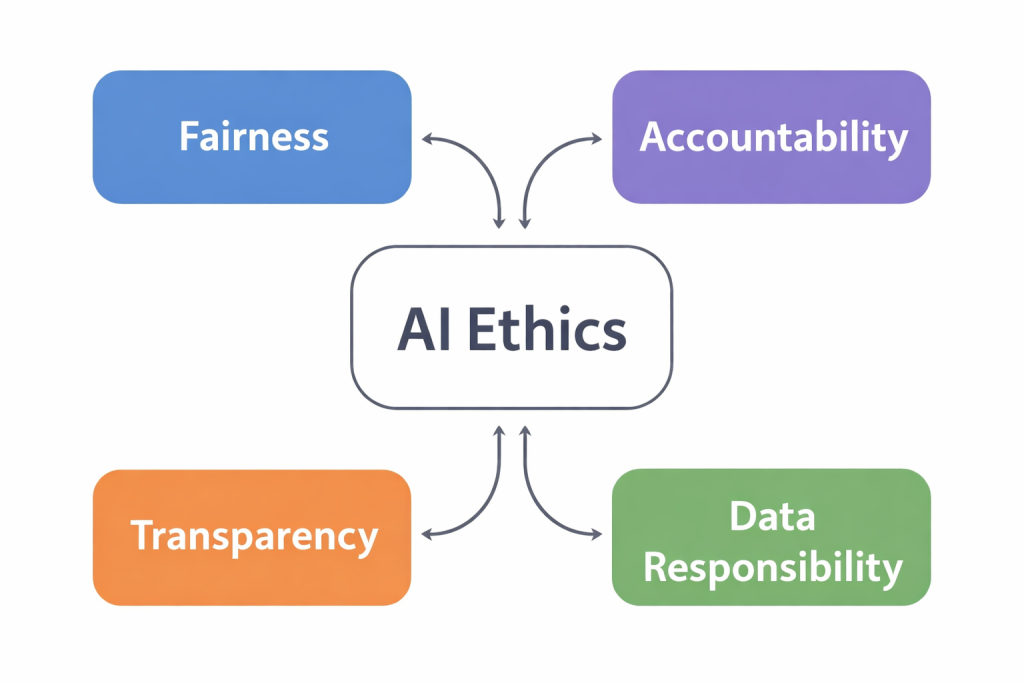
AI ethics is often reduced to one question: is the model biased or not? That question matters, but it is too narrow. Research across AI ethics, accountability, and responsible machine learning shows that ethical AI is not only about unfair outputs. It also involves transparency, accountability, privacy, dataset quality, safety, and the social context in which systems are built and deployed. Work in the FATE tradition explicitly frames fairness, accountability, transparency, and ethics as interconnected concerns rather than isolated technical checks.
Fairness matters, but fairness is not the whole of AI ethics
Fairness is one of the most visible concerns in AI ethics because algorithmic systems can reproduce or amplify inequalities in domains such as healthcare, employment, education, and credit. Recent reviews in medicine, for example, note that insufficiently fair AI can undermine equitable care and that important gaps remain between technical fairness methods and real clinical practice.
But fairness alone is not enough. A system can be relatively fair on one benchmark and still be ethically weak in other ways. It may be opaque to users, impossible to contest, trained on problematic data, or deployed in a context where people have little power over how decisions affect them. This is why AI ethics should be understood as a broader governance and design problem, not just a model-evaluation problem. Research on accountability in algorithmic society argues that equity and justice depend on stronger accountability practices, not only fairness metrics.
Accountability is what turns ethical principles into real responsibility
One of the hardest problems in AI ethics is accountability. It is easy to say that AI systems should be fair, transparent, and safe. It is much harder to identify who is responsible when a system causes harm, makes a discriminatory recommendation, or fails in a high-stakes setting.
That is why accountability matters so much. Scholarly work on AI accountability argues that the concept is often used vaguely, even though it is essential for turning abstract ethical values into enforceable responsibility. Without accountability, ethical principles remain aspirational. With accountability, they begin to shape design choices, deployment decisions, audit processes, and redress mechanisms.
This also explains why ethical AI cannot be solved only by “better models.” A technically improved model does not automatically answer questions such as: Who approved deployment? Who monitors errors? Who can challenge a harmful decision? Who is responsible when a system works differently across populations? Those are accountability questions, not only engineering questions.
Transparency starts before the model and continues after deployment
Transparency is often treated as explainability: can the model explain its prediction? That matters, but research suggests transparency should be understood more broadly. In biomedical and behavioral research, recent work argues for transparency across the entire AI lifecycle, including explainability, interpretability, accountability, and the conditions under which models are developed and evaluated.
In practice, transparency begins before training. It includes how data is collected, what assumptions shape labels, which populations are underrepresented, what metrics are chosen, and what limitations are known but not communicated. Recent research on responsible machine learning datasets emphasizes that fairness, privacy, and regulatory norms are deeply connected to data practices, especially in sensitive domains such as biometrics and healthcare.
This is an important shift in how AI ethics should be discussed. Ethical concerns do not begin only when a model produces an output. They begin when someone decides what data counts, what outcome should be optimized, and what trade-offs are acceptable.
Ethical AI depends on context, not only technical correctness
A common mistake in AI discussions is to assume that one ethical checklist can apply equally across all use cases. But context matters. An AI system used for movie recommendations, medical triage, hiring support, or student admissions does not carry the same risks. The ethical demands change with the domain, the stakes, and the vulnerability of affected people.
That is one reason researchers continue to stress socio-technical perspectives on AI ethics. Survey work in this area identifies multiple recurring concerns, including fairness, privacy, responsibility, robustness, transparency, and environmental impact, and treats them as part of a larger socio-technical system rather than purely mathematical properties of models.
This broader view makes ethical reasoning more realistic. A model can be statistically strong and still be ethically inappropriate in a given context. It can be accurate on average yet harmful in deployment. It can be efficient for institutions while unfair to individuals who must live with its decisions. Ethical AI therefore depends not only on technical validity, but on whether the system is suitable, contestable, understandable, and justifiable in the real world.
AI ethics is really about power, trade-offs, and design choices
At its core, AI ethics is not just about whether artificial intelligence is “good” or “bad.” It is about how power is embedded in technical systems: who defines the objective, who supplies the data, who benefits from automation, who bears the risk, and who gets to challenge harmful outcomes.
That is why good intentions are not enough. Ethical AI requires deliberate design, clear responsibility, responsible data practices, and domain-sensitive evaluation. It also requires admitting that trade-offs are real. A system may improve efficiency while reducing transparency. It may scale decisions while weakening human oversight. It may optimize one fairness criterion while worsening another. Ethical maturity begins when those trade-offs are made visible rather than hidden behind technical language.
For that reason, the best starting question is not only “Is this AI biased?” A better question is: What values, assumptions, and risks are being built into this system, and who is accountable for them? That question is harder, but it is closer to what AI ethics is actually about.
sources
- ACM Digital Library – FATE in AI: Towards Algorithmic Inclusivity and Accessibility
- Springer / AI & Society – Accountability in artificial intelligence: what it is and how it works
- ACM Digital Library – Accountability in an Algorithmic Society
- Nature Machine Intelligence – On responsible machine learning datasets emphasizing fairness, privacy and regulatory norms
- Nature Medicine – Promoting transparency in AI for biomedical and behavioral research
- arXiv survey – Survey on AI Ethics: A Socio-technical Perspective
- Nature Reviews Bioengineering – Algorithmic fairness in artificial intelligence for medicin
Pingback: AI Transparency Is Harder Than It Sounds: Beyond Explainability Alone
Pingback: AI Contestability: Why Relying on Explanations Alone Is a Dangerous Risk for High‑Stakes Decisions 2026 - Noetrion
Pingback: Human Oversight in AI: 5 Critical Reasons a Human in the Loop Is Not Enough - Noetrion
Pingback: Single-Agent vs Multi-Agent Systems: 7 Powerful Differences Explained
Pingback: AI Agents in Education, Healthcare, and Business: 7 Powerful Benefits and Hidden Risks