A Held-Out AI Benchmark Can Still Reward Familiar Questions
Understand semantic and search-time benchmark contamination, interpret filtered scores carefully, and design an evaluation with explicit exposure boundaries.
A vendor says its model was never fine-tuned on your test file. The file was kept separate from your own training examples, and its exact text does not appear in a simple duplicate scan. That sounds like a clean evaluation. It is a useful start, but the conclusion is stronger than the evidence.
The same questions may exist elsewhere with different wording. A model may have encountered similar problem templates. An agent with web access may retrieve an answer during the test itself. “Held out” needs an object and a boundary: held out from which dataset, from which stage, and from which tools?
This research-informed guide was checked on 28 October 2026. It draws on 2026 primary preprints, including a revision dated 28 September, rather than claiming a new October product announcement. The proposed audit workflow and numerical example are original.
Name the exposure route before designing the control
Benchmark contamination usually refers to evaluation information becoming available through a route that undermines the intended measurement. The relevant route depends on the capability claim.
If a test claims to measure solving unfamiliar problems, prior access to substantially equivalent problems can weaken that interpretation. If it measures retrieving a public fact accurately, access to an authoritative source may be part of the intended task. Retrieving the benchmark's answer key is a different exposure from retrieving legitimate task evidence.
| Exposure route | Example | Candidate control and its limit |
|---|---|---|
| Exact training overlap | Test question copied into a corpus | Exact matching catches copies, not all rewrites |
| Semantic overlap | Same problem with names changed | Similarity review needs judgment and can miss cases |
| Repeated test feedback | Prompts repeatedly optimized against scores | A reserved final set reduces feedback reuse |
| Retrieval during evaluation | Agent finds the published solution | Search traces expose the route if adequately recorded |
None of these controls alone establishes that a score measures the intended capability. Start with the claim and then specify which routes would defeat it.
Understand why text matching leaves a gap
The February 2026 preprint Soft Contamination Means Benchmarks Test Shallow Generalization studies semantic duplicates that ordinary text overlap filters can miss. Its experiments report that exposure to duplicates can improve performance, including on held-out items from the same benchmark.
That is evidence from the authors' examined corpora, benchmarks and experimental setups. It does not prove that every strong model score is memorization or provide a universal contamination rate. The practical lesson is narrower: a clean exact-match scan does not settle the semantic-overlap question.
For an original illustration, changing “three red boxes contain seven tokens each” into “seven coins are placed in each of three bags” changes the string while preserving much of the structure. Depending on the test's purpose, that may be ordinary transfer, near-duplicate exposure or an unhelpful item. Document the intended novelty instead of letting a similarity threshold decide it implicitly.
Keep generative evaluation claims within the evidence
A study revised on 28 September 2026 examines controlled contamination of generative evaluations using language models up to 344 million parameters and the MATH benchmark. It investigates how exposure, further training and inference settings interact with observed performance.
These controlled interventions help study mechanisms because the researchers know which examples they injected. They do not reveal the unknown training history of every deployed frontier model. They also do not establish that one contamination detector will remain reliable after arbitrary later training.
This distinction matters in procurement. “A mechanism has been demonstrated” and “the mechanism explains this vendor's score” are different claims. The second requires evidence about the actual model, test and exposure conditions.
Audit the tool path as well as the training path
The June 2026 preprint Search-Time Contamination in Deep Research Agents studies agents that can encounter benchmark material while searching. It separates benchmark metadata, question context and explicit answer leakage. Its proposed precautions include controlled access and transparent trajectories.
A private training split cannot prevent an agent from retrieving a public answer page during evaluation. For a reasoning-only test, disable or constrain retrieval and record that choice. For an open-web research test, preserve search queries, retrieved URLs, timestamps and relevant source excerpts where collection is permitted.
Then inspect whether the path answered the real research question or merely discovered benchmark-specific material. A correct final answer without a usable trajectory may leave this distinction unresolved. Record that limitation rather than quietly labeling the run uncontaminated.
Do not subtract a filtered score and call it the effect
Consider this invented audit:
| Question subset | Questions | Correct answers | Accuracy |
|---|---|---|---|
| Flagged by a matching heuristic | 20 | 18 | 90% |
| Not flagged | 80 | 62 | 77.5% |
| All questions | 100 | 80 | 80% |
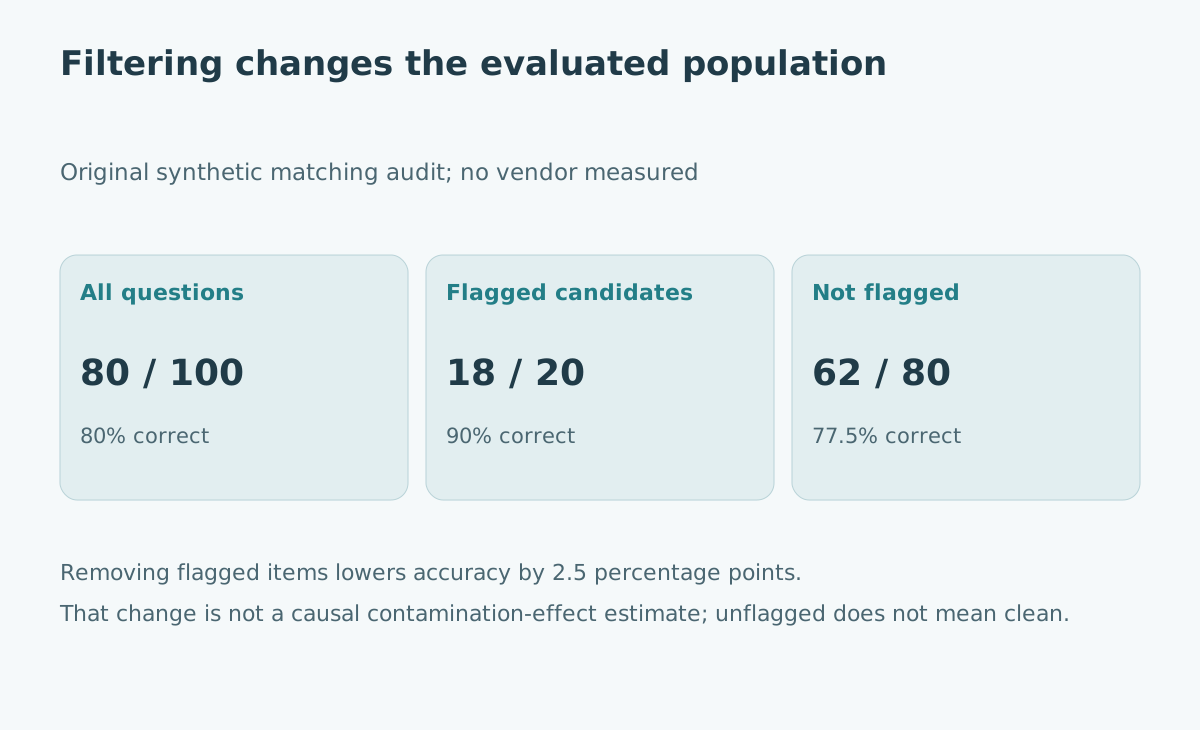
Removing the flagged subset changes the score from 80% to 77.5%, a reduction of 2.5 percentage points. That difference is not an estimate of how much contamination helped the model.
The heuristic may have false positives and false negatives. The flagged questions may be easier, use a different subject mix or have shorter answers. Removal changes the evaluated population. Most importantly, this table never observes how the same model would have answered the same questions without exposure.
Report the two descriptive scores with subset counts and matching criteria. Keep causal language for a design that can support it, such as an appropriate controlled exposure experiment. A filtered score is useful evidence about sensitivity to a selection rule, not a newly certified clean capability score.
Reserve a final evaluation that development cannot consume
For a practical internal workflow, separate an openly inspected development set from a final set whose item-level answers and scores are not repeatedly returned to prompt developers. Decide the attempt budget before running the final comparison.
Create items tied to the actual deployment task and record when they were authored, reviewed and frozen. Keep benchmark-specific solutions away from the retrieval corpus. Where privacy permits, preserve sufficient provenance to investigate later exposure concerns.
Fresh items are helpful but imperfect: they can share templates with old material, contain writing errors or fail to represent the intended workload. Use expert review appropriate to the task and a clear scoring rubric. The grouped validation guide explains a related boundary problem when apparently separate records come from the same underlying entity.
Publish the remaining uncertainty with the score
A useful scorecard names the model and version, task population, item provenance, tools, prompt-development budget, number of attempts, scoring rules and exposure checks. Distinguish an unknown training corpus from a corpus that was actually inspected.
Preserve negative findings carefully: “no exact overlaps found in the available corpus” is a result; “no contamination exists” is a much broader assertion. If the vendor cannot disclose training details, say which checks were unavailable and supplement the benchmark with a limited deployment pilot on genuinely representative work.
The objective is not to disqualify every benchmark. It is to make the evidence match the claim closely enough that another team can judge what a strong score does—and does not—tell them.
Sources and scope
- Spiesberger and colleagues, Soft Contamination Means Benchmarks Test Shallow Generalization, submitted 12 February 2026; primary preprint, abstract and relevant methods/results consulted.
- Schaeffer and colleagues, Test Set Contamination of Generative Evaluations, version 3 dated 28 September 2026; primary preprint, controlled-experiment scope and limitations consulted.
- Wang and colleagues, Search-Time Contamination in Deep Research Agents, submitted 3 June 2026; primary preprint, taxonomy and evaluation-path discussion consulted.
Preprints are provisional research, not regulatory standards or independent verification of a specific vendor. No model ranking or real-world contamination percentage is inferred from the original illustrative table.