Does AI Actually Pay Off? Calculate Review, Rework, and the Value of Time
Evaluate AI business ROI with a clear baseline, full review and rework costs, a tested break-even example, and a practical pilot plan beyond productivity headlines.
Reviewed October 12, 2026. All dollar amounts and workflow times in the worked example are synthetic teaching inputs, not industry benchmarks or measured company results.
A team introduces an AI assistant and draft preparation becomes faster. The demonstration looks excellent: a document that once took twenty minutes appears in seconds. A week later, someone is checking every factual claim, fixing inconsistent wording, and asking colleagues to resolve ambiguous instructions. The team may still benefit, but the first demonstration measured only a fraction of the work.
That is the central problem with many AI return-on-investment discussions. They price the draft and forget the accepted deliverable. A useful calculation follows the entire workflow, including human review, corrections, failed attempts, training, integration, and the value of the time actually recovered.
The question is timely as businesses decide how much of the current AI enthusiasm belongs in their operating budgets. The OECD's 2025 report on generative AI and the SME workforce, based on a representative late-2024 survey of more than 5,000 SMEs in seven countries, reports perceived performance benefits alongside skills and governance concerns. Survey responses are evidence about respondents' experiences, not a guaranteed return for your company. A sound purchase decision still needs evidence from the task you intend to change.
Measure a completed outcome, not a generated draft
Choose a unit of work that another person can accept or reject. Examples include a customer reply that meets policy, a reconciled spreadsheet, or a product description approved for publication. “Number of AI responses generated” measures activity. It does not establish useful output.
Define acceptance criteria before running the pilot. For a product description, that might mean correct specifications, supported claims, required fields, and a tone consistent with the brand. For a spreadsheet, it may mean reconciled totals and explicit treatment of missing entries. If criteria are vague, people can unconsciously make the AI condition easier to pass.
The U.S. Bureau of Labor Statistics defines productivity as output relative to inputs. Applying that basic distinction to an office workflow suggests a practical rule: count accepted output and all relevant inputs. The accounting framework below is Noetrion's own worked analysis, not a BLS method for valuing an AI product.
Quality belongs beside speed. A faster process that produces more corrections, customer complaints, or unusable outputs may move costs elsewhere. Track those consequences across the same observation window rather than declaring success when the first draft appears.
Research shows gains can be real and uneven
In the revised 2024 version of Generative AI at Work, Erik Brynjolfsson, Danielle Li, and Lindsey Raymond study an AI assistant introduced to customer-support workers. The abstract reports a 15% average increase in issues resolved per hour, with differences across workers. Less experienced workers benefited more, while the most experienced group showed a different balance of speed and quality. This is evidence from a specific support setting, not a universal percentage to enter into any business spreadsheet.
That last distinction is useful for planning. If your team works on unusual contracts, creative strategy, or highly customised software, its tasks and quality requirements may differ substantially from customer support. Even two support teams can have different policies, languages, tools, and escalation rules.
Treat published research as a reason to investigate a suitable use case. Do not substitute its average effect for your own baseline. The most useful pilot asks where assistance helps, where it hurts, and which workers or task types need a different workflow.
Separate time, capacity, and cash
Recovered time has several possible uses. It can reduce overtime, shorten queues, make room for additional work, or reduce pressure on staff. Those are different benefits, and only some create an immediate reduction in spending.
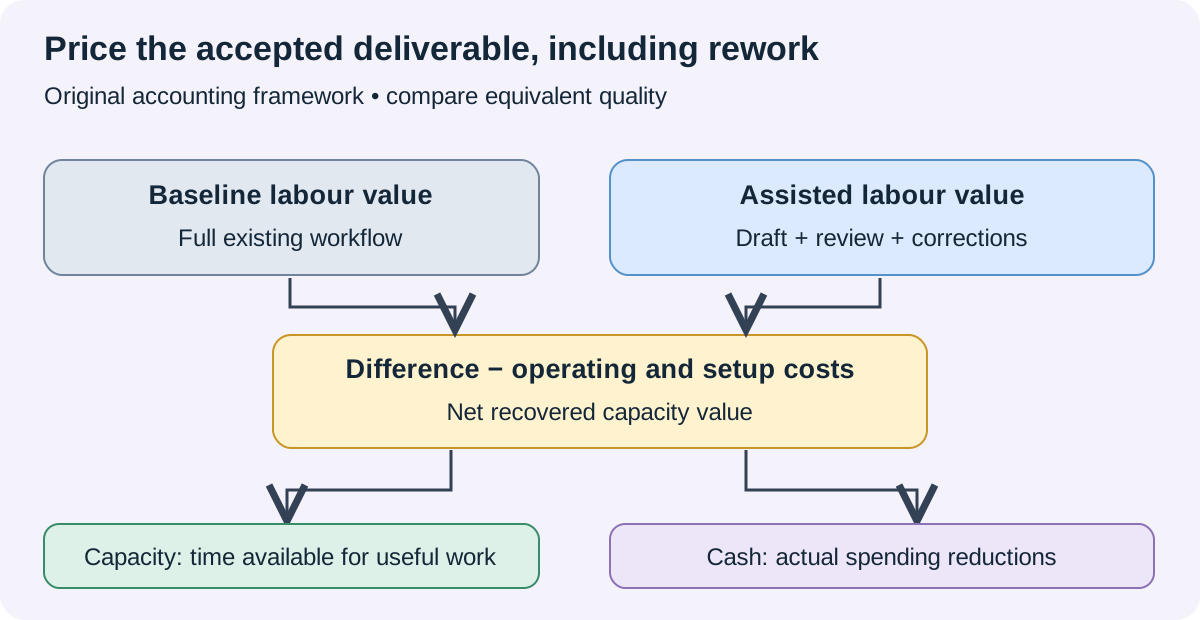
If salaried staff remain on the same payroll, multiplying saved hours by an hourly labour value estimates capacity value. It does not show cash that has left the bank account less often. Cash savings require an actual change in expenditure, such as reduced paid overtime or an avoided contractor invoice, measured against a credible alternative.
Additional capacity may still be worthwhile. A support team could respond sooner or accept more cases without hiring. A business might use freed time to perform checks it previously skipped. In these cases, describe the outcome clearly and avoid presenting the same hour both as a labour saving and as extra revenue without demonstrating how the second benefit arises.
The following diagram separates the calculation from the decision about how to use recovered time:
List the costs that disappear in a quick demo
A subscription is visible and easy to price. Other costs are scattered across the organisation. Someone teaches colleagues to use the tool. Someone updates templates. A manager reviews edge cases. An engineer maintains an integration. Staff spend time finding source material that the model was not given.
Separate one-time setup costs from recurring operating costs. For a short pilot, spreading setup across a long imagined lifetime can make the economics look better than the actual commitment. Record the cash paid upfront and the amortisation assumption separately.
| Cost or benefit | What to measure | Common mistake |
|---|---|---|
| Drafting time | Active time from input preparation to usable draft | Timing generation only |
| Review time | Checking facts, policy, format, and completeness | Treating review as free |
| Rework | Corrections, retries, and escalation | Removing failed attempts from the sample |
| Fixed operating cost | Licences, maintenance, and administration | Ignoring tools bought outside the pilot budget |
| Setup cost | Integration and staff training | Assuming immediate full adoption |
| Recovered capacity | Work time released at acceptable quality | Calling it realised cash savings |
A useful pilot log records unsuccessful outputs too. Otherwise the final spreadsheet describes only the best cases. It should also include work that returns to the original process, because those fallbacks consume time even if the AI draft is discarded.
A worked example with review and rework included
Consider a hypothetical team handling 400 documents per month. Its baseline requires 20 active minutes per accepted document. With assistance, drafting takes 7 minutes and mandatory review takes 5 minutes. One quarter of documents need another 8 minutes of correction. For this simplified expectation, average correction time is 0.25 × 8 = 2 minutes, giving 14 total minutes per document.
The synthetic loaded labour value is $24 per hour. Monthly recurring operating cost is $500. Setup cost is $600, allocated over three months at $200 per month for this teaching calculation. We assume comparable accepted quality and that all recorded time is active work time; changing either assumption changes the result.
| Synthetic monthly item | Calculation | Result |
|---|---|---|
| Baseline labour value | 400 × 20 ÷ 60 × $24 | $3,200 |
| Assisted labour value | 400 × 14 ÷ 60 × $24 | $2,240 |
| Gross recovered capacity value | $3,200 − $2,240 | $960 |
| Recurring plus allocated setup cost | $500 + $200 | $700 |
| Net capacity value | $960 − $700 | $260 |
The $260 is a modelled net capacity value, not a guaranteed monthly cash saving. The business must decide whether the 40 recovered hours can be used productively. If work cannot be reassigned, or if review quality is worse, the apparent benefit can shrink or disappear.
This complete Python program reproduces the calculation and an alternative rework case:
from decimal import Decimal as D
from math import ceil

volume = 400
rate = D("24")
baseline_minutes = D("20")
draft_minutes = D("7")
review_minutes = D("5")
rework_probability = D("0.25")
rework_minutes = D("8")
monthly_fixed = D("500") + D("600") / D("3")

assisted_minutes = (
    draft_minutes + review_minutes
    + rework_probability * rework_minutes
)
per_item_capacity = (baseline_minutes - assisted_minutes) * rate / D("60")
gross_capacity = volume * per_item_capacity
net_capacity = gross_capacity - monthly_fixed
break_even_volume = ceil(monthly_fixed / per_item_capacity)
assert assisted_minutes == D("14")
assert gross_capacity == D("960")
assert net_capacity == D("260")
assert break_even_volume == 292

worse_rework = D("0.50")
worse_minutes = draft_minutes + review_minutes + worse_rework * rework_minutes
worse_net = volume * (baseline_minutes - worse_minutes) * rate / D("60") - monthly_fixed
assert worse_minutes == D("16")
assert worse_net == D("-60")
print(net_capacity, break_even_volume, worse_net)
At these particular assumptions, at least 292 documents per month are needed to cover the $700 cost using recovered capacity value. If the correction probability rises to one half, the model becomes negative at the original volume. That sensitivity is more informative than a single attractive ROI percentage.
Design a pilot that can answer the purchase question
Select representative work, including difficult cases, rather than a handful of demonstrations chosen by the vendor or enthusiastic users. Record the existing process first. If the baseline is already changing, document that change so it is not mistakenly attributed to the assistant.
Where practical, compare similar tasks across assisted and unassisted conditions. Random assignment can reduce systematic differences, but implementation must consider staff learning, task difficulty, and spillovers. For a small operational pilot, a transparent comparison with clear limitations is preferable to claiming causal certainty from a before-and-after chart.
Keep time and quality measurement consistent. Use the same start and end definitions, the same acceptance criteria, and a reviewer who can evaluate outputs fairly. Separate waiting time from active labour time. A faster turnaround can be valuable, but it should not be priced as labour saved if staff were already doing other work while waiting.
Set a review date and decision rules beforehand. These might concern acceptable error rates, net capacity value, support burden, and whether users can complete the workflow without constant intervention. The appropriate thresholds depend on the task and the organisation's constraints; they are not universal numbers.
Quality and governance affect the economics
NIST's AI Risk Management Framework is voluntary guidance for incorporating trustworthiness into AI design, use, and evaluation. Its companion Playbook organises suggested actions around Govern, Map, Measure, and Manage. Neither document certifies that a particular tool is safe or financially worthwhile.
For a business pilot, use that perspective to ask who owns the workflow, what data it may use, how outputs are checked, and what happens when performance changes. These questions affect costs as well as risk. An integration that needs an expert to repair it every week has a different economic profile from one staff can maintain reliably.
Review requirements should follow the consequence of error. A draft for internal brainstorming and an external claim about a customer's contract should not receive identical treatment merely because the same model generated both. The economic calculation must include the checks the real deployment needs.
Frequently asked questions
Is a positive capacity calculation enough to buy the tool?
It is one input. Check acceptable quality, realistic adoption, available work for the recovered hours, operational support, and alternatives. A lower-cost change to the existing process may solve the same bottleneck.
Should a failed pilot mean AI cannot help our business?
No. It can mean the selected workflow, tool, assumptions, or integration was unsuitable. Preserve what you learned about review and rework instead of repeating the same demo with a more optimistic spreadsheet.
What should be reported to management?
Show accepted outputs, full workflow time, quality results, failed attempts, actual expenditure, and the intended use of recovered capacity. State which benefits were realised and which remain modelled. That makes the result understandable without pretending the uncertainty is gone.
Sources and scope
Primary references are Generative AI at Work, revised November 2024, the OECD SME workforce report, BLS's productivity explanation, NIST's AI RMF, and the NIST Playbook. The hypothetical scenario, accounting rules, pilot design, and calculations are original explanatory analysis. They do not predict the return from a particular AI product.