CPI Is Not Your Personal Cost of Living: A Careful Guide to Inflation Measures
Understand baskets, weights, substitution, quality adjustment, and why household expenses can diverge from headline CPI.
Reviewed October 10, 2026. Examples are illustrative; current inflation decisions should use the latest release from the relevant national statistics office.
When a consumer price index rises 4%, it does not mean every product rose 4% or every household's expenses rose by exactly that amount. A CPI summarizes price change for a defined population, basket, weighting system, geography, and period. Your household buys a different mixture of housing, food, transport, health care, education, and entertainment.
The index remains useful because a common statistical reference makes periods and places comparable. Problems begin when that population measure is treated as a personalized invoice or when a few memorable prices are treated as the complete inflation rate.
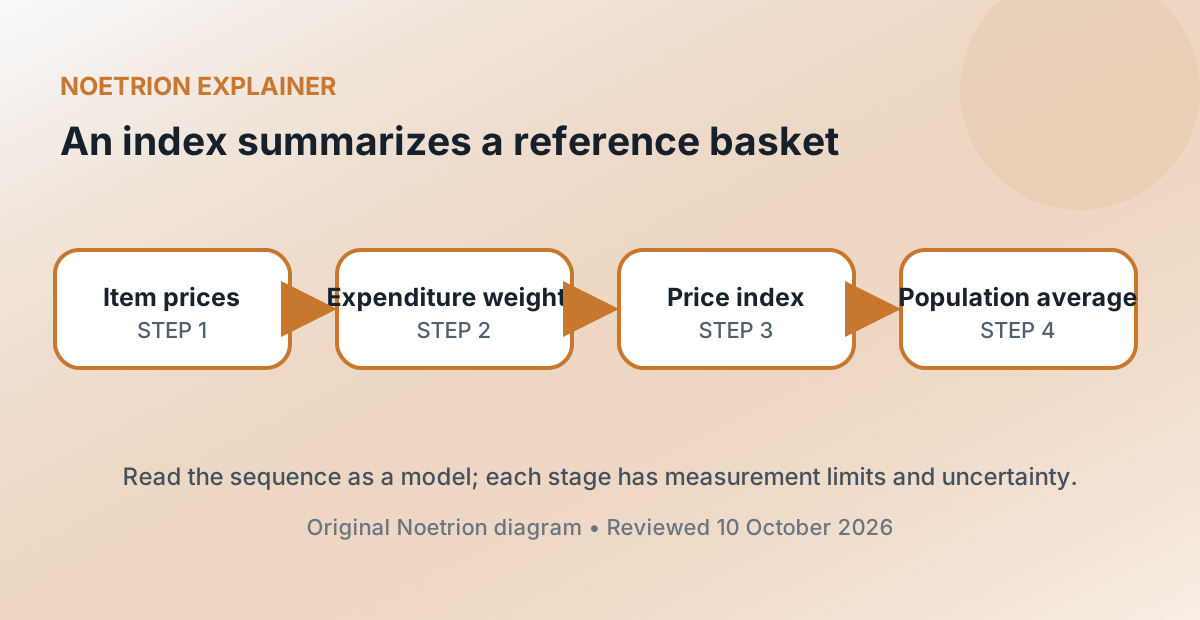
1. An index tracks change from a reference period
Suppose a basket costs 100 index units in a reference period and 104 one year later. The measured price level is 4% higher for that index's basket and method. The number 104 is not a currency price. It is a relative scale.
Monthly inflation can be reported from one month to the next, while twelve-month inflation compares a month with the same month a year earlier. These can move differently because they answer different questions. Seasonal adjustment can help compare adjacent months but creates another distinction between adjusted and unadjusted series.
2. Weights describe spending importance
Prices are combined using expenditure weights. A 10% rise in a category that represents 30% of the basket has more influence than the same rise in a category representing 1%. Statistical agencies estimate weights from household expenditure data and update them according to a published schedule.
| Household pattern | Why personal experience may differ from CPI |
|---|---|
| Renter in a high-growth city | Local rent may rise faster than national shelter measures |
| Car-free student | Fuel prices have little direct budget effect |
| Household with young children | Childcare may have an unusually large weight |
| Homeowner with fixed mortgage | Current financing costs may not match shelter index concepts |
The examples do not show that CPI is wrong. They show that a population average and a personal budget are different statistical objects.
3. Fixed baskets face substitution questions
If coffee becomes expensive relative to tea, some consumers buy less coffee and more tea. A strictly fixed basket ignores that substitution and can overstate the cost of maintaining a level of well-being. But allowing substitution can make an index less representative of buying the original basket.
Different index formulas handle this trade-off differently. The U.S. Bureau of Labor Statistics describes the CPI-U and CPI-W as measuring price change for particular urban populations, while the chained CPI uses a formula designed to account for substitution across item categories. No formula directly observes an abstract “true cost of living” for every household.
4. Quality change is not ordinary inflation
A laptop today may have a faster processor, more memory, and a better screen than a similarly priced laptop several years ago. If a product changes, statisticians try to separate price change from quality change. Methods include direct comparison, option-cost adjustments, and hedonic models that relate observed prices to characteristics.
Quality adjustment is necessary because treating a much better product as identical would mismeasure the price of comparable service. It is also a modeling task that should be documented and revised when markets change. “They removed quality” and “quality adjustment eliminates inflation” are both misleading simplifications.
5. Housing illustrates the importance of concepts
Owner-occupied housing provides a stream of shelter services and is also an asset. Consumer price indexes must decide how to represent that service. In the U.S. CPI, owners' equivalent rent estimates the rent a homeowner would receive for the home unfurnished and without utilities. It is not the same as the home's sale price or the owner's current mortgage payment.
This distinction surprises readers during periods when house prices or mortgage rates move rapidly. The index is measuring consumption of shelter under its published framework, not the cost of purchasing an investment asset at today's financing rate.
6. CPI differs from other broad price measures
The personal consumption expenditures price index uses different data sources, population coverage, weights, and formulas. A producer price index tracks selling prices received by domestic producers at earlier stages, not the retail basket purchased by households. A GDP deflator covers domestically produced final goods and services in national accounts.
These measures can disagree without contradiction. Always match the measure to the question: household consumer prices, business input and output prices, personal consumption in national accounts, or the price of domestic production.
7. “Core” inflation removes selected volatility, not importance
Measures excluding food and energy are often used to study underlying persistence because those categories can move sharply. This does not imply households can stop buying food or energy. Headline and core measures serve different analytical purposes.
Policymakers also examine trimmed means, medians, services categories, wages, expectations, and other indicators. No single series contains every dimension of inflation pressure. Selecting whichever measure supports a desired story after seeing the data is poor analysis.
8. Build a personal inflation estimate carefully
A household can group spending from two comparable periods, calculate category shares in the earlier period, and combine category price changes with those personal weights. Keep quantities separate from prices: spending more because you bought twice as much is not inflation. Handle large irregular purchases explicitly and avoid inferring a yearly trend from one bill.
The result is a budget-specific estimate, not a replacement for official CPI. It may be useful for planning, while the official index remains better for contracts, macroeconomic comparison, and population analysis because its sample and methods are consistent and published.
9. Read every inflation claim with metadata
Ask which index, population, geography, adjustment, comparison period, and release vintage is being used. Check whether the statement refers to the price level or the rate of change. Falling inflation means prices are rising more slowly; it does not necessarily mean the price level has fallen. An outright decline in a broad price index is deflation.
CPI is best understood as a carefully constructed measurement instrument. It compresses thousands of observations into a usable signal, but compression necessarily loses household detail. Respecting both the value and the boundary of the instrument produces a clearer view of inflation.