EU AI Act in 2026: A Practical Compliance Checklist for Small Businesses
What the EU AI Act means in 2026: applicable rules, delayed high-risk deadlines, and a practical compliance checklist for small businesses.
An AI feature can look harmless in a product demo and become complicated the moment a customer asks who is accountable for its output. That is the practical problem behind the European Union's AI Act: it treats different uses of AI differently, rather than declaring every chatbot equally risky.
As of October 2026, the Act is no longer merely a future deadline. The European Commission says the legislation entered into force on 1 August 2024 and became broadly applicable on 2 August 2026, with important exceptions. The Commission's updated implementation timeline places certain high-risk use cases in December 2027 and AI integrated into specified regulated products in August 2028. Those dates matter, but they do not mean every business can ignore the rules until then.
First, identify what your business actually does
The most useful starting question is not “Do we use AI?” It is “Where does AI affect a person, a decision, or a product?” A retailer using a writing assistant to draft a product description faces a different risk profile from an employer using automated ranking to screen candidates.
Make a simple inventory. Record the AI provider, the feature, the data it receives, who sees the output, and whether a human can reverse a consequential decision. Include third-party features embedded in software your team already uses. A procurement contract is not a substitute for knowing the workflow.
| AI use | Main question to investigate | First practical control |
|---|---|---|
| Marketing copy assistant | Could content mislead or impersonate someone? | Editorial review and disclosure assessment |
| Customer-facing chatbot | Will users know they are interacting with AI? | Clear interface notice where required |
| Candidate screening | Could the system affect access to employment? | Legal classification and documented oversight |
| Internal meeting summary | Does it process confidential personal data? | Access, retention and accuracy controls |
| AI-generated synthetic media | Does a transparency obligation apply? | Provenance and labeling workflow |
This is a triage table, not a legal classification of any particular system. The exact obligations depend on the Act's definitions, your role as provider or deployer, the use case, and other applicable law.
What changed in the 2026 timeline?
The Commission's AI Act information page distinguishes obligations already applicable from high-risk requirements with later dates. Its current summary identifies prohibited practices and AI literacy requirements as applicable from February 2025, and governance requirements for general-purpose AI models from August 2025. A number of transparency rules became enforceable in August 2026.
The updated timeline is particularly important for teams that read older summaries stating that every high-risk obligation would arrive in August 2026. Some high-risk provisions now have later application dates. A compliance spreadsheet built from an old blog post may therefore be wrong in either direction.
Practical rule: use the Commission's current timeline as your starting reference, then confirm the relevant legal text and sector-specific obligations. This article is operational guidance, not legal advice.
Build an evidence trail before buying another tool
A defensible process does not require an enormous compliance department. It does require records that survive staff turnover.
- Assign an owner for each AI use case.
- Document its purpose, limitations and human review points.
- Test representative outputs, including failure cases and language differences.
- Establish a route for users to report errors or request human attention.
- Revisit the assessment when the model, data source or purpose changes.
For example, a support chatbot that only suggests help-center articles can become materially different if it starts approving refunds or making eligibility decisions. The same vendor name does not mean the same risk.
The business opportunity is clarity
Clear governance can improve customer trust and reduce rework. Teams that know where AI is used can also spot duplicated subscriptions, unapproved data transfers and automations that no longer help anyone. Regulation should not become an excuse for collecting paperwork without improving actual decisions.
Start with a 60-minute inventory meeting, choose your three highest-impact use cases, and verify their obligations. The goal is not to call a system “compliant” after one checklist. It is to build a repeatable process for making and checking that claim.
FAQ
Does the AI Act apply only to AI companies?
No. Depending on the activity and territorial scope, obligations can affect organizations that deploy AI systems as well as those that develop or supply them.
Are all high-risk AI deadlines in August 2026?
No. The Commission's updated timeline specifies later application dates for certain high-risk categories. Check the latest official text before planning.
What should a five-person company do this week?
Create an AI inventory, flag systems influencing people or sensitive data, identify the responsible owner, and verify disclosure requirements. Escalate uncertain classifications to qualified counsel.
Sources and further reading
Editorial notes
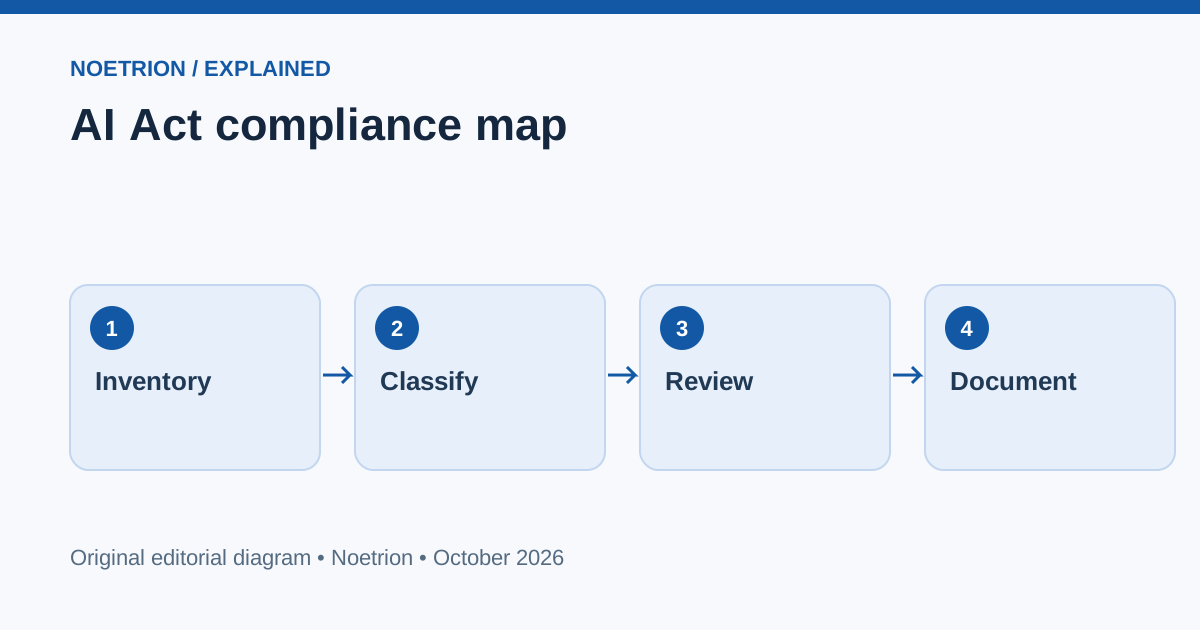
Visual: AI Act compliance map. Original vector checklist showing AI inventory, classification, oversight and review for a small business.
Verification note: Facts were checked against the linked primary or specialist sources on 13 October 2026. Forecasts are labeled as forecasts, illustrative calculations as hypothetical, and the article does not constitute personalized legal, medical, or investment advice.