HashingVectorizer: Fixed Feature Space, Visible Collisions, and Honest Tradeoffs
Verify fixed-dimensional text hashing, construct a collision, and distinguish a stateless vectorizer from a stateful learning pipeline.
Reviewed October 9, 2026. Examples use Python 3.12 and scikit-learn 1.8.0 with invented text.
A streaming text service may encounter new words after every deployment. Maintaining a learned vocabulary can then require explicit decisions about updates, storage, synchronization, and compatibility with a trained model. Feature hashing takes a different route: a deterministic mapping places analyzed terms into a fixed number of columns without retaining a vocabulary of observed terms.
That convenience comes with a consequential tradeoff. Different terms can land in the same column, so a column no longer has a unique human-readable meaning. This article makes the collision concrete, explains signed hashing, and identifies the boundaries of the word stateless. It does not claim that hashing is automatically faster, smaller, or more accurate for every text workload.
1. Define the object whose state is removed
The HashingVectorizer API describes a transformer without a learned vocabulary. Given the same configuration and supported implementation, a term is mapped consistently without a corpus-dependent fitting step. New documents can be transformed into the same number of feature columns even when their words never appeared earlier.
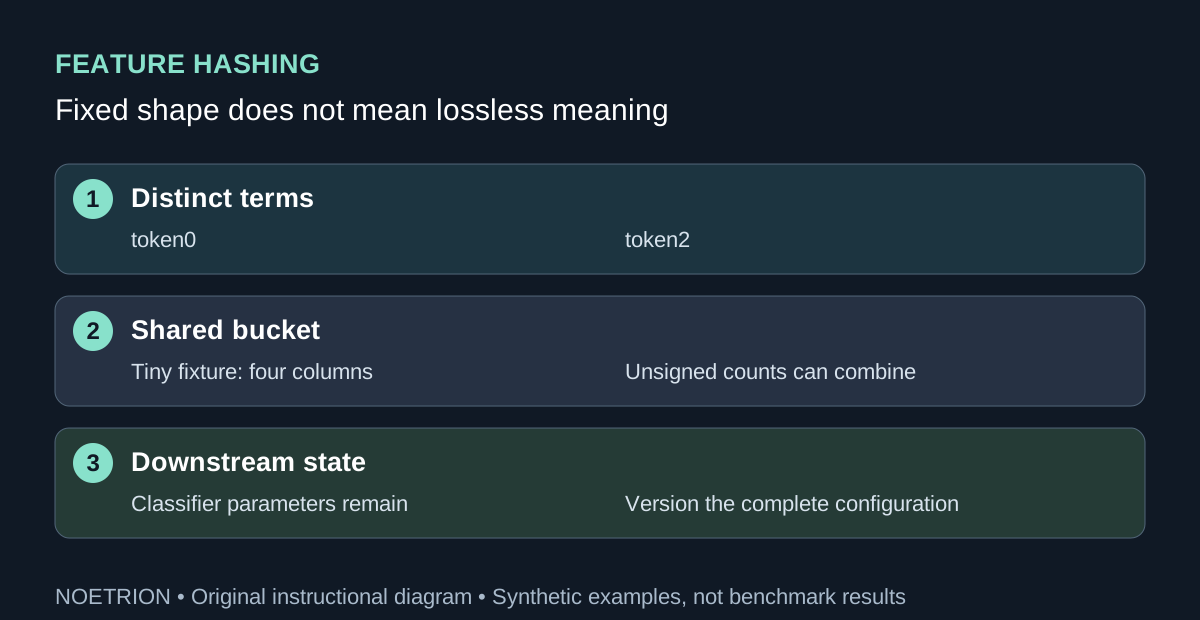
This property concerns the vectorizer. A classifier still learns coefficients or other state. A document-frequency weighting stage can also learn state. Text cleaning rules, analyzer configuration, package compatibility, label mappings, and monitoring definitions remain part of the deployed artifact. Saying the whole system has no state would obscure precisely the information needed to reproduce its predictions.
Imagine two workers receiving separate batches. With hashing, their feature spaces can align without exchanging a vocabulary built from those batches. They must nevertheless agree on the analyzer, number of columns, sign rule, normalization, and dtype. Two workers using different settings can produce arrays with compatible dimensions while assigning different meanings or magnitudes to those dimensions.
2. Verify fixed shape before considering performance
import numpy as np
from sklearn.feature_extraction.text import HashingVectorizer

vectorizer = HashingVectorizer(n_features=16, norm=None,
                              alternate_sign=False)
first = vectorizer.transform(["parcel delayed", "account locked"])
later = vectorizer.transform(["new vocabulary arrives"])
assert first.shape == (2, 16)
assert later.shape == (1, 16)
assert np.all(first.data >= 0)
assert np.array_equal(first.toarray(),
                      vectorizer.transform(["parcel delayed", "account locked"]).toarray())
assert not hasattr(vectorizer, "vocabulary_")
print("Batch shapes:", first.shape, later.shape)
The example disables normalization and alternate signs so that the fixture is easy to inspect as nonnegative counts. Those settings differ from the defaults and should not be copied without considering the downstream estimator. Sixteen columns are intentionally tiny; they are appropriate for a collision demonstration, not a recommendation for a production vocabulary.
The shape check demonstrates compatibility across batches. It says nothing about the time to tokenize, transform, transfer, or classify them. A real capacity study should include those stages, representative document lengths, sparse matrix storage, coefficient storage, and concurrency. A fixed column count alone is insufficient evidence for a claimed memory reduction.
3. Construct a collision instead of hiding it
If more distinct single tokens are mapped than there are columns, at least two share a column. That statement follows from the finite number of available destinations; no random benchmark is required. The next example searches a tiny space and then proves that two different tokens become indistinguishable under an unsigned, unnormalized configuration.
import numpy as np
from sklearn.feature_extraction.text import HashingVectorizer

vectorizer = HashingVectorizer(n_features=4, norm=None,
                              alternate_sign=False)
seen = {}
pair = None
for number in range(20):
    token = f"token{number}"
    row = vectorizer.transform([token])
    assert row.nnz == 1
    bucket = int(row.indices[0])
    if bucket in seen:
        pair = (seen[bucket], token)
        break
    seen[bucket] = token
assert pair is not None and pair[0] != pair[1]
left, right = (vectorizer.transform([token]).toarray() for token in pair)
assert np.array_equal(left, right)
combined = vectorizer.transform([" ".join(pair)]).toarray()
assert np.array_equal(combined, 2 * left)
print("Collision fixture:", pair)
The exact token pair is discovered by the program rather than asserted as a permanent semantic fact. The important result is the equal output. A downstream model using only this representation has no way to distinguish those two one-token documents. No amount of coefficient tuning can reconstruct a distinction erased before fitting.
For longer documents, a collision does not necessarily make the entire rows identical. Other features may still distinguish them. Conversely, an apparently rare collision can affect an important cue. Assess the practical impact through held-out predictions and targeted fixtures rather than estimating model quality solely from the number of buckets.
4. Understand what signed hashing changes
With alternate signs enabled, contributions can be positive or negative. Terms sharing a column may reinforce or partly cancel one another. Signed hashing is intended to better preserve inner-product behavior approximately; it does not make the mapping one-to-one. The FeatureHasher reference provides the lower-level hashing context.
A negative entry is therefore not a negative word count in the everyday sense. A zero entry can also reflect cancellation rather than absence of every contributing term. If an estimator or diagnostic expects nonnegative counts, make that expectation explicit and test the chosen representation. Silently replacing negative entries with zero changes the representation again and requires its own evaluation.
| Decision | Consequence | Evidence to retain |
|---|---|---|
| Number of columns | Sets available destinations and model input width | Held-out comparison and resource measurements |
| Alternate signs | Changes how colliding contributions combine | Estimator compatibility checks |
| Normalization | Changes document-vector magnitude | Long and short document fixtures |
| Word or character analyzer | Changes the terms being hashed | Actual analyzer outputs |
| Downstream weighting | May introduce learned corpus state | Fitting boundary and stored parameters |
This table separates independent choices. A report that says only hashing was used cannot reproduce the feature vectors or explain why a later model behaves differently.
5. Account for interpretability and artifact size
There is no vocabulary-based inverse transformation that reliably tells you the original terms from hashed columns. A large coefficient for a bucket may combine contributions from multiple terms. An explanation that labels that bucket with one convenient example term can misrepresent the actual evidence used by the classifier.
You can retain a controlled sample of observed token-to-bucket mappings for debugging, subject to privacy and retention rules. That sample is incomplete and must be labeled as such. It cannot prove that no unobserved token collides with the bucket. If human-readable feature attribution is a central requirement, compare a vocabulary-based alternative before selecting hashing.
The feature extraction guide discusses hashing in the broader text-processing workflow. For an actual resource assessment, include the trained estimator. A very wide feature space can increase downstream parameter storage even when each document has few nonzero entries. Measure bytes and operational limits on representative inputs; do not publish an invented throughput ratio from these small programs.
6. Make streaming updates a complete contract
A stateless transformation can make batching convenient, but it does not guarantee that a learner supports incremental updates. Confirm the estimator's update API, class handling, and update order. A fit call that replaces existing state is different from an incremental call that incorporates another batch. Record how repeated documents and retried batches are handled so that a transport retry does not silently duplicate training influence.
Separate operational changes from model changes. Increasing the number of hash columns changes the feature space and generally requires a compatible newly trained model. Changing tokenization can do the same even if the column count stays fixed. Version the vectorizer configuration together with the model and test them as one artifact.
Monitor document lengths, empty outputs, label distributions, and delayed outcome quality. New terms are transformable without a vocabulary update, but transformable does not mean understood or correctly classified. An emerging topic may still require new labels, examples, or a different representation. Fixed shape solves a specific coordination problem; the rest of the learning system still needs evidence and maintenance.
Sources and scope
The three linked official scikit-learn 1.8 pages support the API and hashing mechanics. The collision construction, deployment questions, and diagram are original instructional analysis. Both programs use deliberately small synthetic inputs and establish representation properties rather than production quality or resource benchmarks.