How to Read a Research Paper Critically: A 30-Minute Evidence Checklist
Learn to read research papers without being misled by abstracts, p-values or bold headlines. A practical evidence checklist for students and professionals.
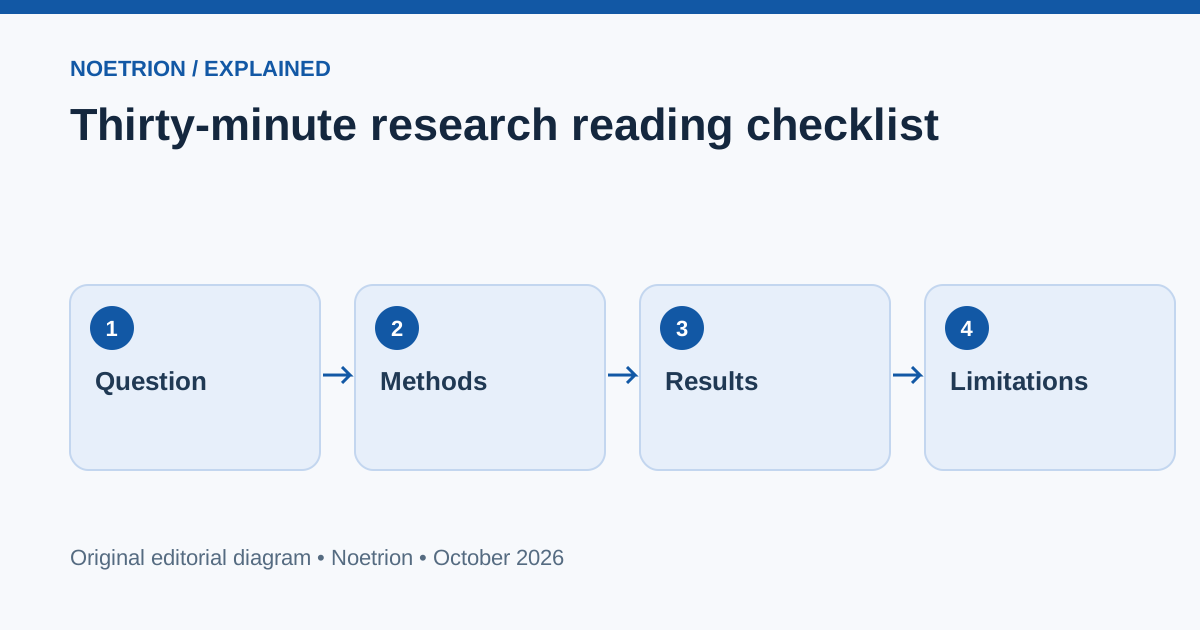
A research paper can be carefully written and still answer a narrower question than the headline suggests. A study may show an association rather than a cause. An average improvement may conceal large variation. And an impressive chart may omit the comparison that matters most.
Learning to read research critically is therefore less about memorizing jargon and more about asking a small set of repeatable questions. The CONSORT 2025 reporting guideline for randomized trials provides a useful illustration: it calls for clear information about trial design, participant flow, outcomes, harms and transparency. Cochrane's risk-of-bias tools offer a separate framework for judging whether study methods may distort results.
These resources concern particular kinds of studies. They are not universal scorecards for every paper in psychology, computer science or economics.
Minute 0–5: identify the actual question
Read the title and abstract, then write one sentence in your own words: “The researchers wanted to know whether X is associated with or causes Y in population Z.”
Next, inspect the study design. Was it a randomized trial, observational cohort, cross-sectional survey, simulation, qualitative interview study or benchmark evaluation? Different designs support different claims.
A randomized trial can provide stronger evidence about an intervention under suitable conditions, but randomization alone does not guarantee that execution, measurement and reporting were sound.
Minute 5–12: inspect who and what was measured
Find the sample size, recruitment method, inclusion criteria and setting. Ask who was left out. A result from one hospital, country, age group or dataset may not generalize to a different population.
Then identify the outcome measure. If the headline promises better learning, did researchers measure long-term understanding, a quiz immediately after training, self-reported confidence, or something else? Those are not interchangeable.
| Research claim | Question to ask |
|---|---|
| “Method A improves performance” | Compared with what, and by how much? |
| “The result is significant” | What is the effect size and uncertainty? |
| “AI beats humans” | Which humans, task, dataset and evaluation rules? |
| “The treatment is safe” | How were adverse events collected and reported? |
| “Results generalize” | Who was sampled, and who was excluded? |
Minute 12–20: interpret the numbers
A p-value does not tell you the probability that the hypothesis is true. It summarizes how compatible the observed data are with a specified statistical model under its assumptions. Read effect sizes and confidence intervals alongside it.
For a hypothetical example, a training method might improve test scores by two points on a 100-point scale. Whether that is meaningful depends on the test, baseline performance, uncertainty, costs and the population studied. Statistical significance and practical importance are separate questions.
Watch for relative versus absolute changes. A “50% reduction” could mean a risk dropping from 2% to 1%, or from 20% to 10%. Both are relative reductions of 50%, but their absolute implications differ.
Minute 20–26: look for bias and missing information
Cochrane's RoB 2 framework assesses randomized trials across structured domains rather than treating a polished article as automatically reliable. Useful questions include whether allocation was appropriate, outcomes were measured consistently, missing data were handled reasonably and reported results matched prespecified analyses.
CONSORT 2025 emphasizes transparent reporting and includes a 30-item checklist. Its authors also caution that a reporting guideline is not itself a study-quality rating instrument. A paper can report weak methods clearly; transparency helps readers detect that weakness.
For other designs, seek the appropriate reporting and appraisal guidance rather than forcing trial criteria onto every study.
Minute 26–30: write a three-sentence verdict
Use this template:
- Finding: In the studied population, the researchers observed ...
- Confidence: The main strengths and limitations are ...
- Application: I would or would not apply this result to ... because ...
Add one unanswered question. That final step turns reading into inquiry rather than passive highlighting.
A practical example
Suppose a paper claims a new study app “doubles learning.” Before sharing it, ask whether the outcome was immediate recall, whether the comparison group received equal study time, whether the sample was representative, and whether the effect persisted after a month.
The right response may be “promising, but not established for my context.” That is a useful conclusion, not a failure to understand the paper.
FAQ
Should I read every paper from beginning to end?
Not necessarily. Start by deciding whether the question and design are relevant. Read methods and results closely for papers you plan to rely on.
Is peer review proof that a claim is correct?
No. It is one quality-control process, not a guarantee against errors, bias or later contradictory evidence.
Sources and further reading
Editorial notes
Visual: Thirty-minute research reading checklist. Original infographic: question, design, sample, effect, bias and three-sentence verdict.
Verification note: Facts were checked against the linked primary or specialist sources on 13 October 2026. Forecasts are labeled as forecasts, illustrative calculations as hypothetical, and the article does not constitute personalized legal, medical, or investment advice.