IPv6 Transition: Why the Internet Runs Two Address Systems at Once
Understand address exhaustion, dual stack, translation, tunneling, DNS64/NAT64, and why migration is a long coexistence problem.
Reviewed October 11, 2026.
Understand address exhaustion, dual stack, translation, tunneling, DNS64/NAT64, and why migration is a long coexistence problem.
| Concept | What it means | Important limit |
|---|---|---|
| Dual stack | Hosts run IPv4 and IPv6 | Two networks must be operated and secured |
| DNS64 + NAT64 | IPv6 clients reach IPv4 servers | Literal IPv4 assumptions can break |
| Tunneling | One protocol crosses another network | Adds encapsulation and operational complexity |
| IPv4-as-a-Service | IPv4 delivered over IPv6 access | Preserves legacy reachability during migration |
1. IPv6 solves address scale but cannot erase deployed IPv4
IPv4 uses 32-bit addresses, providing roughly 4.3 billion possible values before reservations and operational constraints. Network address translation extended its life by letting many private devices share public addresses, but added state and complicated end-to-end connectivity. IPv6 uses 128-bit addresses and redesigns several network mechanisms. The difficulty is installed base: old servers, applications, routers, customer equipment, and operational processes still expect IPv4. Migration is therefore coexistence among independently upgraded systems rather than a coordinated global switch.
2. Dual stack lets endpoints choose either protocol
A dual-stack host and network support both IPv4 and IPv6. DNS can return A records for IPv4 and AAAA records for IPv6, and connection algorithms choose a usable path. This approach preserves broad compatibility and allows incremental deployment. It also means operating two control planes, firewall policies, address-management systems, monitoring stacks, and troubleshooting skills. IPv6 should not be treated as an invisible copy of IPv4: unnoticed exposure can occur if security teams filter one protocol carefully while leaving the other on defaults.
3. DNS participates in path selection
Applications usually start with names rather than addresses. A resolver may return both address families, and modern clients often race or quickly fall back between them to avoid long delays when one path is broken. Monitoring only successful IPv4 traffic can hide an IPv6 failure because users eventually connect through fallback. Operators need family-specific latency, loss, DNS, and reachability measurements. Literal addresses embedded in configuration or application payloads bypass this flexibility and are a common barrier to transition.
4. NAT64 connects IPv6 clients to IPv4 servers
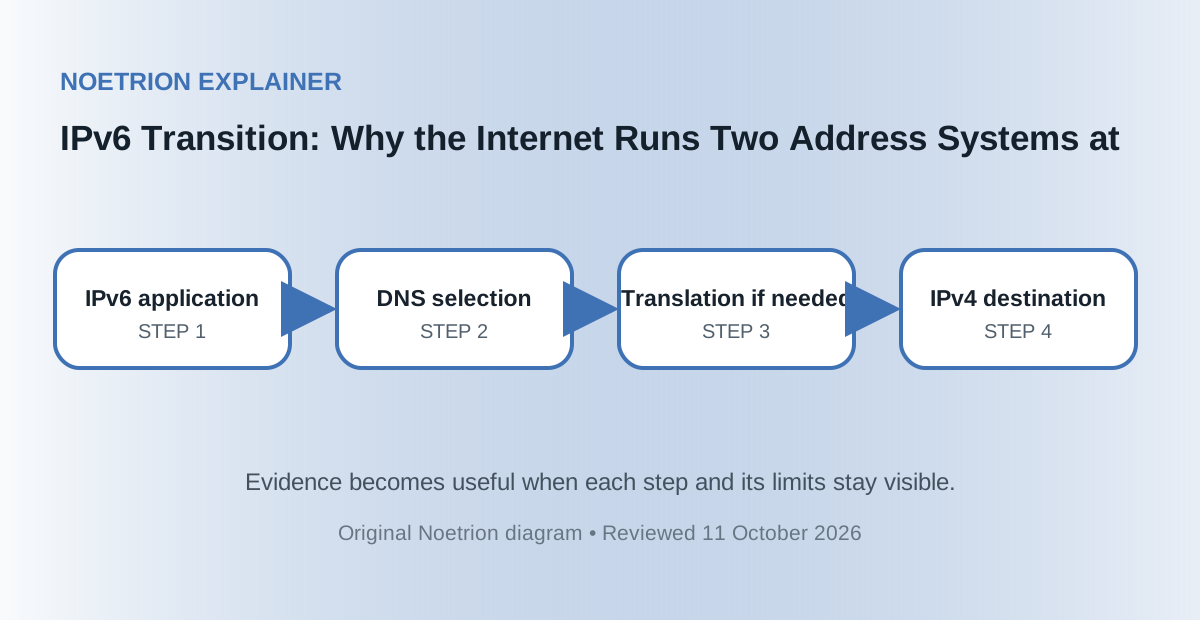
In an IPv6-only access network, DNS64 can synthesize an IPv6 address from an IPv4-only DNS answer. A NAT64 translator recognizes the special prefix, maps the IPv6 flow to IPv4, and maintains necessary state. The destination server continues to see IPv4. This allows the client side to operate primarily on IPv6 while retaining access to legacy services. Translation is not magic: protocols carrying literal addresses, unusual IP semantics, or inbound connection requirements may need application changes or gateways.
5. Tunnels carry one protocol through another
A tunnel encapsulates packets of one address family inside another so separated networks can communicate across infrastructure that has not been upgraded. Configured tunnels can be useful for controlled links, while large automatic-tunneling systems have often introduced debugging and security problems. Encapsulation reduces effective maximum transmission unit and can create fragmentation or path-MTU issues if filtering blocks control messages. Tunnels should be documented as network dependencies with explicit endpoints, capacity, monitoring, and retirement plans.
6. Service providers increasingly run IPv6 under legacy IPv4
IPv4-as-a-Service designs let an operator build an IPv6-centric access network while carrying or translating the subscriber’s remaining IPv4 traffic at the edge. Variants differ in whether they encapsulate packets, perform single or double translation, and share public IPv4 addresses. The goal is not to prove IPv4 has vanished, but to reduce how much internal infrastructure must natively operate it. Selecting a mechanism depends on equipment, address holdings, logging duties, application mix, performance, and operational experience.
7. Security policy must cover extension headers and translation state
IPv6 offers abundant addresses but does not automatically deliver encryption or safety. Firewalls still need least-privilege rules, neighbor discovery needs protection, and routers must correctly handle control traffic needed for path operation. Translation devices create state and logging demands comparable to large NAT systems. Scanning an entire subnet is harder, yet attackers can discover targets through DNS, logs, predictable addressing, or application services. Security improves when inventories, patching, identity, and segmentation cover both families consistently.
8. Measure readiness with applications, not ping alone
A successful IPv6 ping does not prove that users can complete login, payment, uploads, or API calls. Test DNS, TLS certificates, load balancers, content delivery, observability, rate limits, geolocation, abuse controls, and third-party callbacks. Compare latency and error rate by address family. Run IPv6-only test environments to uncover hidden IPv4 literals and dependencies. Transition is complete for a service when it operates reliably under the intended architecture and support teams can diagnose it—not when an address appears on an interface.
Conclusion
The Internet’s migration works through layered coexistence: dual stack where both protocols are available, translation where only one side has IPv4, and tunnels or IPv4-as-a-Service where infrastructure is optimized around IPv6. The engineering goal is controlled reduction of legacy dependence while preserving reachability, security, and observable service quality.