Medical Device Recalls: Match the Exact Model Before Closing the Alert
Turn a medical device recall notice into a traceable inventory check using device identifiers, affected lots, uncertain matches, and documented follow-up.
This guide explains research and technology. It does not provide diagnosis or treatment, and regulatory status should be checked with the relevant authority.
The email says a familiar medical device has been recalled. One colleague recognizes the brand; another says the department already installed an update. Neither statement answers the operational question: which exact items are affected, and what evidence shows that the required action is complete?
That gap is a technology and data problem as well as a safety problem. Brand names are broad, local inventory records can be incomplete, and a notice may concern instructions rather than physical removal. Closing an alert because somebody read the email can leave the important work unfinished.
Recent FDA communications illustrate why the details matter. This guide develops an original inventory worksheet for matching a notice to equipment. It concerns identification and documentation, not decisions about an individual patient's treatment or whether a particular device should remain in use.
The current hook: an alert can change status without changing the action
The FDA's Lumify ultrasound correction communication records an October 9, 2026 early alert followed by an October 19 update reporting Class I classification. It explicitly says the affected products and recommendations had not changed. The action concerns updated use instructions rather than removing the equipment from its locations.
That example should not be reduced to a brand-wide instruction from this article. The official notice contains the affected software versions, device identifiers, and specific recommendations. Staff responsible for an actual device should consult its current notice and the manufacturer's communication directly.
The distinction between publication, classification, and action dates is useful beyond this case. A team needs to know whether a new message introduces different affected products, changes the action, or updates the regulatory status of an existing issue.
Recall does not automatically mean removal
The FDA's recall explanation distinguishes a correction performed where a device is used or sold from a removal. It explains that recalls can involve inspection, repair, changes, or other actions and do not always require stopping use or returning a product.
For an operations team, this means the response must follow the notice rather than the emotional meaning of the word recall. A generic checklist that always says return equipment can be as misleading as one that always says install an update.
A useful first record captures the notice URL, version or retrieval date, affected-product definition, required action, response contact, and local owner. Keep the source wording accessible. A paraphrase may be convenient for a task list, but it should not replace the instructions on which the task depends.
Device identity has more than one level
The FDA UDI basics page describes the device identifier, or DI, as the fixed portion identifying a labeler and a specific version or model. The production identifier, or PI, is conditional and may include lot, serial number, expiration, or manufacturing information.
The same page explains that GUDID contains the DI and basic identifying information, not the PI. Therefore, finding a model in a database does not resolve every lot-specific or serial-specific question. The physical label and reliable local records still matter.
| Identity field | Useful question | Common limitation |
|---|---|---|
| Brand and device family | Which broad product is this? | Too broad for many matches |
| Device identifier | Which labeler and version or model? | Does not identify every production detail |
| Lot or batch | Which manufacturing group? | May be missing from local inventory |
| Serial number | Which individual unit? | Must be captured accurately |
| Software version | Which installed configuration? | Can change after procurement |
| Location and custodian | Where is the item now? | Transfers can leave records stale |
This resembles the record integrity problem discussed in data contracts and quality: the meaning and completeness of a field matter as much as whether a spreadsheet cell is populated.
Worked example: reconcile thirty fictional units
Assume a completely fictional notice covers model M-42 with local training identifier DEMO-DI-42 and lots L 7 and L 8. These strings are intentionally invented and are not valid identifiers for a real medical product.
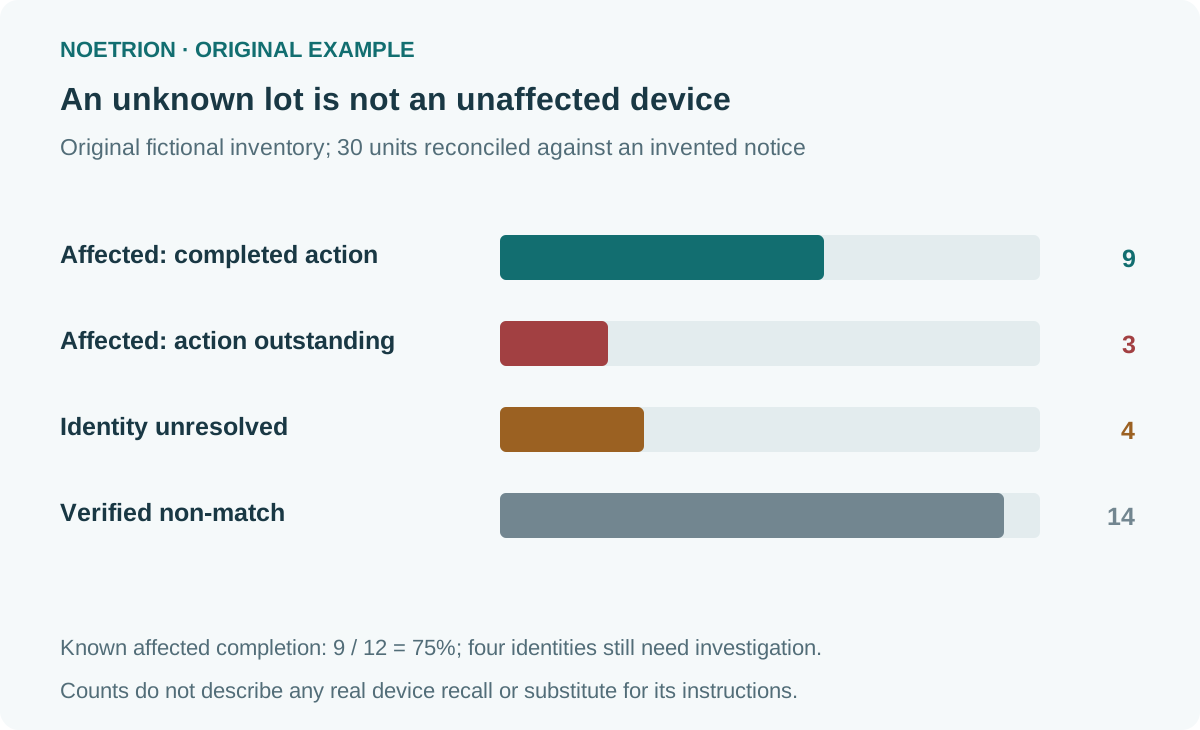
A local register contains thirty units. The team checks identifiers against reliable records and physical labels where required. Its first reconciliation produces the following groups:
| Inventory group | Units | Match status |
|---|---|---|
| Correct model, verified affected lots | 12 | Affected |
| Correct model, verified other lots | 8 | Not matched by this fictional notice |
| Correct model, lot missing | 4 | Unresolved |
| Verified different model | 6 | Not matched by this fictional notice |
| Total | 30 | All units accounted for |
Twelve units are verified matches. Four more need investigation. Calling those four unaffected would replace missing evidence with an unsupported conclusion. The remaining fourteen are verified non-matches for the defined scope of this invented notice; that says nothing about other notices or other issues.
Suppose records show completed notice-specific action for nine of the twelve affected units. Documented completion among known affected units is 9/12, or 75%. It is not 9/30. The latter mixes unrelated units into the action denominator and produces a statistic with little operational meaning.
Keep uncertainty visible in the completion number
Before the four unresolved units are identified, the true number of affected units could range from twelve to sixteen. If no additional completed actions have been documented, the share with verified completion among the eventually affected set could range from 9/16, or 56.25%, to 9/12, or 75%.
Those are simple bounds under the example assumptions, not probabilities that any particular unit is affected. The useful operational report is more direct: nine verified completions, three known affected units awaiting documented completion, and four unresolved identities.
If later evidence identifies three unresolved units as affected and one as outside scope, the affected denominator becomes fifteen. If the completed count remains nine, completion becomes 60%. That decline need not mean previous work was undone. It can mean the inventory became more complete.
This is why a daily dashboard should preserve counts alongside percentages. Otherwise, better investigation can look like worsening performance, creating an incentive to leave difficult records unresolved.
Identification and action completion are separate checks
A verified match does not show that a response was completed. Conversely, a note saying training done does not establish that it applies to the exact item and current notice. Link the action record to the affected inventory record and the instruction version.
| Closure field | Evidence to retain |
|---|---|
| Item identity | Verified identifier, serial or lot where relevant, and configuration |
| Notice applicability | Source criteria and reason the item matches |
| Required local action | Exact task derived from the current communication |
| Completion evidence | Authorized record, date, responsible person, and verification |
| Outstanding uncertainty | Missing identifiers, inaccessible item, or pending clarification |
| Final review | Accountable owner and documented disposition |
The worksheet is an editorial organizational aid. The specific notice and institutional process determine what counts as adequate completion. It should not be used to invent a substitute repair, clinical workaround, or instruction for an unfamiliar device.
For connected equipment, identity can also include software configuration. The medical device cybersecurity handoff guide explains a related ownership problem: technical information becomes useful only when someone can associate it with a deployed product and an accountable action.
Use public databases for the questions they can answer
AccessGUDID provides searchable device identification information submitted to FDA, along with downloads and APIs. It can help resolve a model or identifier, but it is not the hospital's live location register or a list of local action completions.
A sensible workflow records the public identification source separately from the local evidence. The database may help explain what a DI refers to; a local asset check establishes where a particular item is and which production details appear on it. Joining those records is useful only when the keys and scope are correct.
Preserve identifiers as text. Spreadsheet conversion can remove leading zeros, reinterpret long numeric strings, or change formatting. Retain the original captured value alongside any normalized comparison field, and review mismatches rather than guessing the intended digits.
Public identification data should also be kept separate from sensitive patient or operational information. An internal reconciliation does not require publishing local device locations or patient associations on a public tracking page.
Make the next alert easier to handle
A retrospective review can identify why matching was slow. Were lots never captured at receipt? Did software versions change without updating the register? Were items loaned to another department without a custodian record? Those are concrete process improvements rather than reasons to buy a larger dashboard immediately.
Start with a small sample of current equipment and test whether staff can recover the fields needed for a realistic notice. Measure unresolved identifiers and time to establish a match. Keep that exercise separate from real safety actions so that a training scenario cannot be mistaken for an official instruction.
For people using equipment at home, the appropriate next step is the manufacturer's or care team's specified contact and current notice. Do not change treatment or remove an implanted device based on a model-name match in an article.
The goal is a defensible chain: current notice, exact applicability, accountable action, and evidence of closure. An alert is handled when that chain is complete, not when its email is marked read.
Sources and review boundary
- FDA, Lumify diagnostic ultrasound correction, timeline updated October 19, 2026; initially posted as an early alert October 9.
- FDA, What is a Medical Device Recall?.
- FDA, UDI Basics, and NLM AccessGUDID.
Reviewed October 21, 2026. All inventory identifiers, counts, completion records, and bounds are synthetic. This article is not a complete summary of any device-specific corrective instruction.