A Neuroscience Biomarker Can Improve Before We Know Whether Patients Benefit
Read the FDA's October 2026 neuroscience initiative with a clear evidence ladder. Separate biomarker change, surrogate validation and meaningful patient outcomes.
This guide explains research and technology. It does not provide diagnosis or treatment, and regulatory status should be checked with the relevant authority.
A medical technology detects a biological change earlier than older tools could. That may be an important scientific advance. It does not automatically tell us whether treating that change helps people feel better, function better or live longer.
The distinction is timely after the FDA's October 22, 2026 launch of the Neuroscience Advancement and Innovation Nexus, or NAIN. The agency describes a program bringing together expertise across drugs, biologics and devices, with an Alzheimer's Prevention Accelerator as its first initiative. A development initiative is not an approval of a particular test, therapy or clinical claim.
This guide offers an original evidence-reading worksheet. It does not evaluate an individual treatment, interpret a personal test result or suggest a change in medical care.
Identify what was measured
A biomarker is an objectively measured characteristic used to indicate biological processes or responses. A clinical outcome concerns how a person feels, functions or survives. The FDA's surrogate endpoint resource distinguishes these concepts and explains why some biomarkers can serve as substitutes for clinical outcomes in defined contexts.
That context matters. A marker may be useful for selecting a trial population, monitoring safety or indicating biological activity without being a validated substitute for the patient outcome of interest.
Begin with a concrete sentence: “The study measured this variable, using this method, at this time.” Avoid replacing the variable with a broader word such as health, prevention or cure unless the evidence supports that broader claim.
Separate four evidence questions
| Evidence question | What it asks | What a positive answer leaves open |
|---|---|---|
| Measurement | Can the method measure the characteristic adequately? | Its medical meaning |
| Association | Is the characteristic related to disease or outcome? | Whether changing it changes that outcome |
| Intervention response | Does the product change the characteristic? | Whether patients benefit overall |
| Clinical benefit | Does the intervention improve a relevant patient outcome? | Applicability beyond studied conditions |
These are not four mandatory steps in a single legal procedure. They are a way to prevent one kind of evidence from being silently promoted into another.
A reliable sensor may accurately measure a variable whose usefulness remains uncertain. An intervention may change a meaningful marker while also causing harms that offset its benefit. The complete product question includes both benefit and risk.
Understand a surrogate claim
A surrogate endpoint stands in for a clinical outcome. The FDA describes different levels of supporting evidence, including candidate, reasonably likely and validated surrogates. A biomarker's status is not established merely because its name appears in a news release.
The key question is whether a change produced by an intervention predicts the relevant clinical benefit in the specified setting. An association between naturally occurring marker levels and disease does not alone establish that every intervention changing the marker will help.
Keep the disease, population, intervention class and intended use visible. Evidence from one setting may not transfer automatically to another, even when the measurement has the same name.
Work a fictional trial comparison
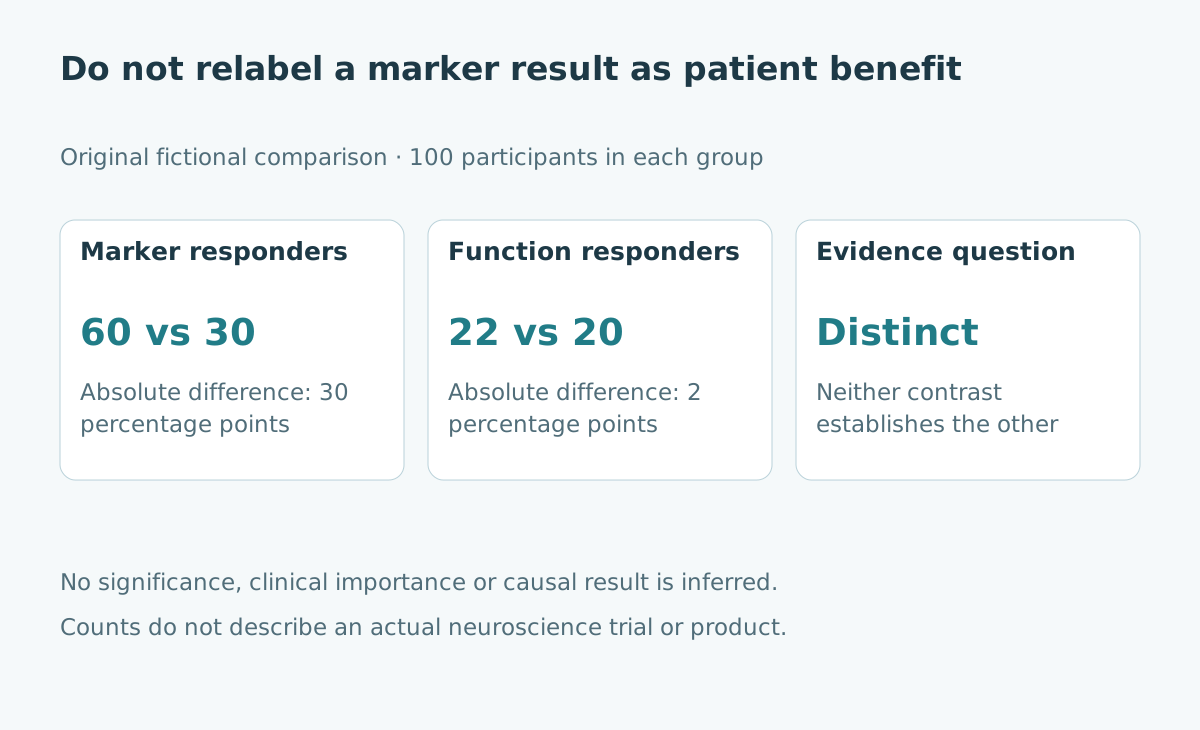
Imagine two groups of 100 participants in a purely invented study. A predefined biomarker response occurs in 60 treated participants and 30 comparison participants. A separately defined patient-function improvement occurs in 22 and 20 participants respectively.
| Synthetic result | Treatment group | Comparison group | Absolute difference |
|---|---|---|---|
| Biomarker responders | 60 / 100 | 30 / 100 | 30 percentage points |
| Function responders | 22 / 100 | 20 / 100 | 2 percentage points |
The biomarker contrast is much larger in this toy dataset. That does not establish whether either difference is statistically persuasive, clinically important or caused by treatment. Study design, uncertainty and the actual definitions still matter.
The lesson is narrower: a result about the marker cannot be reported as if it were the result about function. The two outcomes have different numerators and answer different questions.
Keep absolute and relative changes distinct
In the example, the biomarker-response proportion doubles from 30% to 60%, a 100% relative increase and a 30-percentage-point absolute increase. Function response rises from 20% to 22%, a 10% relative increase and a 2-percentage-point absolute increase.
Both styles of reporting can be correct, but a reader needs the baseline. A relative percentage without counts can make a small absolute difference difficult to see. Also check whether the reported change concerns a continuous measurement, a response threshold or a clinical event rate.
Do not combine these outcomes into one invented success score. Any composite measure needs a stated definition and an explanation of how its components affect interpretation.
Ask about missing outcomes and follow-up
If function is measured for only some participants, the available-case percentage describes that subset. Report the number assigned, the number assessed and the reasons outcomes are missing. Missingness may affect the interpretation, especially when it differs between groups.
Follow-up duration also matters. A marker may change quickly while a patient outcome develops slowly. An early result can justify more investigation without establishing a long-term benefit that has not yet been observed.
Read adverse-event reporting and treatment discontinuation alongside efficacy outcomes. A favorable signal on one measure is not the whole benefit-risk assessment.
Read a development announcement at its actual level
NAIN's announced coordination across FDA centers addresses scientific and regulatory challenges. The existence of a program shows institutional activity and stated goals. It does not establish that a particular company's product meets an approval standard or that a proposed prevention strategy works.
For a product announcement, identify the sponsor, product version, study population, comparator, primary endpoint and regulatory status. Distinguish a research collaboration from a completed trial and a completed trial from marketing authorization.
When those details are absent, say what is missing. A precise statement of uncertainty is more informative than filling the gap with a plausible mechanism.
A practical self-check
A study reports a large improvement in a blood marker but does not report the patient outcome mentioned in its headline. What can you conclude? You can describe the marker result and its study conditions. You cannot independently promote it into demonstrated patient benefit without the supporting evidence.
For the separate question of software changes after deployment, read medical AI update evidence. Measurement, clinical meaning and version-specific evidence all matter, but they should remain distinguishable.
Sources and limits
- FDA: NAIN announcement, October 22, 2026.
- FDA: surrogate endpoint resources: definitions and context of use.
Checked October 23, 2026. All trial counts are fictional and do not describe Alzheimer's research or any actual product. The worksheet is for reading evidence, not choosing personal treatment.