NumPy Indexing: Trace Views, Copies, and Assignment Targets
Understand why slices share data, gathered selections copy, and direct indexed assignment changes the original array.
Reviewed October 9, 2026. Examples target Python 3.12 and NumPy 2.3 and use synthetic integer arrays.
A preprocessing step can unexpectedly modify its input when it receives a slice of an array. Another step can fail to modify that input because it receives a gathered selection instead. Both objects look like ordinary arrays, and both accept assignments. The difference is whether their elements share the original array's data buffer.
This article follows concrete assignments through small arrays. It distinguishes the object returned by an indexing expression from the target of a direct indexed assignment. The examples deliberately use numeric dtypes so that buffer independence is easy to interpret. Object arrays require an additional review of the Python objects stored inside them; copying their slots does not recursively copy those objects.
1. State who owns the working data
A useful preprocessing interface declares whether it modifies its input or returns an independent result. This decision belongs in the function contract, rather than being left to whichever indexing operation happens to appear inside the function. Otherwise callers must inspect implementation details to know whether their raw data remains intact.
For numeric arrays, a view can expose the same stored values through different shape or stride metadata. An independent copy uses a separate data buffer. These are different ownership arrangements even when the arrays initially compare equal. Equality answers a value question; it does not establish whether a later write will be visible elsewhere.
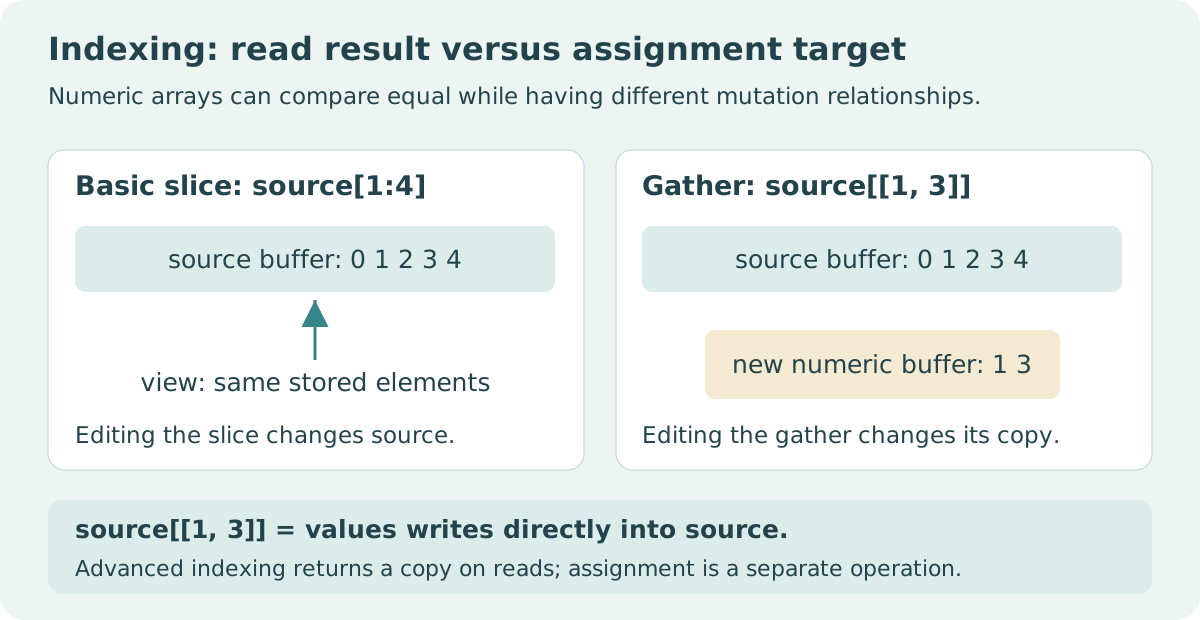
An interface that permits in-place mutation should say so prominently. An interface that promises preservation should create an appropriate working copy at its boundary and test that the input remains unchanged. Neither policy is universally better; the appropriate policy depends on how the array is shared and how much storage the operation can afford.
2. Compare a basic slice with a gathered selection
Basic slicing produces views, while advanced indexing with integer or Boolean arrays produces copies of the selected data. The following fixture tests that distinction with mutations that have unmistakable values. It also checks the numeric arrays directly with np.shares_memory.
import numpy as np

source = np.arange(8, dtype=np.int64)
slice_view = source[1:5]
gathered = source[[1, 3, 4]]
assert np.shares_memory(source, slice_view)
assert not np.shares_memory(source, gathered)

slice_view[0] = 100
assert source[1] == 100
gathered[0] = 999
assert source[1] == 100
assert gathered[0] == 999

independent = slice_view.copy()
independent[1] = -10
assert source[2] == 2
assert not np.shares_memory(source, independent)
np.testing.assert_array_equal(source, [0, 100, 2, 3, 4, 5, 6, 7])
print(source, gathered, independent, sep="\n")
This example separates two reasons an input might remain unchanged. The gathered array was independent when created, while the copied slice became independent because the program explicitly requested a copy. A function receiving either array cannot infer the caller's broader intent from that distinction alone.
| Expression or operation | Relationship for this numeric fixture | Effect of a subsequent write |
|---|---|---|
source[1:5] |
View of source data | Visible through source |
source[[1, 3, 4]] |
Gathered copy | Changes the gathered array |
source[source > 3] |
Boolean-indexed copy | Changes the selected result |
source[1:5].copy() |
Explicit independent copy | Changes the copy |
source[[1, 3]] = values |
Direct assignment to source | Updates indexed source positions |
The final row is an assignment statement, not a claim that advanced indexing returns a view. Keeping reads and assignment targets separate prevents a common false inference.
3. Direct assignment is different from editing a temporary
When the indexing expression is the target of an assignment, NumPy writes into the indexed array. In contrast, storing an advanced-indexed result and editing it changes that gathered result. Chained indexing can conceal which object receives the final assignment, particularly when the first selection creates a temporary copy.
Prefer a single direct assignment when modifying selected positions in an original array. Compute the selection separately if that improves readability, but keep the assignment target explicit. If you want a transformed subset instead, name the subset and return it; that makes its independent lifecycle visible.
import numpy as np

values = np.array([2, 5, 8, 11], dtype=np.int64)
mask = values >= 8
temporary = values[mask]
temporary[:] = 0
np.testing.assert_array_equal(values, [2, 5, 8, 11])

values[mask] = 0
np.testing.assert_array_equal(values, [2, 5, 0, 0])

chained = np.arange(6, dtype=np.int64)
chained[[1, 3, 5]][:] = -1
np.testing.assert_array_equal(chained, [0, 1, 2, 3, 4, 5])
chained[[1, 3, 5]] = -1
np.testing.assert_array_equal(chained, [0, -1, 2, -1, 4, -1])

def centered_copy(array):
    working = np.array(array, dtype=np.float64, copy=True)
    working -= working.mean()
    return working

raw = np.array([1.0, 2.0, 6.0])
before = raw.copy()
centered = centered_copy(raw)
np.testing.assert_array_equal(raw, before)
np.testing.assert_allclose(centered, [-2.0, -1.0, 3.0])
assert not np.shares_memory(raw, centered)
print(values, chained, centered, sep="\n")
The chained assignment runs without raising an exception yet leaves the original array unchanged. The assertion documents the observed contract instead of relying on a warning to catch the mistake. The helper at the end takes the opposite approach: it promises preservation and deliberately establishes independent numeric storage before subtracting the mean.
4. Inspect sharing without mistaking it for a business rule
np.shares_memory answers whether two arrays overlap in memory. For ordinary small fixtures, it is a useful diagnostic that supports a mutation test. More complex stride patterns can make exact overlap determination expensive, so this should not become an unconditional validation step on every large production input without considering its cost.
The base attribute can reveal a relationship to underlying storage, but checking only whether array.base is source is too narrow. A view can be based on another object in a chain, and a reshape can produce a view of an intermediate copy. Use a direct overlap diagnostic or a carefully controlled mutation fixture when the actual relationship matters.
Even perfect knowledge of memory overlap does not establish whether modification is allowed. Two functions may share storage intentionally, or one may have a read-only obligation. Document the ownership rule independently of the diagnostic so the code remains understandable when its implementation changes.
5. Review reshape and object arrays separately
Reshaping may create a view when the existing arrangement permits it or a copy when it does not. A transpose followed by a reshape is therefore not a dependable declaration of independent ownership. If independence is required, request it explicitly; if avoiding a copy is required, verify that condition using an appropriate supported interface and an actual representative layout.
For object dtype, array copying separates the storage of object references, but the referenced Python objects can still be shared. A list stored in one cell can remain the same list in both arrays. This is why a numeric ownership example should not be presented as proof that arbitrary nested records are deeply independent.
Consider converting structured records into suitable numeric columns when the calculation is numerical. If object arrays are necessary, define whether the objects themselves are immutable, shared intentionally, or copied by another mechanism. The correct choice depends on those objects' behavior, rather than on NumPy's numeric-buffer rules alone.
6. Account for retention and allocation
A small view can keep a much larger underlying allocation alive. That can be desirable when the original data will be reused, but surprising when a small subset is retained for a long-running job. An explicit copy of that subset can establish a smaller independent allocation, after all other references to the original buffer are released.
The reverse tradeoff also matters. Repeatedly gathering large selections allocates additional buffers, and preserving every result can increase memory use. Decide whether the application needs a complete selected array or can process a smaller region and immediately reduce it. Measure representative usage before turning either copying or viewing into a universal performance recommendation.
These examples establish relationships, not timing or peak-memory measurements. Their small sizes make expected behavior easy to audit. Real workloads add dtype width, layout, selection size, intermediate arrays, and the lifetime of references to the memory question.
7. Test the boundary rather than the syntax alone
For a function promising preservation, save an input snapshot, call the function, and compare the original with the snapshot. Also test an input that is itself a slice of a larger array. That catches implementations that appear harmless with an independent input but alter a caller's parent array through a view.
For an in-place function, test exactly which positions should change and which should remain fixed. Include a non-contiguous slice and a Boolean selection where appropriate. Do not rely on equal initial values, because a wrong target can escape detection when all values look the same.
A reliable review can explain the assignment target, the selection rule, the sharing relationship, and the lifetime of the result. Once those are explicit, indexing becomes a controlled data transformation rather than a hidden source of mutation.
Primary sources
- NumPy 2.3 copies and views: data buffers, views, copying, and reshape behavior.
- NumPy 2.3 indexing guide: basic versus advanced indexing and assignment.
- NumPy 2.3
shares_memory: overlap testing and complexity limitations.