The October 2026 PHP Security Update: Verify the Runtime, Not Just the Website
Understand the October 21 PHP security fixes and build a remediation record that distinguishes installed packages, running workers, hosting responsibility and recovery.
A website administrator sees that the content management system is up to date and closes a security ticket. The server's PHP runtime may still be a separate component with a separate update process. The application's dashboard and the environment executing its requests do not necessarily move together.
That distinction matters after the PHP project's October 21, 2026 security advisory. The project released fixes for two critical vulnerabilities that can allow unauthenticated remote code execution. This guide summarizes the dated official notices and develops an original evidence worksheet for site owners and operations teams.
The purpose is defensive remediation. It does not provide exploit steps, establish that a particular site has been compromised, or imply that Noetrion itself uses PHP. Check current vendor notices before acting because release and package information can change.
What the official advisory establishes
PHP identifies CVE-2026-109618 and CVE-2026-109619 as critical issues affecting installations serving web requests. Its advisory lists PHP-FPM, Apache mod_php and other deployment modes, with particular concern for the demonstrated mod_php case. The published upstream fixes are:
| Supported upstream branch | Fixed release announced October 21 |
|---|---|
| PHP 8.5 | 8.5.12 |
| PHP 8.4 | 8.4.27 |
| PHP 8.3 | 8.3.36 |
| PHP 8.2 | 8.2.35 |
The project says older branches do not receive PHP-project updates and notes that distributions or long-term-support vendors may provide backported fixes. Therefore an upstream version number is one part of the evidence, not the complete answer for every vendor-managed package.
WordPress's notice clarifies that these issues are not WordPress-specific and that no WordPress update is required or planned for them. It directs site owners to check their PHP environment and hosting provider. Updating themes or plugins alone does not establish that the runtime fix is installed.
Start with a system inventory
An organization can have public sites, internal applications, scheduled jobs and appliances that bundle a runtime. Build an inventory with a named owner and an exposure assessment. Do not assume the main website represents every installation.
For managed hosting, ask the provider which service was updated and what evidence confirms it. For self-managed infrastructure, connect each deployed service to its package or image source and the process that runs it. A ticket without an affected system identifier is hard to audit later.
| Evidence field | Example question |
|---|---|
| Service and owner | Who can approve and verify changes? |
| Runtime location | Host package, container, managed platform or bundled product? |
| Exposure | Does it handle web requests, and through which path? |
| Fix authority | Which vendor advisory applies to this build? |
| Running state | Which build is actually serving traffic? |
| Recovery evidence | Have representative service checks passed? |
Avoid publishing sensitive environment diagnostics on a public page. Gather the required information through authenticated administration tools and retain it in the organization's normal operational record.
Separate installed from running
A successful package transaction shows that files were changed. It does not alone show that every relevant worker now uses the corrected build. Long-lived processes, multiple hosts and old container replicas can leave a mixed environment.
Use the service manager or platform's documented rollout procedure and verify the serving instances. The correct procedure depends on the deployment; do not copy an arbitrary restart command from an unrelated stack. Confirm that traffic reaches the updated instances rather than a forgotten pool.
Similarly, a command-line PHP version may describe a different binary or configuration from the web runtime. Compare the actual request-serving environment with the vendor-confirmed fixed build. If the provider backported a patch, retain its package revision and advisory rather than declaring failure solely from the upstream-looking number.
Follow the mitigation decision, not a generic checklist
The UK NCSC notice recommends identifying affected systems, applying vendor updates and following the PHP team's hardening and temporary-mitigation guidance. Where timely remediation or mitigation is not feasible, it says organizations should consider taking the system offline. It also addresses assessing evidence of compromise when immediate update or disabling is not possible.
Those actions require an accountable operational decision. A temporary control should have an owner, a verification method and an expiry condition. Record whether it is a vendor-supported mitigation or a local risk-reduction measure whose coverage is uncertain.
A web application firewall may be useful in a provider's response, but the presence of a rule is not equivalent to installing a runtime fix. Ask which protection applies to the actual route and what remains to be completed.
Work a small completion example
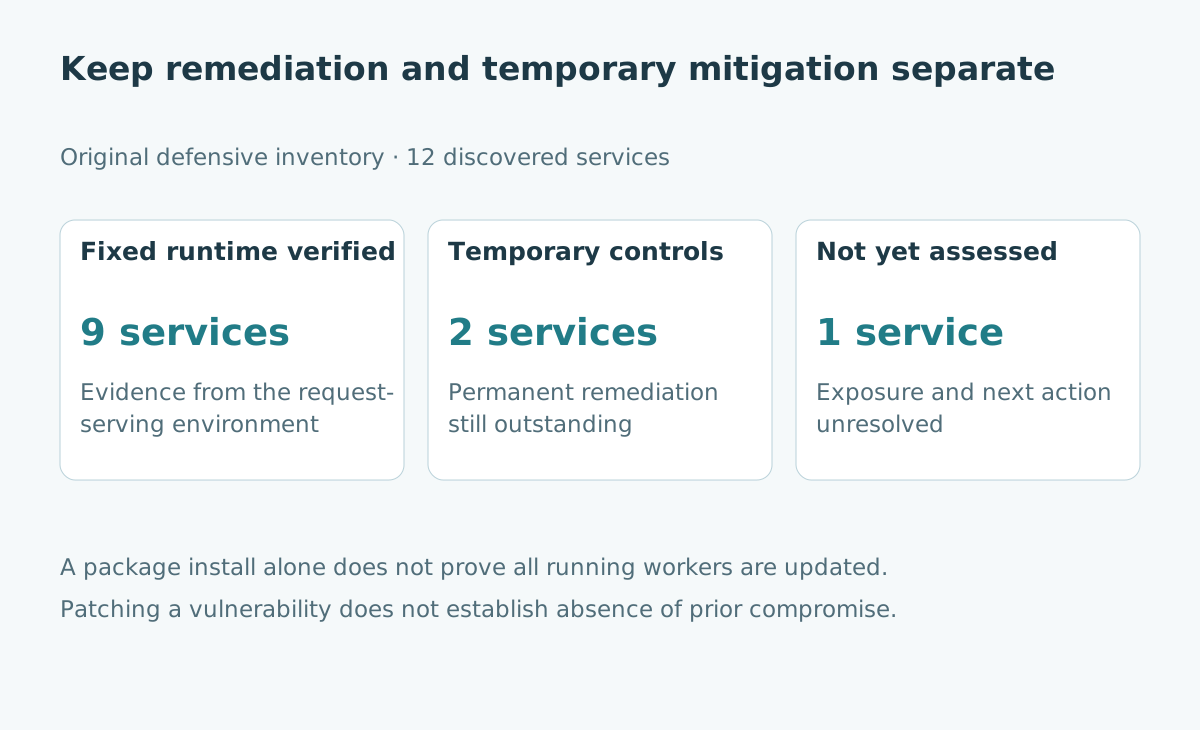
Suppose an invented organization discovers twelve PHP-backed services. By the end of the first review, nine have verified corrected runtimes, two have documented temporary controls, and one is unassessed. Calling this “eleven fixed” would erase the difference between remediation and mitigation.
| Original inventory status | Services | Accurate wording |
|---|---|---|
| Fixed runtime verified | 9 | Remediation verified for identified instances |
| Temporary control recorded | 2 | Mitigated pending permanent action |
| Not yet assessed | 1 | Exposure and action remain unresolved |
| Total discovered | 12 | Inventory may still expand |
The figures are synthetic. They illustrate why a progress report should retain distinct states. Discovery coverage is another question: twelve completed records do not establish that there were only twelve systems in the organization.
Verify service recovery and preserve evidence
After the deployment, run representative application checks: sign-in, a read operation, an authorized write operation and relevant background processing. Use test accounts and ordinary change procedures. A home page returning a success status does not demonstrate that checkout or an administrative task still works.
Keep timestamps, affected instances, package or image identity, vendor references and the person or process that verified completion. Record remaining exceptions. This makes a later question answerable without reconstructing a rushed response from chat messages.
A rollback plan also needs a security boundary. Restoring an old vulnerable image may restore availability while reintroducing exposure. Decide the recovery route with the security and service owners, rather than treating any previous working build as automatically acceptable.
Do not confuse patching with incident closure
A patch addresses a known vulnerability in the updated environment. It does not establish that no attacker used the earlier environment. If evidence indicates compromise, incident response can require containment, investigation and recovery beyond installing the fix.
Preserve relevant logs under the organization's procedures and involve qualified responders where needed. Do not assert that a site is clean merely because a scan returned no finding or because the application appears normal.
For a related dependency skill, read Python package provenance. Different ecosystems use different tools, but both require identifying the exact component and understanding what the available evidence proves.
Sources and scope
- PHP official security advisory, October 21, 2026: affected deployments and fixed upstream releases.
- WordPress official notice, October 21, 2026: distinction between WordPress and its PHP runtime.
- UK NCSC: critical security issue affecting PHP: remediation, temporary controls and response priorities.
Checked October 22, 2026. The inventory example and evidence workflow are original. This article is not a security assessment of any named site's infrastructure.