Decimal in Python: Make Numeric Boundaries and Rounding Policies Explicit
Understand decimal versus binary representation, explicit rounding, finite-value validation, and reproducible invoice arithmetic without hiding policy choices.
Reviewed October 6, 2026. Examples use Python 3.12.14. Invoice values are synthetic arithmetic fixtures. The rounding policy is an example contract, not accounting, tax, or jurisdiction-specific guidance.
Two systems receive the same decimal price and produce totals that differ by a cent. One rounded every line, the other rounded after summing. A developer switches from float to Decimal and expects the disagreement to disappear. It does not: representation and rounding policy are different parts of the calculation.
Decimal is useful when decimal input and explicitly controlled rounding belong to the task. It does not decide where rounding happens, which rule is correct for a business process, or how a currency is represented externally. Those choices must be documented and tested against the system's actual requirements.
Practical rule: preserve decimal text until a deliberate conversion, reject unsupported numeric values, choose precision and rounding explicitly, and test both intermediate values and final totals. Never treat a tidy two-decimal display as evidence that the underlying computation followed your intended policy.
Start at the input boundary
Binary floating-point represents many familiar decimal fractions approximately. That is a property of the representation, not a general defect making floats unsuitable for all numerical work. Scientific calculations often use floats appropriately while tolerances and numerical conditioning receive explicit attention.
The Python floating-point tutorial explains why displayed decimal text can hide the exact binary value. Constructing Decimal from a float converts that existing value; it does not recover the original decimal intent automatically.
from decimal import Decimal

from_text = Decimal("0.1")
from_float = Decimal(0.1)
assert from_text != from_float
assert Decimal("0.1") + Decimal("0.2") == Decimal("0.3")
print("Decimal text:", from_text)
print("Existing binary float:", from_float)
If an API supplies prices as decimal strings, parse those strings directly. If it already supplied a binary float, you need a stated reconstruction policy; wrapping the float with str may produce a convenient decimal spelling, but it is a new interpretation rather than proof that every original digit was preserved.
For integer minor-unit storage, you also need a scale contract. A field called amount=1250 is ambiguous without a unit, and not every currency or domain has the same fixed decimal scale. The lesson is to carry unit and representation together rather than declaring one universal storage strategy.
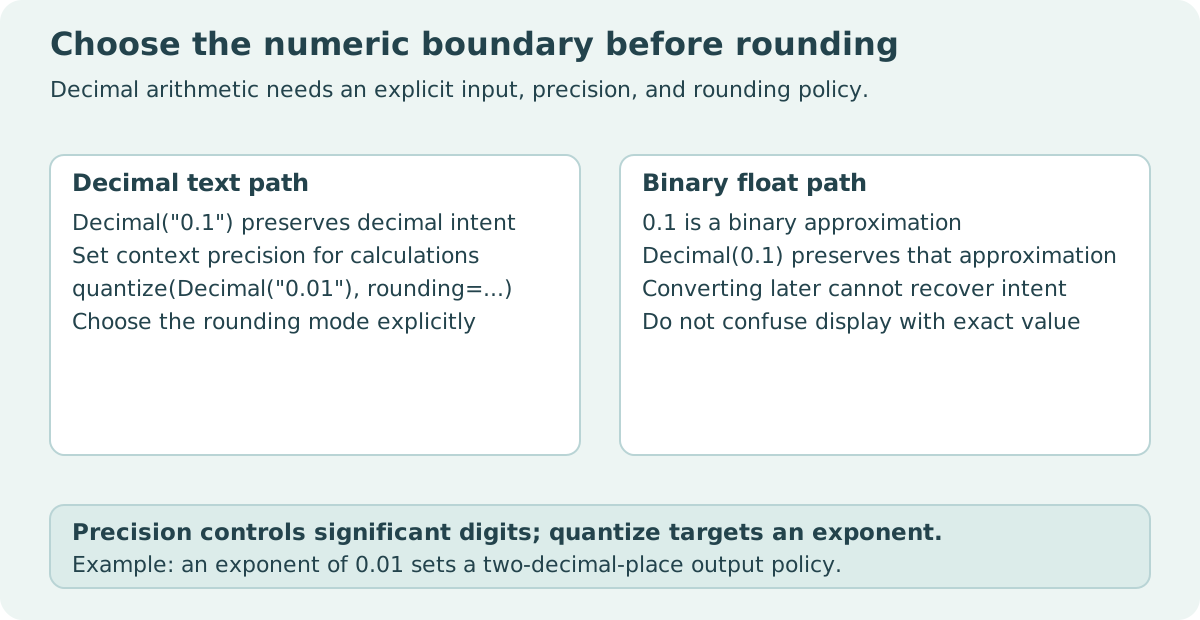
Quantize specifies an exponent and a rounding rule
Quantize returns a value with the exponent of another Decimal. A quantum of Decimal("0.01") expresses two decimal places. It is not a general instruction to round to any arbitrary multiple: quantizing to Decimal("0.05") still concerns its exponent, not necessarily a five-cent increment.
A rounding rule resolves ties and other discarded digits. ROUND_HALF_EVEN and ROUND_HALF_UP differ at particular midpoints. Choose one deliberately instead of relying on ambient context that another component might change.
from decimal import Decimal, ROUND_HALF_EVEN, ROUND_HALF_UP

quantum = Decimal("0.01")
assert Decimal("2.345").quantize(quantum, rounding=ROUND_HALF_EVEN) == Decimal("2.34")
assert Decimal("2.345").quantize(quantum, rounding=ROUND_HALF_UP) == Decimal("2.35")
assert Decimal("2.355").quantize(quantum, rounding=ROUND_HALF_EVEN) == Decimal("2.36")
assert Decimal("-2.345").quantize(quantum, rounding=ROUND_HALF_UP) == Decimal("-2.35")
print("Tie behavior is part of the calculation contract")
| Value | Half even to 0.01 | Half up to 0.01 |
|---|---|---|
| 2.345 | 2.34 | 2.35 |
| 2.355 | 2.36 | 2.36 |
| -2.345 | -2.34 | -2.35 |
Half up moves an exact tie away from zero. Calling it “always upward” would misdescribe negative numbers. The table is derived from these rules and fixtures, not from an external pricing dataset.
The point of rounding changes the result
Consider three lines whose unrounded amounts are each 0.335. Under our example policy, half-up rounding applies to each line before their rounded values are summed. Another system rounds only the combined unrounded total. Both use Decimal and the same tie rule, yet their results differ.
from decimal import Decimal, ROUND_HALF_UP, localcontext

lines = [Decimal("0.335")] * 3
with localcontext() as context:
    context.prec = 28
    rounded_lines = [value.quantize(Decimal("0.01"), rounding=ROUND_HALF_UP)
                     for value in lines]
    line_total = sum(rounded_lines, Decimal("0.00"))
    final_total = sum(lines, Decimal("0.00")).quantize(
        Decimal("0.01"), rounding=ROUND_HALF_UP)
assert line_total == Decimal("1.02")
assert final_total == Decimal("1.01")
print("Round each line:", line_total)
print("Round only the total:", final_total)
| Calculation policy | Intermediate work | Total |
|---|---|---|
| Round each line first | 0.34 + 0.34 + 0.34 | 1.02 |
| Sum first, then round | 1.005 becomes 1.01 | 1.01 |
A reconciliation function must therefore compare policies before blaming floating-point representation. Include discounts, taxes, conversions, and allocation steps in the written calculation order if they belong to your application. This article deliberately stops at the simplified three-line contract.
Local context confines precision changes to a block. Precision concerns significant digits in operations; it is not the same setting as two displayed decimal places. A very small precision can cause earlier arithmetic rounding, while quantize can signal InvalidOperation if the resulting coefficient exceeds the permitted precision. Setting precision once does not make every possible input safe.
Reject unsupported values before arithmetic
Decimal accepts special values such as NaN and Infinity. Those values are meaningful in some numerical contexts but violate our finite, nonnegative price contract. Check finiteness before ordering a value; some comparisons involving NaN can signal an exception rather than return an ordinary false result.
from decimal import Decimal, InvalidOperation

def parse_price(text):
    if not isinstance(text, str) or not text.strip():
        raise ValueError("price must be nonempty decimal text")
    try:
        value = Decimal(text.strip())
    except InvalidOperation as error:
        raise ValueError("price is not valid decimal text") from error
    if not value.is_finite() or not Decimal("0") <= value <= Decimal("1000000"):
        raise ValueError("price must be finite and between 0 and 1000000")
    return value

assert parse_price(" 0.00 ") == Decimal("0.00")
assert parse_price("12.50") == Decimal("12.50")
for bad in ["", "oops", "NaN", "Infinity", "-1", "1000001", 12.5]:
    try:
        parse_price(bad)
    except ValueError:
        pass
    else:
        raise AssertionError("Invalid price accepted")
print("Input representation and value domain checked")
The parser accepts Decimal's ordinary textual grammar, including suitable exponent notation. A contract requiring exactly two fractional digits or prohibiting exponent notation needs an additional syntax rule. Separating grammar from value range makes that decision visible rather than accidentally changing it through formatting.
The upper bound is a teaching limit, not a universal financial maximum. Establish meaningful bounds for the actual application and test arithmetic near them. Decimal is flexible enough to accept enormous exponents; accepting arbitrary inputs without a resource policy is a different problem from computing the sample invoice.
Preserve the contract across serialization
JSON's standard Python encoder does not serialize Decimal directly. Converting every value to float can undo the representation choice you made at the beginning. A common explicit boundary is a decimal string plus a documented unit and scale policy; another is bounded integer minor units where that representation is appropriate.
Compare numeric equality separately from presentation. Decimal values can compare equal while carrying different exponents, which can matter for display or a field's declared scale. A round-trip test should verify both the value contract and the promised external representation.
For downstream systems, document whether rounding is already applied and whether a displayed amount is an intermediate or authoritative final result. Otherwise, a consumer might round again, convert units twice, or incorrectly sum a formatted report as if it were the original data.
A useful test matrix
Test positive and negative ties for the chosen rule, a value just below and above a tie, zero, nonfinite values, unsupported input types, and the three-line disagreement. If the application never permits negative amounts, still test rejection rather than assuming the parser cannot produce them.
Then test calculation order using hand-checked expected results. A comparison of the function to itself, or to the same formula copied into a test, offers little independent evidence. The two policies above are intentionally different, so their one-cent gap becomes a fixture documenting why the order matters.
Sources and reproducibility
Primary references: Python decimal, floating-point representation, and JSON encoding. All four examples are independently runnable. The arithmetic, limits, and rounding point are explicitly scoped sample policies.