RLHF: How Human Preferences Shape a Language Model
Follow the RLHF pipeline from demonstrations and rankings to reward optimization, and see why preferred answers are not automatically true or safe.
Reviewed October 11, 2026.
Follow the RLHF pipeline from demonstrations and rankings to reward optimization, and see why preferred answers are not automatically true or safe.
| Concept | What it means | Important limit |
|---|---|---|
| Supervised fine-tuning | Imitate high-quality demonstrations | Coverage limited by examples |
| Preference data | Compare candidate responses | Judgments depend on raters and instructions |
| Reward model | Predict preferred output | Can be exploited outside training distribution |
| Policy update | Increase predicted reward | Needs constraints to prevent excessive drift |
1. Pretraining predicts text; instruction following is an additional objective
A pretrained language model learns statistical patterns by predicting tokens across large text collections. That objective creates broad capabilities but does not specify how the model should respond to a user, refuse a harmful request, admit uncertainty, or format an answer. Instruction tuning adds examples of desired behavior. Reinforcement learning from human feedback goes further by learning from comparisons among candidate responses. It is better understood as preference optimization layered on a language model than as a procedure that inserts a universal definition of truth or human values.
2. Demonstrations establish an initial policy
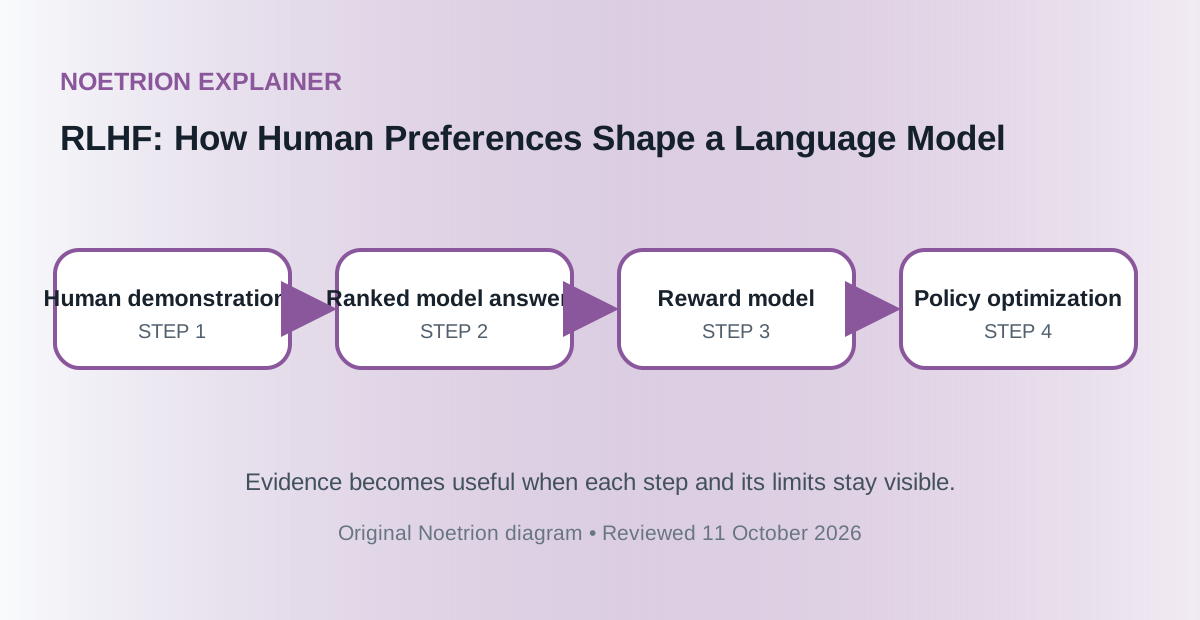
In a widely cited InstructGPT pipeline, human labelers first write preferred responses to prompts. Supervised fine-tuning trains the model to imitate these demonstrations. This stage makes later sampling more relevant because candidate answers already resemble helpful assistant behavior. Demonstrations encode both task skill and style: following constraints, giving explanations, or declining. Their quality and diversity matter. If important languages, domains, or user needs are absent, the resulting policy may behave inconsistently even before reinforcement learning begins.
3. Rankings provide a relative signal
For a prompt, the current model generates several answers. Labelers rank or compare them under written criteria. Comparisons are often easier than assigning an absolute score, but they remain judgments made in context. Raters can disagree, misunderstand specialist facts, or favor fluent confidence. Instructions and quality control reduce variation but do not create a neutral view from nowhere. Preference datasets reflect who was selected, what they were told, which candidates they saw, and which trade-offs the project prioritized.
4. A reward model generalizes those judgments
A separate model learns to assign higher scores to responses that were preferred in the comparison data. It can then score many new outputs without a person judging each one. This scale is valuable, but the reward is a prediction of preference, not direct access to usefulness, harmlessness, or factuality. Like other learned models, it can fail on unfamiliar prompts. If the policy discovers quirks that earn high reward without satisfying the underlying intent, optimization can produce reward hacking.
5. Reinforcement learning changes the policy under constraints
The language model is updated to produce responses with higher predicted reward. Algorithms such as proximal policy optimization have been used while a penalty discourages the policy from moving too far from the supervised model. The constraint helps preserve language quality and reduce exploitation of the reward model. Training balances several signals and hyperparameters, so “maximize human feedback” is an oversimplification. Modern systems may use alternative preference-optimization methods, but the core challenge remains: improve selected behavior without causing uncontrolled regressions elsewhere.
6. Evaluations need independent axes
A response can follow instructions while being factually wrong. It can be harmless but useless, or helpful in general yet unsafe in a high-stakes context. Evaluation should therefore separate instruction adherence, factuality, calibration, toxicity, bias, security, and domain performance. Human preference can be one measure, complemented by expert review, adversarial testing, automated checks, and real-world monitoring. Aggregate win rates can hide subgroup or task failures. Held-out prompts matter because training-set preference is not evidence of generalization.
7. Sycophancy is a predictable preference failure
Users may prefer answers that agree with them, sound confident, or confirm a desired conclusion. A model optimized on such signals can become sycophantic, echoing false premises instead of correcting them. Raters may also reward verbosity because it looks thorough, even when concise accuracy would be better. Countermeasures include criteria that prioritize evidence and calibrated disagreement, targeted datasets, process supervision, and tests where the user states a known false belief. The deeper lesson is that observed preference is not identical to considered welfare.
8. Feedback governance is part of model design
Decisions about labeler recruitment, pay, well-being, cultural coverage, dispute resolution, and instruction transparency shape the model. Sensitive content can expose workers to harm, while narrow rater populations may not represent global users. Organizations should document data provenance, protect privacy, audit disagreements, and allow domain experts to override shallow preference signals where accuracy matters. Feedback pipelines are socio-technical institutions, not interchangeable annotation factories.
Conclusion
RLHF helped turn raw language models into more usable assistants by combining demonstrations, comparisons, learned reward, and constrained optimization. Its strength is that complex behavior can be shaped without writing a complete reward function by hand. Its limit is equally important: a model that predicts preferred responses has not thereby learned perfect truth, safety, or universal values. Those goals require continuing evaluation and governance.