Swift's Address Deadline Was Deferred: Build a Beneficiary Data Worksheet Now
Reconcile Swift's deferred address migration with older November guidance, then audit beneficiary records using a practical worksheet and Python checks.
Educational analysis, not a personal investment or payment recommendation. Check the dated sources and the rules that apply in your jurisdiction.
A payment team can make two costly mistakes after a deadline changes: keep repeating the old date, or stop improving the data until a replacement arrives. Swift's structured-address migration currently calls for a different response. Update the timetable in your change register, while continuing to find beneficiary records whose town and country cannot be reliably identified.
The status below was checked on October 14, 2026. The worksheet and examples are original implementation suggestions, not a Swift certification procedure.
What changed, and which date remains unsettled
Swift's August 27 announcement, updated September 21, defers payments changes under Standards Release 2026. For structured addresses, Swift says it will consult on timing and approach and provide an update by December at the latest. That announcement does not establish a replacement structured-address cutoff.
The September update gives June 12, 2027 for a specified deferred release: MT messages excluding Category 1, ISO 20022 securities and funds messages, Tracker messages, and exceptions and investigations messages. Do not transfer that date to structured addresses simply because both changes appear on the same page.
| Information encountered | Correct use in an October 14 change register |
|---|---|
| May 28 article says unstructured addresses end after November 14, 2026 | Record as the previous timetable, superseded for this migration by the later deferral announcement |
| August 27 announcement defers payments changes | Current public status for the payments migration |
| September 21 update specifies June 12, 2027 | Apply only to the release scope explicitly listed |
| Address timing update promised by December | Monitoring milestone; it is not an implementation date |
Why older official pages still need a date check
The May 28 call to action still displays the November 14 timetable. Swift's address-format resource also retains November wording. Those pages remain useful for format explanations, but their deadline wording must be read alongside the newer announcement.
This is a source-reconciliation problem, not a reason to discard all earlier documentation. A technical specification may still explain how to populate a field while a later release notice changes when a requirement becomes mandatory. Keep separate columns for “format rule,” “release status,” and “source checked date.” Otherwise an analyst correcting one calendar field can accidentally remove a valid mapping rule.
Assign one owner to check the announcement and your bank's implementation notices. Preserve the URL and dated evidence behind every schedule change. A calendar entry without scope is especially dangerous when several message families share a release name. Domestic infrastructure and bank-channel readiness also need their own confirmation; a public Swift announcement does not answer every local rollout question.
Structured fields solve a different problem from prettier text
Under the format descriptions in Swift's address resource, both fully structured and hybrid addresses require separate town and country elements. Fully structured addresses exclude address lines; hybrid addresses allow up to two address lines of 70 characters each, alongside the required structured elements.
Consider the synthetic legacy record “8 Orchard Road, Kingston.” Reformatting its capitalization does not establish a country. A parser that confidently chooses one Kingston creates an apparently complete record from an unresolved ambiguity. Likewise, copying a supplier's bank country into its operating address can conflate two different facts.
Treat extraction as a proposal. Preserve the source, show the proposed fields, and record how an authorized owner verified them. The aim is to make each payment field traceable to a supported fact. A tidy database containing guessed countries can be harder to repair than a clearly marked queue of incomplete records.
Build a worksheet that measures repairability
Start with active beneficiaries and retain a stable record identifier. Include inactive records separately so a large archive does not disguise problems among suppliers paid every week. Do not place real account details in a public example or development fixture.
| Worksheet field | Synthetic example | Purpose |
|---|---|---|
| Beneficiary ID | SUP-104 | Join repairs back to the correct master record |
| Original address | 8 Orchard Road, Kingston | Preserve evidence before transformation |
| Town | Kingston | Capture an explicit proposed field |
| Country code | blank | Expose the unresolved country |
| Address lines | [8 Orchard Road] | Preserve permitted residual text for a hybrid mapping |
| Source and verification | Supplier onboarding form; pending | Distinguish collected data from verified data |
| Issue, owner, next action | Missing country; procurement; request clarification | Turn failure into assigned work |
| Bank test result | Not submitted | Keep source quality separate from transmission success |
A useful status vocabulary is “needs source,” “needs review,” “ready for bank test,” and “tested.” Avoid a single “compliant” column before you know which bank-channel rules and message usage guidelines apply. Add last verification date when suppliers move or reorganize, and keep change history when the approved address changes.
Use Python to find obvious defects without guessing facts
This small validator checks a proposed hybrid-address worksheet, not a complete ISO 20022 message. Its country set is deliberately limited to the synthetic fixture. Production code needs an authoritative country-code list, relevant message rules, and secure handling of source data.
KNOWN_COUNTRIES = {"GB", "BE", "SG"}  # fixture only

def issues(row):
    result = []
    town = row.get("town")
    country = row.get("country")
    lines = row.get("address_lines", [])
    if not isinstance(town, str) or not town.strip():
        result.append("missing_town")
    if not isinstance(country, str) or country not in KNOWN_COUNTRIES:
        result.append("country_needs_review")
    if not isinstance(lines, list):
        result.append("lines_not_list")
    elif len(lines) > 2 or any(
        not isinstance(x, str) or len(x) > 70 for x in lines
    ):
        result.append("invalid_hybrid_lines")
    return result

good = {"town": "London", "country": "GB",
        "address_lines": ["12 Example Street"]}
ambiguous = {"town": "Kingston", "country": "",
             "address_lines": ["8 Orchard Road"]}
assert issues(good) == []
assert issues(ambiguous) == ["country_needs_review"]
assert "country_needs_review" in issues({**good, "country": []})
assert "missing_town" in issues({"town": " ", "country": "BE"})
assert "invalid_hybrid_lines" in issues({**good, "address_lines": ["x" * 71]})
Passing these checks means only that the fixture's required fields and line dimensions passed. It does not prove that London is the correct town, that the country matches the beneficiary, or that XML generated elsewhere preserves the values. Python's string length is also not a substitute for the channel's character-set and encoding validation. Keep those checks in the next testing layer.
Work a repair queue before promising readiness
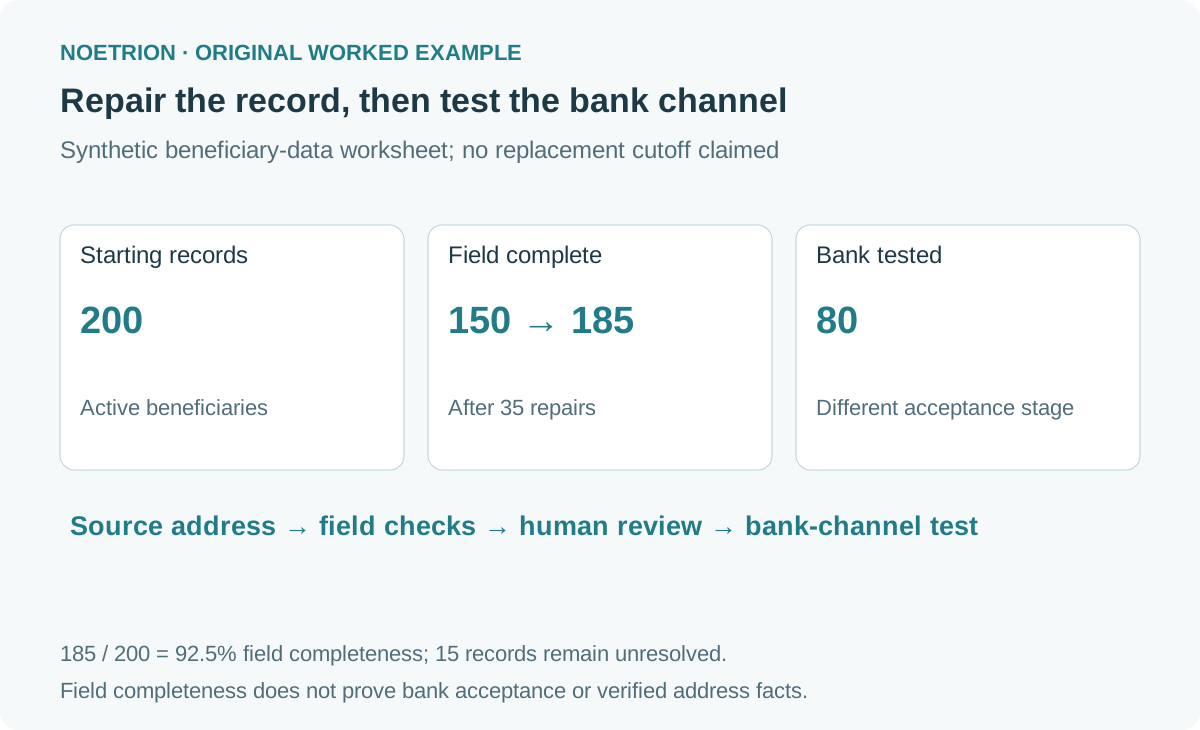
Suppose a synthetic export contains 200 active beneficiaries. Initial review finds 150 records with explicit town and country fields, 30 with town but no reliable country, and 20 with neither. The first worksheet pass therefore identifies 50 records requiring source work: 25% of the active population.
After contacting owners, 35 of those 50 records are verified and repaired. There are now 185 field-complete records and 15 unresolved records. The resulting 92.5% completeness rate is useful, but it is not a payment acceptance rate. If only 80 records have passed bank-channel tests, reporting “92.5% ready” combines two different milestones.
Prioritize the remaining queue by payment frequency and upcoming due dates. A low-volume beneficiary with a payment tomorrow can matter more than a high-volume supplier paid next quarter. Count rejected or manually repaired transactions separately from master-data defects, so you can see whether the same records keep returning to operations.
Test the entire route that the address travels
A corrected master record can still lose structure in a file export, middleware transformation, or bank upload form. Follow one approved synthetic record through every handoff and inspect the outbound representation. Then test boundary cases: missing town, unknown country, a third hybrid line, long text, and non-ASCII characters supported by the relevant channel.
Ask the bank which test environment, usage guideline version, and response codes apply. Capture both accepted and rejected results. A rejected fixture is valuable when it proves an invalid record cannot silently enter the live queue. Reconcile the bank's interpreted fields with the approved worksheet, rather than checking only that a file upload succeeded.
For further data-control practice, see Python validation and errors. The same principle applies here: validation should name the failed assumption and leave a record that a person can resolve.
Use the extension to remove uncertainty from records
The immediate deliverable is a dated schedule register plus a repair queue with owners, evidence, and test results. Keep the old November date visibly marked as superseded, leave the replacement address cutoff unresolved, and watch for Swift's promised update. Continue improving beneficiary data because those improvements can be reviewed now, independently of a future calendar announcement.
Primary sources, checked October 14, 2026:
- Swift: migration extension, August 27; updated September 21, 2026.
- Swift: May 28 call to action, previous timetable.
- Swift: structured and hybrid address formats, read with the later release announcement for dates.