A Text Watermark Is a Provenance Signal, Not a Verdict About the Writer
Read October 2026 text-watermark announcements without treating detection as proof of authorship, accuracy or misconduct. Follow an original base-rate example.
A detector flags a passage, and someone concludes that its named author did no work. Another passage receives no flag, and a reviewer declares it entirely human-written. Both conclusions ask a technical signal to answer a broader question than it measures.
On 5 October 2026, OpenAI described its approach to text provenance, including opt-in API watermarking for selected models, a phased introduction for eligible EU ChatGPT and Codex output, and initially restricted detector access. Those are the announcement's scope and rollout terms, checked here on 27 October. The page does not establish that every eligible output has already been covered or that every reader can access a public detector.
The distinction matters beyond one provider. A provenance signal can help investigate how content was produced. It does not, by itself, establish human contribution, factual reliability or whether a particular policy was breached.
Ask which claim is being tested
“Generated with AI,” “contains this provider's watermark,” “written without permission,” and “factually incorrect” are different claims. A tool designed to detect one signal does not automatically measure the others.
The OpenAI page explicitly separates detection from ownership, user identity, accuracy and the amount of human contribution. It also says that absence of a detected watermark does not establish human authorship. Preserve those distinctions when explaining a result to someone affected by it.
A responsible review begins with the actual question. If the question concerns compliance with an assignment's permitted tools, inspect the stated rule and relevant process evidence. If it concerns factual accuracy, inspect the claims and sources.
Distinguish a watermark from general classification
Watermarking adds a signal during generation. A detector then looks for that signal. This differs from a classifier that estimates whether text resembles generated writing without checking a deliberately embedded marker.
NIST's 2024 synthetic-content transparency report discusses watermarking, provenance metadata and detection as related but distinct approaches, with technical limitations. It provides a foundation for asking what evidence each approach can supply, rather than treating every “AI detector” label as the same instrument.
Before using a result, identify the tool, version, supported content, threshold and output meaning. A numerical score without those details is difficult to interpret or reproduce.
Separate two kinds of detection error
A false positive flags a passage that does not have the target signal. A false negative misses a passage that does. Sensitivity describes the proportion of target-positive passages detected; the false-positive rate describes flags among target-negative passages.
Neither is the same as the proportion of flags that are correct. That last quantity also depends on how common the target signal is in the population being reviewed.
| Question | Relevant denominator |
|---|---|
| How many watermarked passages were detected? | All genuinely watermarked passages |
| How many unwatermarked passages were flagged? | All genuinely unwatermarked passages |
| How many positive flags were correct? | All positively flagged passages |
Keeping the denominators visible prevents a good-looking rate from being transferred to a different question.
Work a low-prevalence example
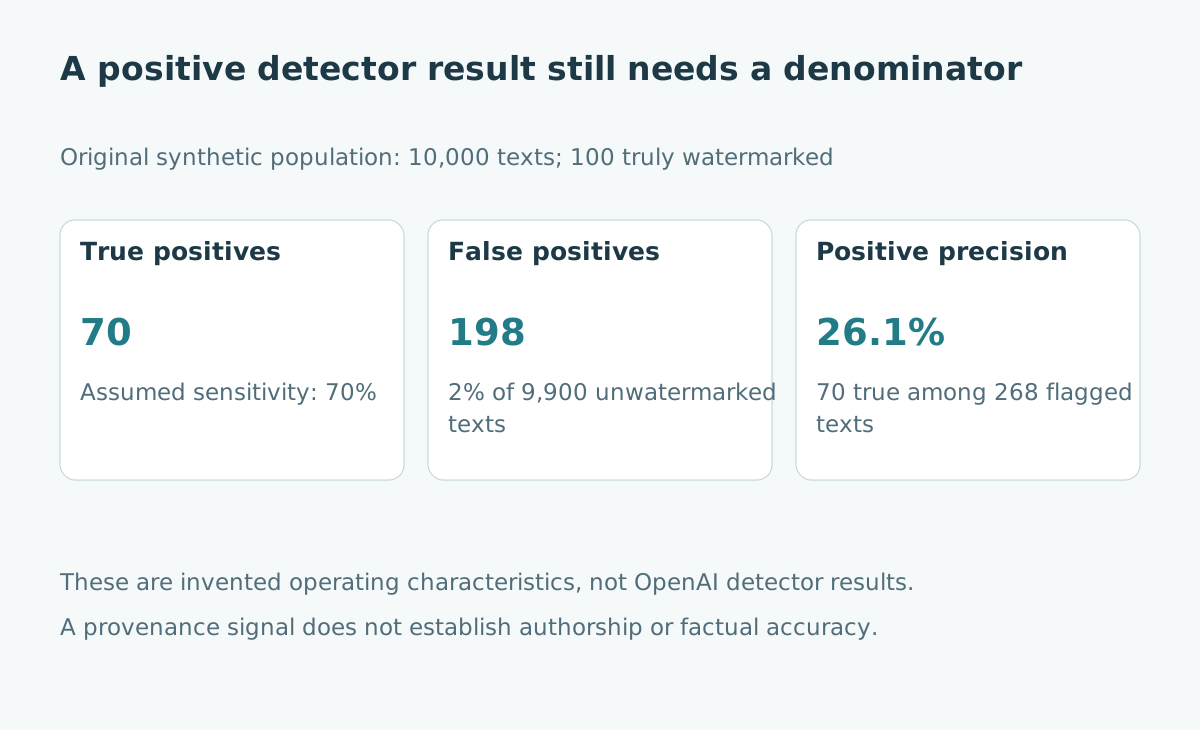
Imagine 10,000 fictional passages, of which 100 carry the target watermark and 9,900 do not. Assume an imaginary detector identifies 70% of watermarked passages and incorrectly flags 2% of unwatermarked passages.
It finds 70 true positives and misses 30 watermarked passages. It also produces 198 false positives, because 2% of 9,900 is 198. There are therefore 268 positive flags in total.
| Original audit category | Passages | Interpretation |
|---|---|---|
| True positives | 70 | Target signal present and flagged |
| False positives | 198 | Target signal absent but flagged |
| False negatives | 30 | Target signal present but missed |
| True negatives | 9,702 | Target signal absent and not flagged |
Only 70 of 268 flags, about 26.1%, are true positives under these assumptions. This does not predict a real detector's performance. It demonstrates why prevalence and the actual error rates matter before using flags for consequential decisions.
Keep coverage separate from a negative result
A negative result can mean the signal is absent, outside the tool's supported scope, or not detected under the actual conditions. The provider's announcement discusses limits involving text characteristics and transformations. Its evaluation conditions should not be silently assumed to match every document a reviewer encounters.
Likewise, a provider-specific tool is not automatically a detector for all generated content. If the reviewed passage comes from a different system, the question may fall outside its target entirely.
The useful report states what was tested and what the result supports. It should not convert “no target watermark detected” into an unqualified declaration about the entire writing process.
Preserve the document and the tool conditions
For an original review workflow, retain the exact passage tested, the tool version, threshold, timestamp, output and any preprocessing. Keep the original document separate from a shortened or reformatted extract used in a test.
If different tools disagree, first check whether they target the same property. A watermark detector and a general style classifier can disagree while answering different questions. Even tools with the same target may use different thresholds or coverage.
Do not average incompatible scores to manufacture a more authoritative-looking number. A review needs an explanation of the evidence, not just an arithmetic combination of labels.
Give the person a meaningful opportunity to explain
A flag should lead to a proportionate inquiry rather than an automatic allegation. Relevant evidence might include drafts, revision history, source notes and the person's explanation of their process, considered under the applicable policy.
Those materials also have limits. A draft history is not a universal authorship certificate, and a fluent explanation is not proof that every claim is accurate. The point is to consider evidence appropriate to the actual decision and allow errors to be corrected.
This is an original procedural suggestion, not a legal conclusion about a school, employer or publication. Consequential rules should identify permitted tools and review procedures clearly before disputes arise.
Use provenance alongside content evaluation
A watermarked passage can be accurate or inaccurate, useful or unhelpful. An unflagged passage can have the same range of qualities. Check citations, calculations and context independently of its provenance label.
The practical benefit of transparency is better-informed inquiry. It is weakened when a narrow technical signal is inflated into a statement about a person's effort, intent or responsibility.
For related distinctions, see AI-judge consistency and correctness and independent evaluation access. Both ask a similar question: what does this measurement actually establish?
Sources and limits
- OpenAI: EU text provenance approach, 5 October 2026, checked 27 October 2026. Provider announcement and stated limitations, not an independent performance audit.
- NIST AI 100-4: Synthetic Content Transparency, November 2024, checked 27 October 2026.
The probability table and review workflow are original teaching examples. No named author's work or actual misconduct is assessed.