When AI Should Abstain: Balance Automation Coverage Against Review Capacity
Evaluate selective AI automation with coverage, accepted-error rates and reviewer workload. Use a worked example to choose when a system should defer a case.
An AI system is correct on 98% of the cases it handles automatically. That sounds reassuring, but it leaves two questions unanswered: how many cases did it decline, and how many incorrect outputs reached the next system? A service that automates ten easy cases is different from one that processes ten thousand mixed cases.
As organizations expand AI workflows, the ability to decline a case becomes a design choice worth measuring. Abstention means routing a case to a different process when the system cannot satisfy the acceptance policy. It should produce a visible status and a responsible next step, rather than quietly disappearing from the denominator.
The NIST generative AI risk profile provides a broader basis for evaluating context-specific AI risks. This article's selective-automation arithmetic is an original operational example, not a NIST certification method or a measured model result.
Define the decision before the score
Start with the action. Is the AI suggesting a label to a trained colleague, publishing a public answer, changing a financial record, or deciding which document receives further inspection? The same textual error can have different consequences in these workflows.
Then define what counts as acceptable. A document label might require an allowed category and supporting evidence. A numerical extraction might need the correct currency and agreement with the source. Formatting success is only one check. An output can satisfy a schema while containing a wrong amount.
Abstention can be triggered by missing evidence, unsupported document types, conflicting fields, or a score falling outside a validated operating region. The trigger need not be a model's verbal claim that it feels uncertain.
Keep four denominators visible
| Measure | Definition in this guide | Useful question |
|---|---|---|
| Coverage | Automatically accepted cases / all eligible cases | How much work is automated? |
| Accepted error rate | Wrong automatic results / automatic results | How reliable is the accepted subset? |
| End-to-end error burden | Wrong automatic results / all eligible cases | How much error enters the overall workflow? |
| Review load | Referred cases per period | Can the fallback process keep up? |
Report the number of cases alongside percentages. Also report exclusions before eligibility: if unsupported documents were removed before evaluation, users need to know how many there were. Otherwise, the system can appear stronger simply by redefining what counts as a case.
Work a daily capacity example
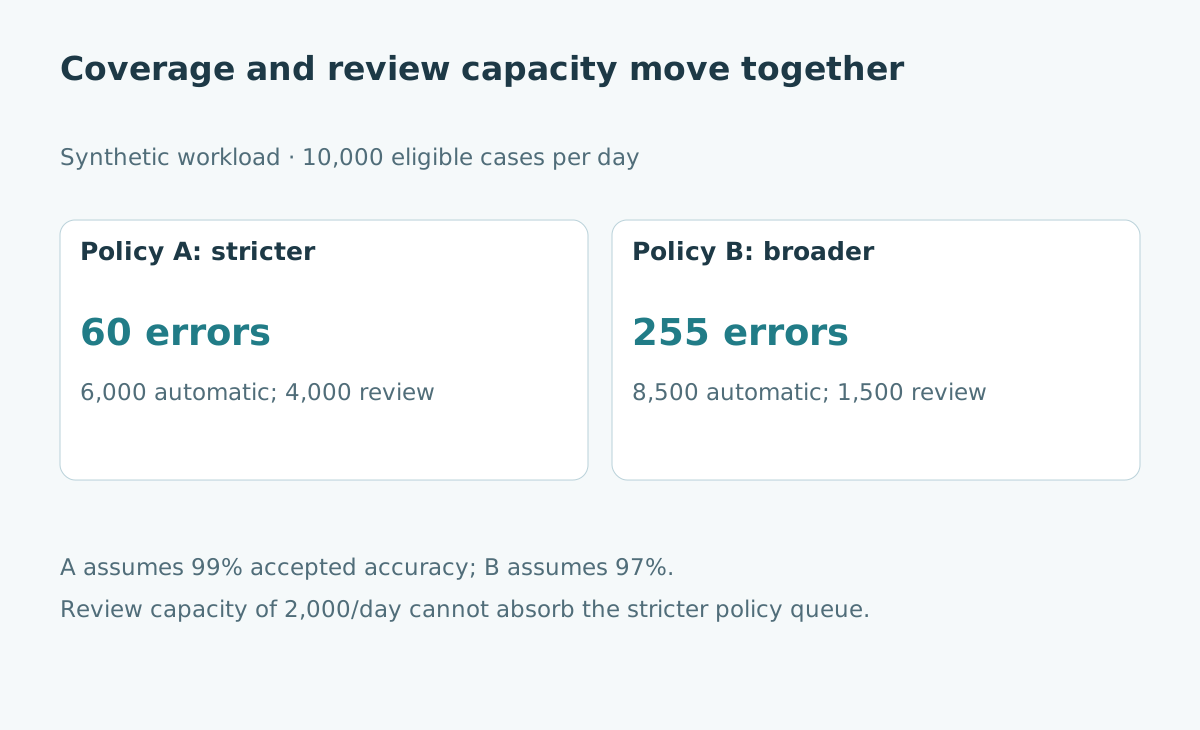
Assume 10,000 eligible cases arrive each day. Policy A automatically handles 6,000 with 99% accepted accuracy, leaving 4,000 for review. That implies 60 incorrect automatic results. Policy B handles 8,500 with 97% accepted accuracy, leaving 1,500 for review and implying 255 incorrect automatic results.
The comparison does not prove that broader coverage always reduces accuracy. These are hypothetical outcomes for two policies on the same representative workload. Actual evaluation must establish the relationship for the selected model, task and acceptance checks.
| Synthetic policy | Automatic cases | Wrong automatic cases | Review cases |
|---|---|---|---|
| A: stricter acceptance | 6,000 | 60 | 4,000 |
| B: broader acceptance | 8,500 | 255 | 1,500 |
| Difference, B minus A | +2,500 | +195 | −2,500 |
Suppose the review team can complete only 2,000 cases daily. Policy A creates a backlog of 2,000 cases per day if staffing and arrivals stay constant. Policy B fits that simple capacity constraint but may violate an acceptable error budget. Neither is automatically a satisfactory deployment.
Possible responses include narrower initial scope, more review capacity, improved acceptance checks, or a slower service promise. Hiding the queue is not a solution to either quality or capacity.
Add costs without pretending money captures everything
Suppose review costs $1 per case and each incorrect automatic result has an average modeled remediation cost of $20. Policy A then has $4,000 review cost plus $1,200 remediation cost, totaling $5,200 per day. Policy B has $1,500 plus $5,100, totaling $6,600.
This simplified comparison assumes review produces no residual errors and excludes inference, infrastructure, delays and fixed staffing costs. Those assumptions are deliberately strong. In a real model, include reviewer error and the cost of unresolved or late cases. Treat serious harms or prohibited actions as constraints rather than assuming that a convenient average dollar figure makes them acceptable.
A sensitivity check is revealing: the policies break even on these two cost components when one incorrect automatic result costs about $12.82, because $2,500 divided by 195 is approximately $12.82. This threshold tells you which uncertain input deserves investigation.
Evaluate confidence rather than trusting its phrasing
A model saying “95% confident” is not evidence that 95 out of 100 comparable answers are correct. Test whether the score separates acceptable from unacceptable cases using labeled examples. If you interpret it as a probability, evaluate calibration as well.
The scikit-learn threshold guide separates probability estimation from the decision made using a threshold and warns against training and tuning on the same data. That distinction transfers to workflow design, although an LLM's self-reported confidence is not automatically a classifier probability.
Keep a final evaluation set untouched while choosing acceptance rules. Include difficult inputs, new document types and cases requiring abstention. Do not let multiple outputs from the same source leak across development and final evaluation when that would make the task artificially familiar.
Make human review an actual service
A referral should carry the source, reason for deferral, relevant evidence and deadline. Give the reviewer authority to correct the case and report a recurring failure. Record which cases remained unresolved and how long they waited.
Reviewers may face the hardest cases, so do not estimate their speed from an easy random sample. Measure handling time and error on the referred subset. Monitor whether the AI suggestion anchors the reviewer toward an incorrect answer; in some workflows, an independent first assessment may be useful.
A small deployment worksheet
For one proposed task, write the maximum daily arrivals, required completion time, available reviewer capacity, unacceptable failure types, evaluation dataset and rollback owner. Plot coverage against both accepted error and queue size across candidate policies.
Then ask a counterfactual: if tomorrow's inputs become harder, which indicator tells you to reduce automation? A rising abstention share may signal healthy caution or a distribution change. A falling abstention share may signal better capability or a broken acceptance check. Inspect the cases before celebrating the trend.
Continue with probability calibration and the site's threshold material. The goal is a workflow whose mistakes and unfinished work remain countable.
Sources and scope
- NIST AI 600-1: context for generative AI risk management; published July 26, 2024.
- scikit-learn: tuning decision thresholds: probability versus action and evaluation separation.
Checked October 22, 2026. All workloads, accuracies and costs above are synthetic. No model provider's current performance or price is implied.