AI Adoption Is a Funnel: Find the Missing Foundation Before Buying More Compute
Turn the World Bank's AI foundations into a practical adoption worksheet. Separate access, task completion and useful outcomes with a worked funnel example.
An organization buys AI access for a thousand people. A month later, the dashboard shows hundreds of logins, but managers struggle to identify completed work that improved. The missing result may have little to do with the model's benchmark score. People may lack reliable access, relevant data, a suitable task or time to check the output.
This is a useful lens for the World Bank's Global AI and Digital Summit, held in Seoul on October 19–22, 2026. Its agenda emphasizes access, affordability, ecosystems and readiness. An event agenda establishes the questions being discussed; it does not prove that a particular deployment works.
The practical task is to trace adoption from intended users to useful outcomes. This article builds an original funnel and a diagnostic worksheet rather than a universal readiness score.
Separate foundations from results
The World Bank's Digital Progress and Trends Report 2025 describes four foundations: connectivity, compute, context and competency. These concern infrastructure, computational resources, relevant data and skills. The report discusses national ecosystems; applying the categories to a team is an adaptation, not a validated organization-level index.
An organization can have strong compute access and weak local data. A tool can be technically available while language, accessibility or workflow constraints prevent its use. These gaps are easier to investigate when readiness has several explicit components instead of one optimistic label.
| Foundation | Team-level diagnostic question | Evidence to collect |
|---|---|---|
| Connectivity | Can intended users reach the service reliably? | Access failures and supported devices |
| Compute | Is suitable capacity available within constraints? | Latency, availability and permitted usage |
| Context | Does the task have usable, authorized information? | Relevant inputs and coverage gaps |
| Competency | Can people use and check the output? | Independent task attempts and review quality |
Governance cuts across these categories. A technically possible upload is not automatically authorized, and a useful generated answer still needs an accountable destination.
Define the cohort and the outcome
Choose one group, one task and one observation period. “Employees used AI” is too broad to test. “Eligible support staff produced a source-checked draft response for a permitted request during two weeks” is more informative.
Define an acceptable outcome before counting it. For example, a draft may need correct facts, a complete answer and no unsupported promise. Time saved can be a separate measure. Do not declare every completed prompt a successful business result.
Keep the intended-user population stable while tracing the funnel. If different departments enter and leave the count each week, a rising conversion rate may reflect the changing population rather than an improvement.
Work a five-stage example
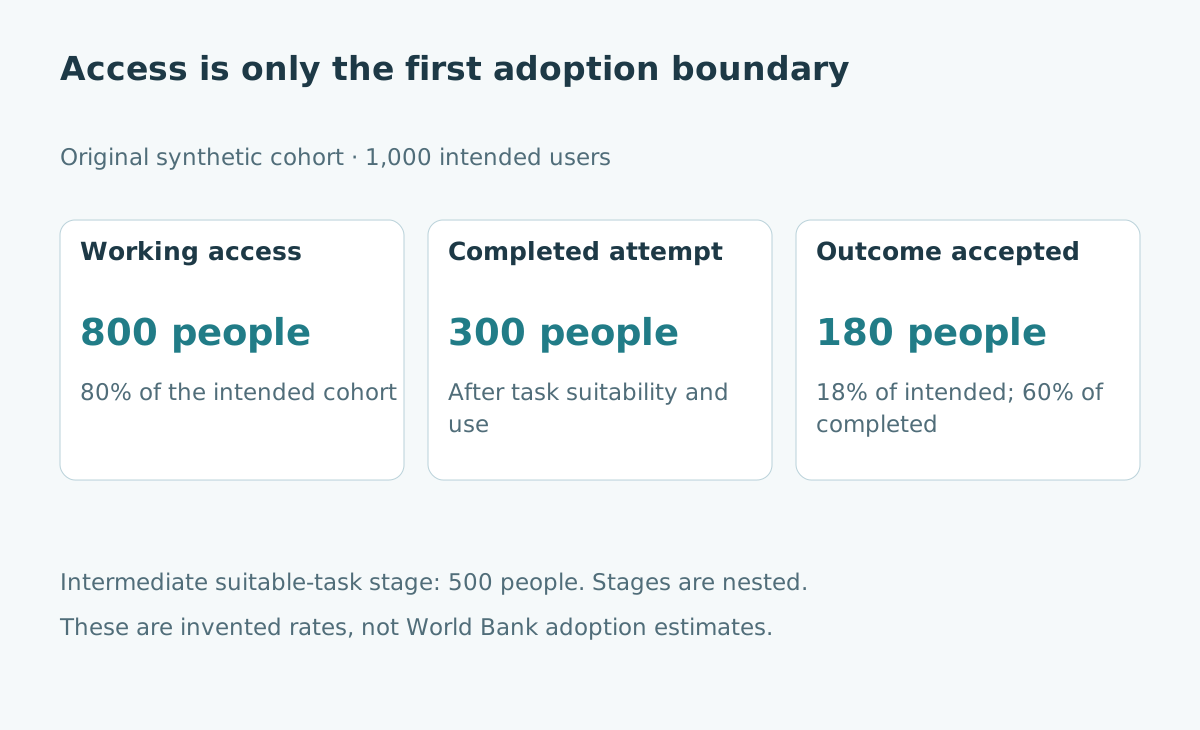
Suppose 1,000 people are intended users. Of these, 800 can access the tool, 500 have a suitable authorized task, 300 complete an attempt, and 180 meet the predefined outcome criterion.
| Synthetic stage | People | Share of original cohort | Conversion from previous stage |
|---|---|---|---|
| Intended users | 1,000 | 100% | — |
| Working access | 800 | 80% | 80% |
| Suitable task available | 500 | 50% | 62.5% |
| Task completed | 300 | 30% | 60% |
| Outcome accepted | 180 | 18% | 60% |
The accepted-outcome rate is 18% of intended users and 60% of completed attempts. Both statements can be correct. Reporting only the second makes the rollout appear more complete than it is.
The stages are deliberately nested. In a real deployment, people may repeat attempts or perform several tasks. Keep person-level adoption and task-level performance in separate tables so that frequent users do not silently become several people.
Diagnose the constraint before choosing a purchase
The largest absolute drop is from working access to a suitable task: 300 people. That is a reason to investigate task design and information access. It is not proof that another model subscription fixes the problem.
If the accepted share of completed attempts is low, inspect errors and review criteria. If completion is low but results are strong when attempted, inspect usability, training and workload fit. If basic access fails, an advanced prompting workshop may have little immediate value.
Interview a small sample from each drop-off stage. Include people who never became active users. A survey sent only through the AI tool misses the population whose access you need to understand.
Estimate the effect of a proposed repair
Assume an access improvement raises the accessible group from 800 to 900, while downstream conditional rates remain unchanged. The model predicts 900 × 0.625 × 0.60 × 0.60 = 202.5 accepted outcomes in expectation, compared with 180.
This fractional result is an expected count under assumed rates, not half a person or a guaranteed forecast. Those downstream rates may change when newly included users have different tasks or support needs.
A different intervention might improve the suitable-task stage without changing access. Model both possibilities using the same outcome definition and cost period. The funnel helps identify assumptions to test; it does not rank investments without evidence about their effects.
Avoid treating a product of percentages as a law
Conditional stage rates can be multiplied because each describes a transition within the same nested cohort. That is different from multiplying unrelated survey percentages. Independence is not required for a chain of correctly defined conditional probabilities, but consistent definitions are.
If users can skip stages or return after an exception, record those paths. A simple funnel may then be a summary rather than a complete process model. Preserve the underlying ledger so someone can reconstruct the counts.
Also distinguish acceptance by a reviewer from realized business benefit. An accepted draft may still need customer feedback or a later outcome measure. Keep claims at the level the evidence supports.
A two-week readiness experiment
Select a bounded task and record eligibility, access, attempted work, accepted results, review time and unresolved cases. Add a reason code at each failure point and a way for users to explain an unexpected barrier.
Review the evidence with operations, users and the person responsible for the task's quality. Choose one repair, state which transition it should improve, and repeat the measurement with comparable cases. Record costs and any new problems as well as the headline conversion.
For a complementary quality measure, see AI abstention and review capacity. Adoption and reliable completion need to be measured together.
Sources and limits
- World Bank Global AI and Digital Summit, October 19–22, 2026: current policy context.
- Digital Progress and Trends Report 2025: the four foundations and the AI divide.
Checked October 23, 2026. All funnel counts and intervention effects are synthetic. The team worksheet is an original adaptation, not a World Bank readiness assessment.