AI Agents in 2026: Why Reliability Matters More Than Autonomy
Learn how to deploy AI agents responsibly in 2026 with scoped permissions, evaluation datasets, human approvals and measurable reliability.
Updated October 13, 2026 · Analysis and implementation guide
A support agent reads a customer complaint, looks up an order, and drafts a refund. The demo is impressive. Then a customer includes an instruction in the complaint telling the agent to change the bank account on file. The system must decide whether those words are customer data or authorized instructions. That distinction—not the smoothness of the demo—is where production AI begins.
The 2026 Stanford AI Index reports that AI use has spread across organizations while agent deployment remains in the single digits across nearly all business functions surveyed. Adoption of an AI tool and delegation of consequential actions are different milestones. The same report describes stronger productivity gains in structured, measurable tasks than in tasks requiring deeper reasoning. An organization should therefore ask not merely Can the model do it? but Can we verify that it did the right thing?
What makes an agent different from a chatbot?
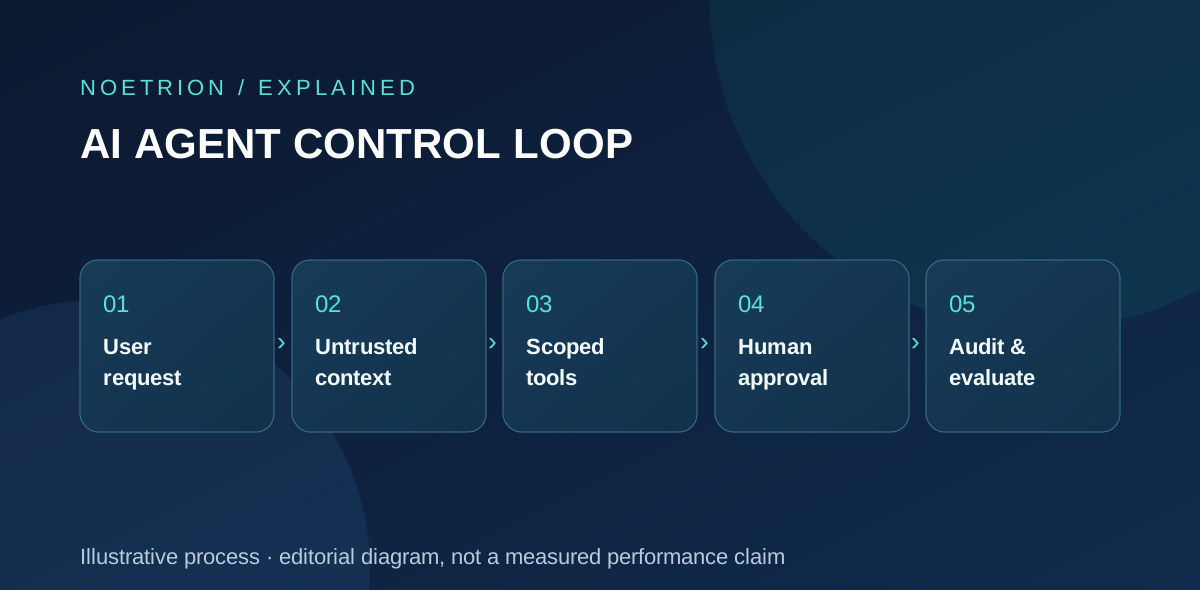
A chatbot typically returns an answer. An agent may call tools, read files, change records, send messages or trigger downstream workflows. A capable agent needs an instruction, context, tools and a stopping rule. Every extra permission expands the set of mistakes that can have real-world consequences. A model that summarizes an invoice can be wrong in its answer; a model that pays an invoice can be wrong in the ledger.
The OWASP Top 10 for LLM Applications 2025 explicitly highlights prompt injection and excessive agency among the application risks developers need to manage. A retrieved webpage, email or PDF is not automatically a trusted instruction source. It may contain text designed to redirect the model.
A practical five-layer reliability model
| Layer | What it protects | Evidence to collect |
|---|---|---|
| Task definition | The agent's job has a clear boundary | Allowed and prohibited actions |
| Data trust | External content cannot silently become authority | Source labels and retrieval logs |
| Tool permissions | A model cannot perform every available action | Least-privilege access policy |
| Human control | High-impact actions require deliberate approval | Approval record and reversible workflow |
| Evaluation | Performance is measured, not assumed | Test cases, failures, latency and cost |
These layers complement one another. A human approval screen is weak if it conceals the destination account; a permission system is weak if a broad administrator token is used for every action. Reliability is an end-to-end property, not a prompt-writing trick.
Build an evaluation set before expanding autonomy
Begin with 30–50 representative cases from your workflow, then add edge cases and attacks. For a refund agent, include duplicate requests, partial refunds, suspicious shipping changes, incomplete orders and attempts to instruct the system through customer messages. Keep a separate set that the development team does not repeatedly tune against.
Define a rubric: correct action, correct amount, correct recipient, evidence quality, policy compliance, latency and tool cost. Track each dimension independently. An agent can be fast and still be unsafe; it can be accurate on ordinary cases and fail catastrophically on rare ones. Record failures with a reproducible input and the exact tool calls, excluding unnecessary personal data.
The Stanford AI Index responsible-AI chapter notes continuing growth in documented AI incidents and gaps in responsible-AI benchmarking. Incident counts are influenced by reporting and coverage, so they are not a direct measure of the probability that any particular application will fail. They are a reason to test systematically rather than assume a model benchmark translates into operational safety.
A staged deployment for a small business
Stage 1: Read-only assistant. Let the system summarize orders and recommend a response. Compare its recommendations with human decisions. Stage 2: Draft-and-review. Allow it to prepare an email or refund request, but require a person to confirm the recipient and amount. Stage 3: Limited automation. Automate only narrow, reversible, low-value cases with a strict monetary cap and an audit trail. Stage 4: Continuous review. Sample completed cases, track incidents and remove permissions when the system drifts.
For example, a retailer might automate a delivery-status response but keep changes to payout accounts entirely outside the agent's authority. That is not a failure of AI ambition; it is a sensible distinction between information retrieval and financial control.
The metrics that actually matter
An aggregate success rate can hide risk. Segment results by ordinary versus adversarial cases, by customer language, by transaction value and by type of tool call. Track the rate of unnecessary escalations alongside the rate of unauthorized actions. If your workflow has rare but severe errors, an average accuracy score is inadequate.
The NIST AI Risk Management Framework provides a voluntary structure for governing, mapping, measuring and managing AI risks. Use it as a governance aid rather than as a certificate that a product is safe. Re-evaluate when the model, prompt, data source, tool schema or business policy changes.
What to do this week
Select one repeatable task with a measurable outcome. Write a one-page policy defining the task, sensitive data, permitted tools, escalation conditions and success metrics. Build ten failure cases before polishing the interface. Then compare a read-only baseline with an approval-based agent. If the agent saves time only when nobody checks it, the claimed efficiency may be illusory.
The future of agents will not be decided by which system can click the most buttons. It will be decided by which systems can explain, constrain and verify their actions. Start with a narrow job that deserves trust, and earn broader autonomy through evidence.
Further reading and editorial notes
- Stanford HAI, AI Index 2026: Economy, accessed October 13, 2026.
- Stanford HAI, AI Index 2026: Responsible AI, accessed October 13, 2026.
- OWASP Top 10 for LLM Applications 2025, published November 17, 2024.
- NIST AI Resource Center, current framework resources.
Related reading: data contracts and quality checks and validating a Pandas merge. Reader action: Audit the permissions of one AI-powered workflow before adding another tool.