An AI Funding Headline Can Combine Public Money, Model Credits and Future Commitments
Read the UK's October 2026 AI Biosecurity Lab announcement carefully. Separate public funding, company credits, delivery milestones and demonstrated public benefit.
A headline puts a large number beside a new AI institution. Readers may reasonably ask how much money the organization can spend, what resources it can actually use, and when the promised capability will exist. Those questions do not necessarily have the same answer.
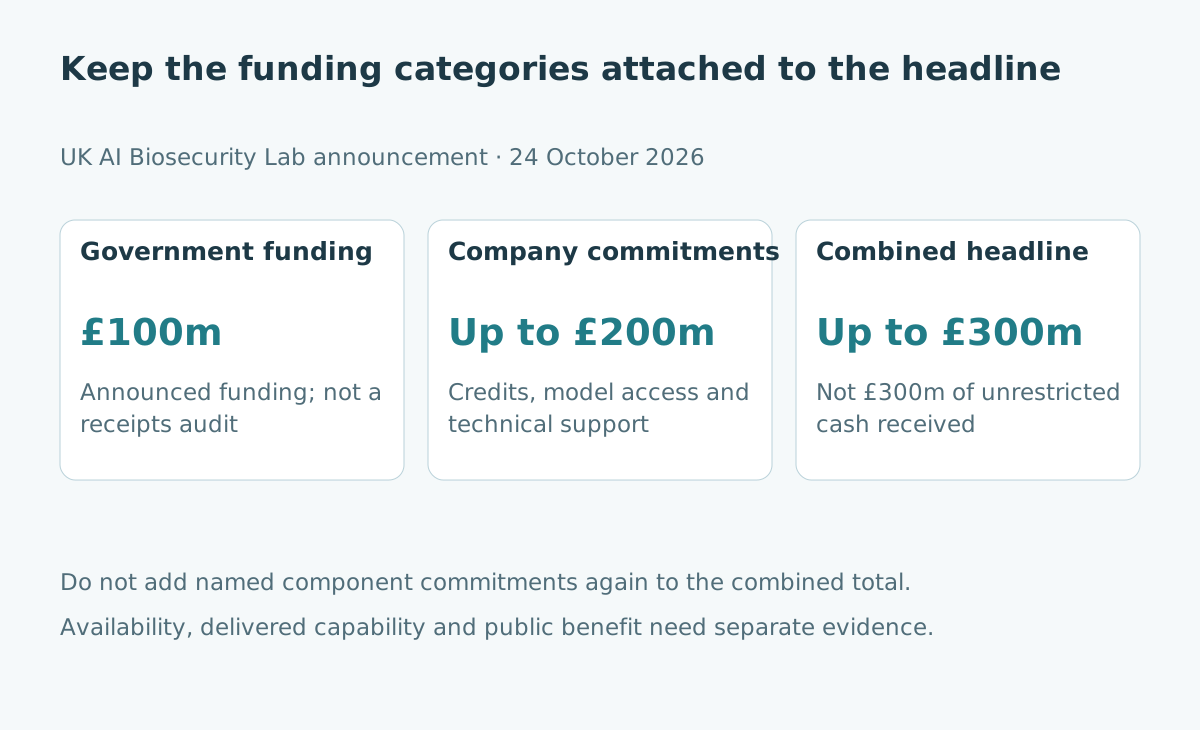
On 24 October 2026, the UK Cabinet Office announced the AI Biosecurity Lab, describing up to £300 million of government funding and company commitments. The stated composition is £100 million in government funding and up to £200 million in commitments from OpenAI and Anthropic. The company contributions include compute or model credits, model access and technical support. This is not a statement that £300 million has already arrived as unrestricted cash.
The Treasury's wider announcement, also dated 24 October, places the lab within a broader AI investment agenda. The useful reading task is to preserve the boundary of each component before comparing totals or judging delivery. Announced resources are evidence of a commitment; demonstrated outcomes require further evidence.
Identify what the number includes
Begin with the noun after the amount. Funding, commitment, credit, investment and expenditure are not interchangeable accounting events. An announcement may combine them to describe the scale of support, while an operating team needs a more detailed resource plan.
The lab announcement specifies £100 million of compute and model credits and model access from OpenAI, and up to £100 million of model credits, model access and dedicated technical support from Anthropic. Keep those terms attached to their amounts rather than replacing them with an unsupported cash label.
This distinction does not make non-cash support unimportant. Access to a scarce capability can matter greatly. Its usefulness depends on the actual tasks and the conditions under which the organization can use it.
Separate four stages of evidence
A practical reading framework distinguishes a commitment, an available resource, a delivered capability and a useful outcome. Each stage needs its own evidence.
| Stage | Question a reader can ask | Evidence that would answer it |
|---|---|---|
| Commitment | What has been promised, by whom and within what scope? | Published terms and accountable parties |
| Availability | What can the organization use now? | Confirmed access, funding conditions and operating arrangements |
| Capability | What can the team demonstrably perform? | Defined tests, documented outputs and limitations |
| Outcome | What difference did that capability make? | A suitable evaluation of the intended benefit |
The table is an original review tool. It is not an official reporting framework for the new lab, and it assigns no performance judgment to an institution that has just been announced.
Work a fictional resource budget
Imagine a separate, entirely fictional program receives 60 resource units as unrestricted cash and up to 40 units of service credits. Its combined face-value support can be described as up to 100 units, provided those categories and their valuation basis are disclosed.
Suppose the program spends 15 cash units and redeems ten units of credits. It has 45 cash units remaining and up to 30 credit units not yet redeemed, under the invented terms. The unredeemed credits cannot automatically pay a supplier who accepts only cash.
| Fictional category | Initial amount | Used in this example | Remaining |
|---|---|---|---|
| Unrestricted cash already received | 60 | 15 | 45 |
| Maximum service-credit face value | 40 | 10 | Up to 30 |
These figures are teaching values, not estimates of the UK lab's receipts or spending. Their purpose is to show why a resource total is different from a cash balance.
Do not count the same commitment twice
A program total may contain named contributions that are described again in a later paragraph. Adding every visible amount can double-count the same support.
In the fictional example, adding the headline 100 to its component credits of 40 would produce 140 without identifying any additional resource. The correct reconciliation is 60 plus up to 40, not 100 plus 40.
Apply the same discipline to wider policy packages. Check whether a lab allocation sits inside a national initiative, whether an annual amount has been multiplied over a stated period, and whether a new announcement restates an earlier commitment. Record unresolved scope rather than inventing a consolidated total.
Ask what the credits can actually support
A face-value credit amount does not describe every operational condition. A reviewer may need to know the eligible services, usage period, pricing basis, access limits, support scope and treatment of unused balances.
Those are questions to investigate, not assertions that the published UK commitments have hidden restrictions. The announcement alone does not supply a complete contract. Avoid filling gaps with assumptions about how another organization's commercial subscription works.
For an operating plan, map the available service to a defined workload. A credit that funds one kind of model access may not provide laboratory equipment, staff time or another provider's infrastructure. Resource planning should keep those dependencies visible.
Link resources to a capability milestone
A useful milestone says what a team can demonstrate under stated conditions. “Used more compute” measures activity. “Completed a defined evaluation with reproducible evidence” describes a capability that can be inspected.
For a generic AI program, an original milestone might require a versioned test set, an identified model configuration, documented results and an independent review of the claimed improvement. This example concerns evaluation governance; it supplies no biological procedures or predictions about the lab's technical results.
A milestone should also state what remains untested. Passing a selected demonstration does not establish that a system works across every deployment condition or that its use improves public outcomes.
Keep independence and access visible
Where a program receives resources from technology providers, ask how it records dependencies, preserves evaluation evidence and handles changes in model access. These questions concern the durability and inspectability of work.
They do not establish a conflict or a failure merely because a partnership exists. The appropriate assessment depends on the actual governance, agreements and publication arrangements. Distinguish a question worth asking from a conclusion already supported by evidence.
A clear public record would help readers tell whether a result changed because the underlying method improved or because the available model, dataset or evaluation procedure changed.
Evaluate delivery on its own clock
A launch announcement, a staffed organization, an operational service and an evaluated benefit occur on different timelines. Track each against the promises actually made, and preserve the date of the evidence.
The 24 October sources establish the government's announcement and stated support structure. They do not establish completed expenditure or demonstrated health benefits. A careful reader can welcome a potential capability while leaving its eventual effectiveness as an open empirical question.
For related evidence distinctions, see AI adoption foundations and independent AI evaluation access. Both help connect a promising input to the result someone ultimately needs.
Sources and reading notes
- UK Cabinet Office: Introducing the AI Biosecurity Lab, 24 October 2026, checked 26 October 2026.
- HM Treasury: Britain's AI investment announcement, 24 October 2026, checked 26 October 2026.
The resource-budget example and review worksheet are original. No independent cash-flow audit, contract valuation or evaluation of the lab's future performance is claimed.