An AI Infrastructure Business Can Report Profit While Spending More Cash Than It Generates
Trace an original AI infrastructure budget from revenue to profit, operating cash flow and capital spending. Separate depreciation, financing and free cash flow.
A company announces growing revenue, positive earnings and a larger infrastructure budget. One reader sees a healthy business funding growth; another sees a cash problem. Both may be looking at real numbers that measure different parts of the company.
The expansion of AI infrastructure makes this distinction especially useful. Equipment purchases, revenue recognition, customer payments and financing do not necessarily happen at the same time. A profit figure cannot answer every question about cash needs.
The SEC's financial-statement guide distinguishes income from operating, investing and financing cash flows. This article uses an original, simplified business to connect those statements. It does not report the results of any actual AI company or estimate whether its shares are attractive.
Start with the question you need answered
Profit asks how recognized revenues compare with recognized expenses over a period. Operating cash flow asks how cash moved through operations. Capital spending concerns purchases of long-lived assets. Financing shows how capital is raised or returned.
For a supplier planning to buy equipment, the immediate question may be whether enough cash is available when the invoice is due. For an investor, the question may include expected future returns on that equipment. Those are connected decisions, but they require different evidence.
| Measure | Useful question | Important limitation |
|---|---|---|
| Revenue | What sales were recognized? | Not necessarily cash collected |
| Net income | What accounting profit was recognized? | Not a direct cash balance |
| Operating cash flow | How much cash did operations provide or use? | Does not subtract all investing outlays |
| Capital expenditure | What was spent on specified long-lived assets? | Classification and timing matter |
| Free cash flow | What remains under the stated calculation? | Definitions can differ |
Build a deliberately small income statement
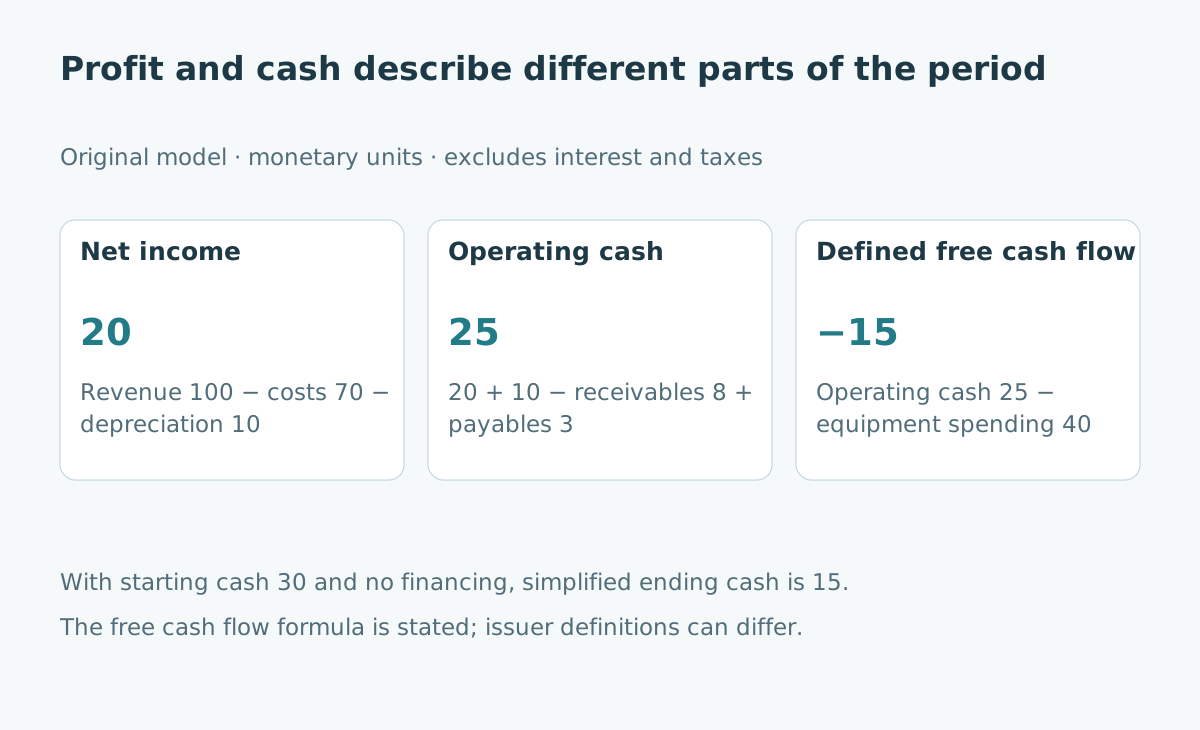
Assume the fictional company recognizes revenue of 100 units. Its operating expenses excluding depreciation are 70, and depreciation is 10. With no interest, taxes or other items in this toy model, net income is 20.
The 10-unit depreciation charge allocates asset cost over accounting periods. It is not assumed to equal the cash spent on equipment this period. That separation is the source of much confusion in capital-intensive growth stories.
The model says nothing about whether the depreciation policy is appropriate for actual equipment. Useful lives, residual values, impairments and accounting policies require the company's disclosures and applicable accounting requirements.
Bridge profit to operating cash
Suppose depreciation is added back in the indirect operating cash-flow bridge, receivables increase by 8, and operating payables increase by 3. Under the simplified assumptions, operating cash flow is 20 + 10 − 8 + 3 = 25.
| Original bridge | Cash-flow adjustment | Running amount |
|---|---|---|
| Net income | Start | 20 |
| Add back depreciation | +10 | 30 |
| Increase in receivables | −8 | 22 |
| Increase in operating payables | +3 | 25 |
An increase in receivables means some recognized sales have not yet become cash in this model. An increase in operating payables means some operating costs have not yet been paid. Real statements include more adjustments and require attention to classification.
Adding back depreciation does not make equipment free. The purchase appears elsewhere in the cash-flow picture, and the asset may need replacement later.
Now include the equipment purchase
Assume the company pays 40 units for equipment. Using the explicitly defined calculation operating cash flow minus cash capital expenditure, free cash flow is 25 − 40 = −15.
The company is profitable in the model and has positive operating cash flow, yet the defined free cash-flow measure is negative. There is no arithmetic contradiction. Capital spending exceeds the cash provided by operations during this period.
If it begins with 30 units of cash and raises no financing, the simplified ending cash balance is 15. If it instead raises 20 in financing, ending cash becomes 35. Financing changes the available cash; it does not turn the underlying −15 into positive operating generation.
Read the definition behind free cash flow
The SEC's non-GAAP guidance, Question 102.07, notes that free cash flow is not uniformly defined and that the calculation should be explained. A number with the same name can therefore require reconciliation before comparison.
Do not assume free cash flow is entirely discretionary. Debt repayments, contractual obligations and other cash needs may remain. Likewise, an adjusted measure may exclude items that matter to the cash available to the business.
When comparing companies, write the formula in words and trace the inputs to their statements. Keep the period and currency consistent. A quarterly figure and a trailing-year figure should not sit in the same comparison without a clear label.
Distinguish growth investment from maintenance claims
A company may describe spending as necessary maintenance or investment in new capacity. That distinction can be economically useful, but the label alone does not establish future returns. New capacity can be underused, and existing capacity can need more upkeep than expected.
Ask what the equipment is expected to produce, when it becomes available, and which demand assumptions support the plan. Include power, connectivity, staff, software and servicing where relevant. A purchase order is not the same milestone as accepted productive capacity.
For a project-level comparison, estimate cash outlays and receipts over time rather than using one accounting period as the whole investment case. Show sensitivity to utilization and pricing without presenting those assumptions as contracted revenue.
Inspect the financing bridge
A cash shortfall can be financed by existing reserves, new borrowing, equity or other arrangements. Each has terms and consequences. A large ending cash balance does not reveal whether operations generated it or financing supplied it.
Read maturities and commitments alongside the cash balance. Also distinguish a future spending commitment from a cash payment already made. Both can matter, but they belong to different timing questions.
An organization should not infer insolvency from one negative free cash-flow period. Nor should it infer that financing can continue indefinitely. The useful analysis asks what obligations come due, which resources are available and how sensitive the plan is to weaker outcomes.
A self-check for the next earnings headline
In the model, net income is 20 and equipment spending is 40. Is subtracting 40 directly from 20 a correct reconstruction of the period's cash change? No. The operating cash bridge, financing and any other cash items still matter.
Use a short worksheet: recognized revenue, net income, operating cash flow, stated capital spending, defined free cash flow, financing and ending cash. Note unexplained differences rather than forcing them to zero.
For working-capital timing, read the cash conversion cycle. It complements the equipment-spending question by following money through ordinary operations.
Sources and limits
- SEC: Beginners' Guide to Financial Statements: relationships among statements and cash-flow categories.
- SEC: Non-GAAP Financial Measures, Question 102.07: free cash-flow definition and disclosure context.
Checked October 23, 2026. All numbers are synthetic and the model excludes taxes, interest and other specified complications. It is not an analysis of a particular issuer.