A Six-Week AI Portfolio Project: Deliverables and an Evidence Rubric
Build one inspectable project with a baseline, reproducible workflow, meaningful evaluation, honest limitations, and a weighted review rubric.
A portfolio becomes easier to assess when it answers one concrete question: can someone else inspect the problem, reproduce the method, and judge the result? A polished AI demo may hide all three. A small project that documents a failed approach and a working correction can show much more.
The World Economic Forum’s Future of Jobs report identifies analytical thinking and technological skills among employer priorities. Those survey findings are context, not a universal hiring rubric. The six-week plan below is an original project framework you can adapt to your domain and available time.
Choose a bounded project with visible output
For a beginning data analyst, consider a synthetic campus-shop dataset with orders, products, and missing values. The deliverable is a reproducible weekly sales report, not a chatbot that promises to answer anything. Write the question, data permissions, input schema, output contract, and person who would use the result.
Use public, permitted, or clearly synthetic data. If AI suggests cleaning rules or explanations, keep a record of the suggestions you accepted and the checks that support them. The professional skill is deciding whether the result is useful, not collecting screenshots of prompts.
| Week | Deliverable | Evidence of completion |
|---|---|---|
| 1 | Problem brief and fixture dataset | A stated user question, permitted inputs, and expected output fields. |
| 2 | Baseline workflow | A manual or existing method with logged time and checked results. |
| 3 | Small working pipeline | A command or notebook that produces the report from the fixture. |
| 4 | Evaluation set | Normal, boundary, and invalid cases with expected outcomes. |
| 5 | Revision and outside review | Feedback, changes, and explanations of rejected suggestions. |
| 6 | Case study and reproducibility check | Another reader follows the setup and reaches the stated result. |
Three two-hour sessions per week would provide 36 hours across six weeks. That is a planning assumption, not a promise that every project fits. With less time, shrink the deliverable or extend the calendar. A reliable one-table report is better evidence than an unfinished platform.
Measure the same job before and after
Suppose a synthetic baseline takes 45 minutes per report and the revised workflow takes 20 minutes including review. The modeled saving is 25 minutes, or about 55.56% of baseline time. If there are four reports monthly, that is 100 minutes per month. These invented numbers demonstrate the calculation; do not put them in a résumé as observed performance.
For actual evidence, log several comparable runs and report the input size, machine, review scope, errors, and range of timings. If the new workflow produces a different report, the time comparison may not be fair. A fast result that silently loses rows has failed the output contract.
Review with a transparent rubric
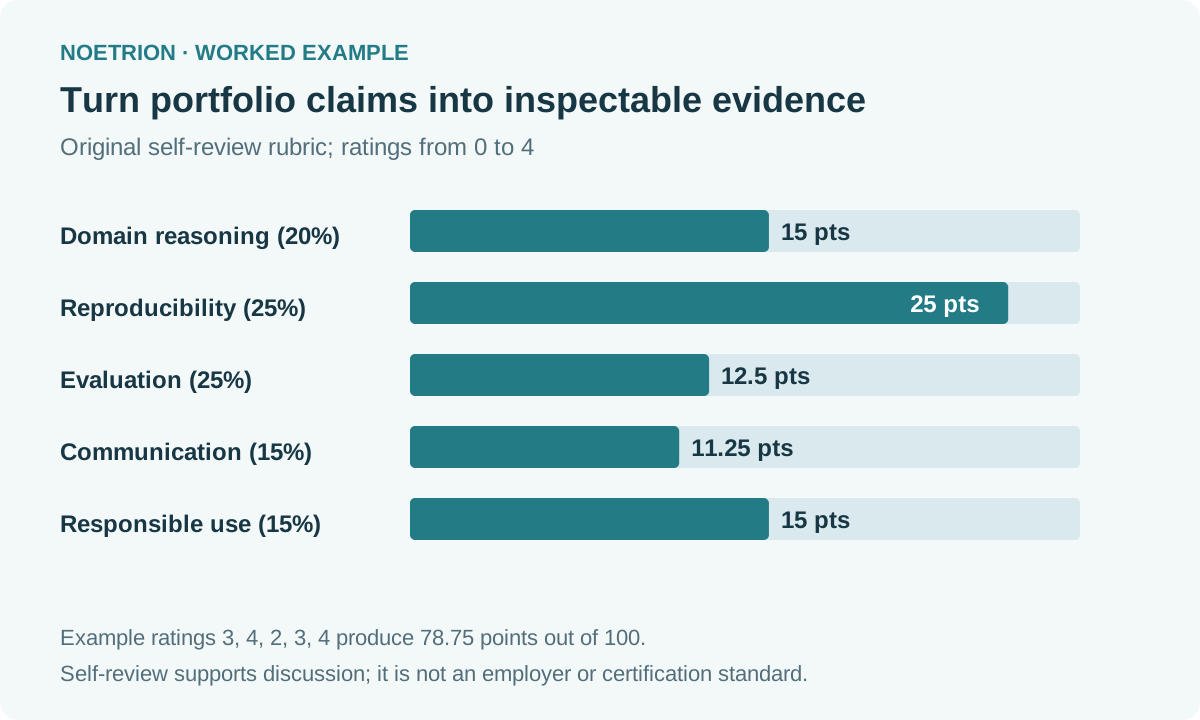
| Criterion | Weight | What a strong rating requires |
|---|---|---|
| Problem and domain reasoning | 20% | The question, audience, and assumptions are explicit. |
| Reproducibility | 25% | Inputs, dependencies, and execution steps are inspectable. |
| Evaluation | 25% | Meaningful cases and expected outcomes test the contract. |
| Communication | 15% | A reader can understand the finding and its implications. |
| Limitations and responsible use | 15% | Failures, permissions, and review boundaries are documented. |
Use zero for absent evidence, one for a partial draft, two for a working example, three for convincing documented evidence, and four for evidence independently reproduced or meaningfully reviewed. These descriptions guide your review; they are not an industry qualification.
A project rated 3, 4, 2, 3, and 4 receives 20×3/4 + 25×4/4 + 25×2/4 + 15×3/4 + 15×4/4 = 78.75 out of 100. The weakest weighted area is evaluation. Add useful test cases instead of redesigning the cover image to chase a higher impression.
Publish an inspectable case study
Show the problem, a small permitted input, the baseline, the final method, results, one failure, and the next improvement. Separate measured results from illustrative examples and distinguish your decisions from AI suggestions. Include enough setup detail for another person to rerun the work.
Ask a reviewer one focused question, such as whether a missing-data rule is justified. Record what changed after the answer. The six-week framework succeeds when it leaves evidence of reasoning and correction; it cannot guarantee an interview or job. For longer-term planning, read the proof-of-work skills guide.