The Skills That Matter Toward 2030: Build Proof, Not Just a Résumé
What the WEF Future of Jobs report says about skills to 2030, and how to build a credible portfolio with AI, analytical thinking and communication.
Updated October 13, 2026 · Career strategy
A student can collect certificates faster than they can explain what they learned. An employee can list "AI proficiency" on a résumé without knowing how to evaluate an AI-generated answer. In a changing labor market, these gaps matter. Employers need evidence that a person can solve a real problem, communicate the result and work responsibly with new tools.
The World Economic Forum's Future of Jobs Report 2025 surveyed more than 1,000 employers representing over 14 million workers. It estimates that 39% of existing skill sets will be transformed or become outdated between 2025 and 2030. This is an employer-survey projection, not a prediction that 39% of people will lose their jobs. The report highlights analytical thinking, resilience, technological literacy, AI and big data, and cybersecurity among important skills.
A better way to interpret future-of-work forecasts
Forecasts are useful for choosing what to learn, but they are not guarantees about one city, profession or company. A broad survey can reveal directional demand while missing local hiring constraints, wages and barriers to entry. Read the numbers as signals that help prioritize experiments, not as a command to abandon a career.
For example, AI literacy is relevant to accountants, marketers, analysts and engineers—but its meaning differs by role. An accountant may need to check extracted invoice data and maintain audit trails. A marketer may need to evaluate claims and respect intellectual-property constraints. A developer may need to test an AI-generated patch. "Uses AI" is too vague to be a meaningful skill.
Four complementary skill pillars
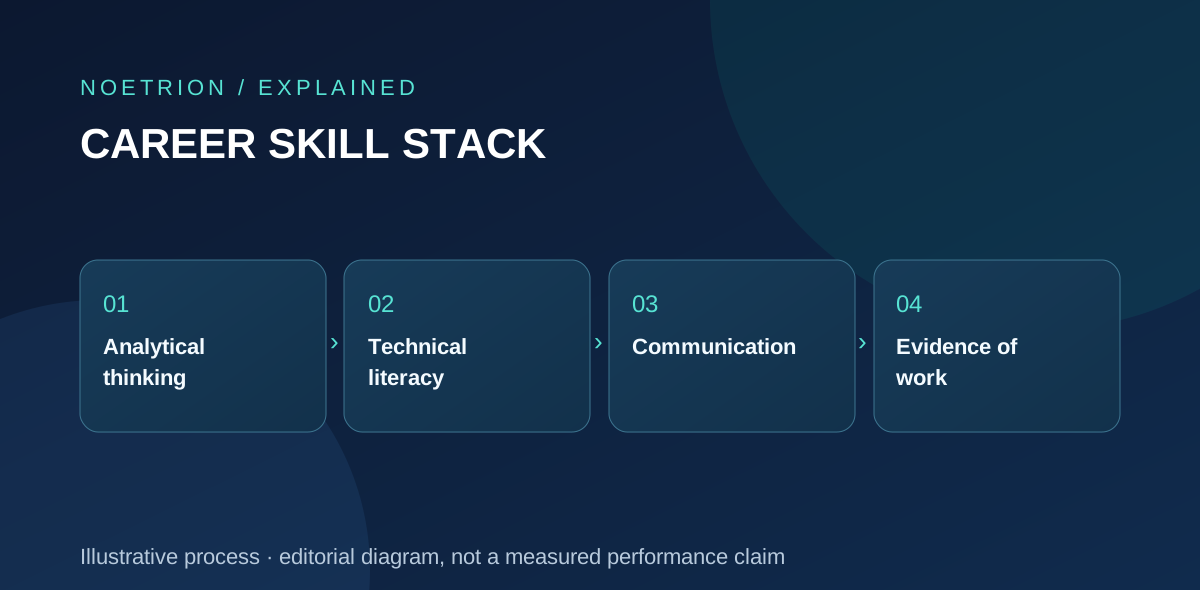
| Pillar | What it looks like in practice | Portfolio evidence |
|---|---|---|
| Analytical thinking | Frames a problem and tests assumptions | A clear decision memo |
| Technical fluency | Uses appropriate software and data | Reproducible project |
| Communication | Explains findings to non-specialists | One-page executive summary |
| Reliability and judgment | Verifies, documents and corrects work | Tests, limitations and change log |
These pillars reinforce one another. A dashboard without a decision is decoration. A clever model without data checks is risky. A persuasive presentation without a sound analysis can mislead. Strong professionals connect the pieces.
What the AI data actually says
The 2026 Stanford AI Index economy chapter reports broad organizational AI adoption, while agent deployment remains early in many functions. The same report describes larger measured productivity gains in structured tasks whose outputs are easy to evaluate. That suggests a practical opportunity: learn to design workflows with clear inputs, outputs and quality checks, rather than chasing every new model name.
It also warns against assuming that automation immediately translates into economy-wide job losses. Organizational expectations, task-level productivity and observed employment changes are distinct measures. A responsible career plan prepares for uncertainty rather than treating any single headline as destiny.
A 30-day proof-of-work project
Choose a real but manageable problem. For a data-science student, one option is to analyze an openly licensed public dataset and answer a specific question, such as whether a service's wait times differ by day of week. Define the question before opening a notebook. Record the source and license, check missing values, write a reproducible analysis and explain limitations. Finally, publish a short report showing the decision a stakeholder could make.
A workplace professional could instead map a repetitive process, measure its current error rate and test a safer alternative. The project need not be large. A carefully scoped five-page case study often reveals more judgment than an impressive-looking but unverified prototype.
How to use AI without outsourcing your thinking
Ask AI to suggest alternative explanations, generate test cases or critique a draft. Then verify facts and run the code yourself. Keep a short note of what you accepted, rejected and changed. This makes AI a tool for accelerating feedback rather than a substitute for comprehension.
An employer interviewing you may ask, "Why did you choose this method?" or "What would make your conclusion wrong?" A portfolio built by blind copying will struggle at that point. A portfolio built through deliberate testing gives you concrete answers.
A weekly learning rhythm
Spend one session learning a foundational concept, another applying it, and a third reviewing mistakes and documenting progress. Revisit earlier skills periodically rather than collecting disconnected tutorials. Track outcomes: a solved bug, a corrected assumption, a clearer report, or a faster but still accurate workflow.
When evaluating courses, ask whether they provide practice and feedback. When evaluating certifications, ask whether employers in your target field recognize them. When evaluating a new tool, ask whether it changes the work you can reliably deliver.
The next move is small and observable
Pick one role you might want in two years. Read five current job descriptions and identify repeated skills, but treat those postings as a local sample rather than the entire labor market. Choose one gap and build a project that demonstrates progress. Ask a practitioner for critique. Revise the artifact.
The durable advantage is not predicting exactly which software will dominate in 2030. It is becoming someone who can learn, test, explain and adapt when the tools change.
A six-month plan with observable milestones
Use this as an adaptable project plan, not a promise of employment or a timetable inferred from an employer survey. Workload, prerequisites, access to feedback, and the role you want can change the pace.
| Stage | Activity | Evidence of progress |
|---|---|---|
| Month 1 | Inspect a local sample of relevant job descriptions | A gap list distinguishing requirements from preferences |
| Months 2–3 | Practice one foundation on increasingly realistic tasks | Small outputs you can explain and reproduce |
| Month 4 | Solve one permitted domain problem | Question, inputs, method, limitations, recommendation |
| Month 5 | Write a case study and present it | Feedback from someone unfamiliar with the work |
| Month 6 | Apply, seek critique, and revise | A documented change based on feedback |
Before paying for a course, name the artifact you expect to create and check prerequisites, practice, feedback, and relevance to actual work. A completion certificate documents participation; the artifact demonstrates what you can do. Revisit the original employer survey for its scope rather than treating its projections as an individual forecast.
Sources and editorial notes
- World Economic Forum, Future of Jobs Report 2025, January 7, 2025.
- Stanford HAI, 2026 AI Index: Economy, 2026.
- Stanford HAI, 2026 AI Index: Education, 2026.
Related reading: retrieval practice and Python upgrade testing. Reader action: Replace one vague résumé skill with a link to a reproducible project.