AI and Entry-Level Jobs: What the Evidence Means for Your Career
Read the latest evidence on AI and young workers without confusing task exposure with job losses, then build a portfolio that shows judgment, verification and useful workplace skills.
Reviewed October 12, 2026. Employment findings below describe specific research populations and periods; the portfolio exercises are practical suggestions, not hiring guarantees.
You open an entry-level vacancy and find a familiar contradiction: the employer wants someone early in their career who can already deliver independently. Then an AI headline suggests the first rung of the ladder is disappearing. It is easy to jump from that headline to “my degree is useless.” The evidence deserves a slower reading, and your next move deserves something more concrete than panic.
On October 12, 2026, Singapore President Tharman Shanmugaratnam warned about weaker demand for fresh graduates in AI-exposed sectors at the IMF and World Bank meetings in Bangkok. That is a current policy concern, reported by Reuters, rather than a measured estimate for every country or profession. Reuters report.
The useful career question is narrower: which parts of a beginner's work can software perform, and what evidence can you provide that you can still contribute to a real team? This article connects recent research to a practical project and workplace-skills plan.
Exposure, adoption and employment are different measurements
An occupation is a bundle of tasks. Some tasks involve drafting text, others involve coordinating people, checking records, negotiating priorities, or taking responsibility for a decision. A model of AI exposure asks which activities technology could affect. It does not observe every employer actually using the technology or every affected worker losing a job.
The International Labour Organization's May 2025 index estimated that one in four workers worldwide were in occupations with some generative AI exposure, with 3.3% of global employment in its highest exposure category. The report identifies job transformation as the more likely overall effect because many occupations still require human input. These are exposure estimates, not forecasts that a quarter of workers will become unemployed. ILO refined index.
Adoption adds another question: did an organization deploy a tool in a particular process? Employment adds another: what happened to hiring, separations, hours, or wages? Those changes can have several causes. Keep these questions apart when reading a graph or deciding whether to abandon a career direction.
The latest young-worker evidence is concerning—and bounded
The Stanford Digital Economy Lab's Canaries in the Coal Mine? working paper was revised on August 12, 2026. Using ADP payroll data through June 2026, it reports that employment of workers aged 22–25 in AI-exposed occupations stood 19% below where it would have been had it kept pace with less-exposed peers. The adjustment was primarily associated with reduced hiring, rather than increased separations. Revised paper and authors' summary.
Read the denominator carefully. The finding is a relative gap against a comparison trajectory, not a statement that 19% of all graduates were fired. The authors report no evidence of widespread economy-wide displacement. They also note weaker patterns after education controls, some pre-existing divergent trends, and differences between the payroll sample and national survey benchmarks. They explicitly describe the findings as early descriptive indicators, not causal estimates.
That combination supports taking the risk seriously without assigning AI sole responsibility for every difficult job search. It also means that old summaries reporting a different percentage should be checked against the version they discuss. A revision date can change the meaning of an apparently familiar statistic.
AI can also help inexperienced workers inside a job
Employment research and productivity research answer different questions. In Generative AI at Work, researchers studied the staggered introduction of an assistant among 5,172 customer-support agents. The reported average increase in issues resolved per hour was 15%, with larger improvements among less experienced and lower-skilled workers. This is evidence about one workplace setting, not a guarantee of the same gain in accounting, medicine, or software engineering. Researchers' publication summary.
The distinction matters for your plan. A tool that helps a junior worker perform better can coexist with organizations hiring fewer junior workers. The first concerns performance within an adopted workflow; the second concerns access to positions. Neither observation cancels the other.
Instead of asking whether AI is simply “good” or “bad” for beginners, ask how a specific role is organized. Does the employer provide mentorship? Can juniors learn from corrections? Who checks automated work? Are entry-level employees allowed to develop the judgment needed for future responsibilities? These are questions you can bring to an interview, rather than trying to infer the entire workplace from a technology slogan.
Build a task map before collecting more certificates
Choose one role you could realistically pursue. Read several current vacancies directly, noting their dates and locations. This is your own small observation exercise; it is not a representative labor-market survey. Extract the tasks, expected outputs, and communication responsibilities rather than counting repeated buzzwords.
For a hypothetical junior data analyst, the map might include importing records, checking inconsistent values, producing a weekly metric, explaining changes, and asking a manager whether a definition is correct. An assistant may draft code or text for several steps. The task map still leaves questions about data permission, metric definitions, validation, and stakeholder understanding.
Mark each task with one of three learning priorities: I can already do it independently; I can do it with help but cannot explain it; or I have not practiced it yet. The middle category is especially useful. It identifies where a polished project may be hiding weak understanding.
Pick one priority that appears repeatedly and produce evidence for it. If the vacancies ask for SQL and clear reporting, another generic AI certificate may add less to your immediate application than a small, checked SQL analysis with a readable explanation. That is a judgment for your target roles, not a universal ranking of credentials.
A portfolio should make your decisions visible
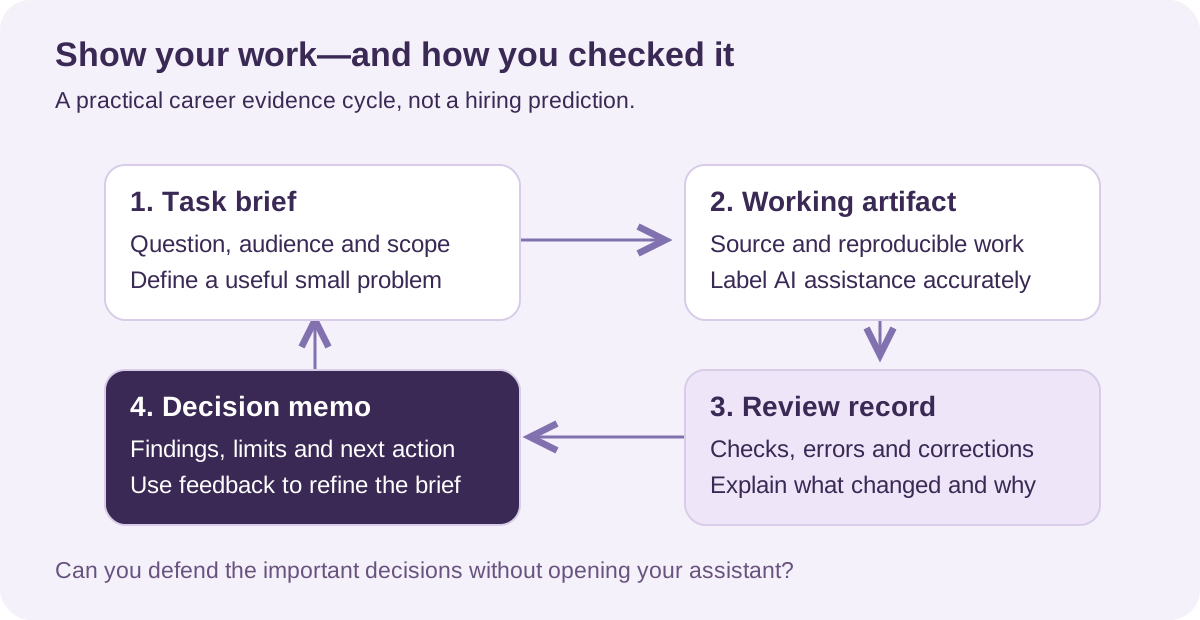
Imagine a fictional local retailer wants to understand why reported sales changed. Use public or synthetic data, clearly labelled, rather than unauthorized customer records. Define a small question: “Did the total change because there were more orders, or because average order value changed?” State the limits before writing a large dashboard.
| Portfolio component | What the reader can inspect | Evidence of your contribution |
|---|---|---|
| Task brief | Question, audience, scope and constraints | You selected an answerable problem |
| Data note | Source, permissions, definitions and limitations | You understood what the records represent |
| Working artifact | Query, notebook, spreadsheet or prototype | The result can be reproduced or inspected |
| Review record | Checks, an error found and the correction | You can question a plausible output |
| Decision memo | Findings, uncertainty and next action | You can communicate beyond the tool interface |
Include an AI-use note when relevant: what assistance you requested, which suggestions you accepted, and what you verified yourself. Do not inflate authorship by claiming to have independently written work you cannot explain. Equally, do not make the whole presentation a list of prompts. The employer needs to understand the problem and your contribution.
This approach fits the broader workplace skills highlighted by the National Association of Colleges and Employers, including communication, critical thinking, teamwork, professionalism, and responsible technology use. The framework identifies competencies; it does not certify that one portfolio guarantees competence or employment. NACE career-readiness framework.
Practice the conversation that follows the project
A portfolio link is only the beginning. Prepare to explain a decision without opening your assistant. Why did you remove that row? What would change if refunds were included? Which result would you avoid presenting to a manager? If those questions feel uncomfortable, they have found useful practice targets.
Ask a friend or classmate to play the stakeholder. Give them the memo, not the full technical explanation. Ask which sentence is confusing and which recommendation lacks support. A small peer review cannot substitute for professional mentorship, but it can reveal whether your communication relies on the reader already knowing everything you know.
When you receive feedback, record a concrete change. “I improved communication” is vague. “I moved the metric definition before the chart because the reviewer interpreted net sales as gross sales” shows an observable response. Use this level of detail when discussing coursework or group projects, too.
A useful interview answer names a situation, your responsibility, your action, and the result or remaining limitation. If the project uses simulated data, say so. An honest account of a modest project is easier to defend than a grand claim built around an untested AI-generated application.
A four-week plan you can adapt
This schedule is an original planning template, not a research-proven hiring intervention. Adjust it to your course deadlines, access to feedback, and the complexity of the role.
In week one, choose the role and map recurring tasks. Select one public or synthetic dataset and write the project brief. Keep the scope small enough that you can inspect the work yourself. Identify the skill you will demonstrate and one limitation you expect to encounter.
In week two, produce the first usable artifact. Save intermediate decisions and run relevant checks. When an assistant provides a suggestion, pause long enough to explain why it fits. If you cannot, use the uncertainty as a learning task before building another feature.
In week three, seek feedback on the output and the explanation. Revise the artifact, then write a short account of the change. Practice answering questions without assistance. You are rehearsing the responsibilities around the tool, as well as the tool itself.
In week four, package the project and tailor your application to specific roles. Track what you submitted, which requirements you met, and any feedback received. Applications may still receive no response; that does not turn the project into wasted work. It leaves you with a clearer artifact to improve and a more precise account of your current capabilities.
Frequently asked questions
Should I avoid every career described as AI-exposed?
Exposure alone cannot answer that decision. Examine the tasks, local opportunities, training pathway, and responsibilities you want to develop. Use the research to ask better questions about a role, not to treat an occupation-level index as a personal verdict.
Do I need to hide AI use in my portfolio?
Follow the employer's or course's rules and describe your contribution accurately. A useful disclosure is specific and brief: the assistance used, the checks you performed, and the parts you can defend independently. Avoid claiming outcomes or expertise that the project does not establish.