How to Study With AI Without Losing the Ability to Work Alone
Separate AI-assisted task performance from learning, understand tutoring experiments, and use a practical hint ladder, error log and independent checks to study more effectively.
Reviewed October 12, 2026. Research findings describe particular tutoring designs and student populations. The study workflow below is an original practical adaptation, not a tested intervention.
The solution makes sense while it is on the screen. You follow each step, finish the exercise, and close the tab feeling productive. The next evening, a similar problem appears without the explanation beside it. Suddenly, the first step is unclear. That is a familiar gap between understanding someone else's work and producing your own.
AI assistants make detailed explanations unusually easy to obtain. That can be valuable. It also makes it easy to measure progress by how much work you finish with assistance, while never checking what you can do after the assistance disappears. Research on AI tutoring gives a more useful question than “Should students use AI?”: which kind of assistance helps a learner develop independent competence?
This article focuses on that design question. It combines bounded research findings with a hint-based practice routine you can adapt for mathematics, Python, data analysis, or a demanding university reading.
The research measures two different kinds of success
In a randomized field experiment with nearly a thousand high-school mathematics students in Turkey, Bastani and colleagues compared a standard GPT-4 interface, a tutor with teacher-designed safeguards, and a control group. Assisted practice improved with both AI designs. When resources were removed for the exam, the standard-interface group performed worse than the control group; the reported grade reduction was 17% relative, not 17 percentage points. The guarded tutor largely mitigated that negative effect, without establishing a positive independent-exam benefit over the control. PNAS study.
These findings concern that experiment, not every student or current chatbot. The paper's August 2025 correction concerned an author affiliation rather than its results. Correction.
A different randomized study by Kestin and colleagues reported better learning with a custom AI tutor than an active-learning classroom comparison. Its design and context differed from a general chat interface. The findings show why “AI tutoring” is too broad a label to describe one uniform educational effect. Authors' abstract, Scientific Reports.
Ask what remains when the help disappears
Imagine you are learning to interpret a hypothesis test. An assistant produces the formula, substitutes the numbers, and writes the conclusion. You can check that the arithmetic looks tidy, but that experience may not reveal whether you can select the test yourself. A better independent check changes the scenario and asks you to justify the assumptions before doing the calculation.
For Python, the equivalent is not merely rerunning the generated function. Can you explain its inputs, identify a case it mishandles, and modify it when a requirement changes? For a reading assignment, can you explain the author's argument without copying the assistant's summary? These are different tasks from recognizing a polished answer.
Independent work does not have to mean refusing all help forever. It means creating moments where the target skill is observable. Decide what those moments will assess before beginning the session. Otherwise, it is tempting to treat every completed page as evidence of mastery, even when the assistant performed the difficult part.
The guiding question is concrete: “What will I be able to attempt tomorrow without opening this conversation?” Write the answer as an action, such as selecting a test, tracing a loop, or comparing two explanations.
Build a hint ladder instead of requesting the whole solution
A hint ladder gives you several levels of help. Start with the smallest cue that lets you continue. If you are stuck on a statistics problem, the first hint might ask which information determines the test choice. A second might direct your attention to whether the population standard deviation is known. A third might show an analogous example using different values.
The point is to preserve a decision for you to make. An assistant can still misunderstand your difficulty or reveal too much; prompting alone does not recreate a validated tutoring system. Inspect the help you receive and stop reading when it provides enough to resume your own attempt.
| Help level | Request you could use | What you still do yourself |
|---|---|---|
| Locate the difficulty | “Ask me one question to identify where my reasoning breaks.” | Describe your current reasoning |
| Give a small cue | “Give one hint about the next decision, without calculating it.” | Choose and carry out the next step |
| Use an analogous example | “Show the same concept with different values.” | Transfer the method to your problem |
| Review an attempt | “Identify the first unsupported step in my explanation.” | Revise and justify that step |
| Inspect a full solution | “Explain this worked example, then give me a new problem.” | Complete the new problem independently |
There is no moral failure in needing the last row. A beginner may need to study a worked example before meaningful practice is possible. The mistake is ending the session at that example and declaring the skill acquired without another attempt.
Make your prompt reveal thinking, not just request an answer
Consider this original prompt template: “My goal is to choose an appropriate method independently. Here is my attempted reasoning. Ask one diagnostic question, then give one hint if needed. Do not complete the calculation until I have tried. If my premise is wrong, identify it and explain how to check it against my course materials.”
The useful part is the attempted reasoning. It gives the assistant something to respond to and makes your own uncertainty explicit. A blank request for “a simpler explanation” may yield a pleasant paragraph without resolving the precise step you cannot perform.
For code, paste a small reproducible example and describe what you expected. Ask the assistant to help locate the first point where the result differs. Before accepting a proposed fix, predict what it will change. Afterward, explain the corrected behavior in your own words and run a case that challenges it.
For reading, ask for questions rather than an instant summary. Then compare your responses with the assigned text. If the assistant invents a claim or reference, the text remains the authority. The prompt is a way to organize interaction, not a guarantee of accurate teaching.
Use an error log that tells you what to practice next
“I got it wrong” is not specific enough to guide another session. A short error log should identify the decision that failed, the correction, and a future test of that correction. Avoid turning it into a transcript archive you will never read.
Suppose a fictional student confuses a population standard deviation with a sample standard deviation. The log could say: “I chose the method from the sample size alone. Next time I will identify what is known about the population before choosing the reference distribution.” The next practice question should change that information, not merely change the numbers.
For Python, “I used a mutable default argument” becomes useful when paired with a small explanation of why repeated calls shared state and a fresh example to predict. For a business reading, “I confused revenue with profit” suggests a comparison question where expenses change. Each log entry should lead to a specific future attempt.
The Institute of Education Sciences guide supports using quizzes to re-expose learners to content and asking explanatory questions. It also recommends combining worked examples with problem-solving exercises. The AI workflow here is an adaptation of those ideas, not something evaluated by the 2007 guide itself. IES practice guide.
A session plan with a visible independent checkpoint
Set aside a manageable session and begin with a clear target. The example below uses forty minutes as a planning convenience; research cited here does not establish that forty minutes is an optimal duration.
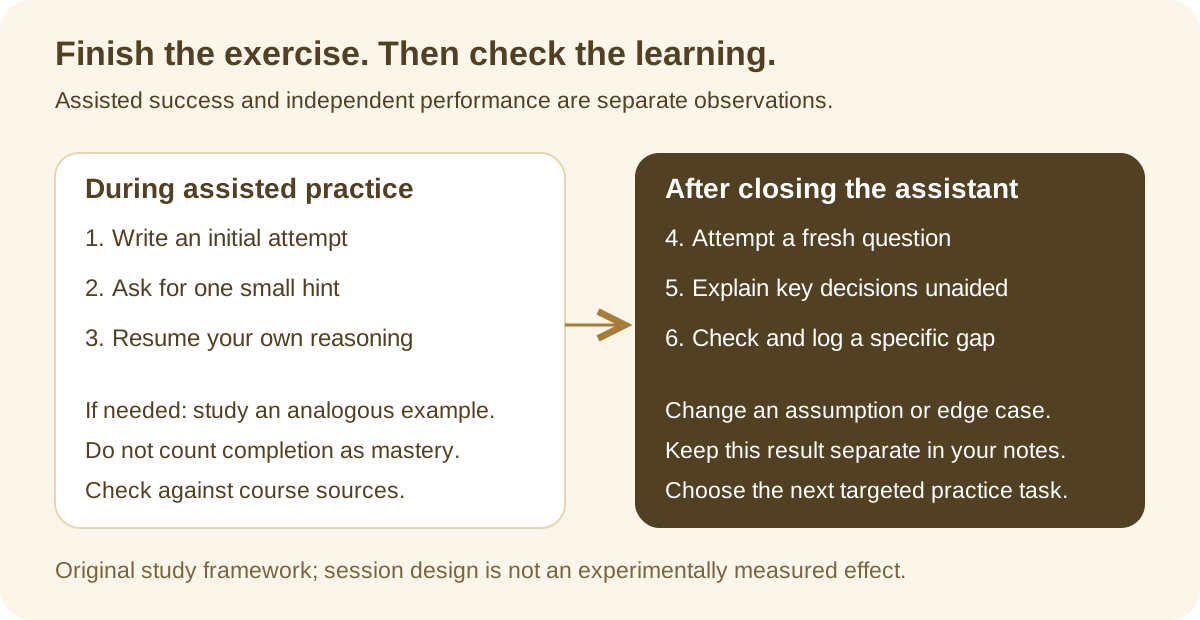
Spend the opening five minutes attempting a small problem without the assistant. Record what you can do and where you stop. If the topic is entirely new, begin with a course example instead and identify its key decisions. You need enough background to ask a useful question.
Use the next fifteen minutes for targeted assistance. Follow the hint ladder, compare the explanation with your materials, and resume your own work after each cue. Resist adding three new topics simply because the assistant can explain them quickly. The session has one target.
Then close the assistant and spend ten minutes on a fresh question. Change a meaningful feature: a boundary case in code, an assumption in statistics, or the setting in a conceptual problem. Finally, use the remaining time to check the result and record the next practice task.
If you cannot complete the independent question, you have found a gap rather than wasted the session. Return to the relevant example, ask a more precise question, or seek a lecturer's or tutor's help. Keep the independent result separate from the assisted one in your notes.
Keep course rules and privacy inside the workflow
An effective learning method can still violate an assignment's rules if you use it in the wrong context. Before sharing assessed work, check whether assistance is allowed and how it must be disclosed. A take-home assignment and a personal practice exercise may have different requirements.
UNESCO's guidance emphasizes human agency, pedagogical evaluation, and protection of data privacy when using generative AI in education. It is guidance for responsible implementation, not evidence that a particular chatbot improves grades. UNESCO guidance.
A practical habit is to replace personal or sensitive details with a fictional example before asking for help. Avoid uploading classmates' identifiable records, confidential workplace data, or restricted assessment material merely because it makes the explanation easier. Keep your study question focused on the concept whenever possible.
Also preserve the ability to challenge the assistant. If its explanation conflicts with the course, ask it to expose the assumption and verify the disputed claim using the assigned source. When the disagreement remains unresolved, bring the question and both explanations to an instructor. Fluent wording should not decide the argument.
Supervised tutoring is a different intervention
An exploratory UK trial described in a December 2025 preprint involved 165 students across five secondary schools. Expert tutors directly supervised LearnLM messages and could revise them before students received them. The authors reported encouraging learning results in that arrangement. Because the intervention included specialist supervision, it should not be presented as proof that an unsupervised consumer chatbot delivers the same outcomes. Research preprint.
This is a useful distinction when evaluating an educational product. Ask who designed the tasks, whether an expert checked the explanations, what feedback students received, and how independent learning was measured. A model name alone leaves those questions unanswered.
For your own study routine, the practical lesson is to build checks around assistance. Use course sources, meaningful fresh questions, and human feedback when needed. You do not have to recreate a research platform to improve the visibility of your learning, but you should not label an improvised prompt as equivalent to one.
Frequently asked questions
Should I always attempt a problem before viewing an explanation?
Use your current understanding to decide. A short attempt can reveal a specific difficulty, while an unfamiliar topic may require an introductory worked example first. In either case, include a later independent task so that recognizing the explanation is not your only evidence of learning.
Can I ask AI to generate my practice questions?
Yes, where your course rules permit it, but verify the questions and solutions against reliable material. Ask for a small set with clearly stated assumptions. A faulty question can create confusion that looks like a weakness in your knowledge; your assigned exercises provide an important reference point.
Sources and further reading
- Bastani and colleagues: randomized mathematics experiment, PNAS.
- PNAS: author-affiliation correction.
- Kestin and colleagues: AI tutor randomized study, authors' abstract; journal record.
- IES: Organizing Instruction and Study to Improve Student Learning.
- UNESCO: Guidance for Generative AI in Education and Research.
- LearnLM and Eedi: exploratory supervised-tutoring trial, preprint.