Retrieval Practice and Spacing: Build a Study System That Produces Recall
Convert notes into scheduled recall, use feedback without memorizing mistakes, and match practice to the kind of exam performance required.
Reviewed October 10, 2026. The recommendations synthesize peer-reviewed learning research and should be adapted to the subject and assessment.
Rereading can make a page feel fluent because the answers remain visible. Exams usually ask for something harder: produce an idea, method, or decision when the answer is absent. Retrieval practice trains that act of production. Spacing distributes attempts across time so that recall must be reconstructed rather than echoed from short-term availability.
Neither method requires elaborate software. A blank page, question list, and calendar are enough. The difficult part is designing prompts that reflect the target skill and using feedback before errors become habits.
1. Retrieval is different from exposure
Seeing a term and thinking “I know that” measures recognition under a strong cue. Producing its definition, explaining it in a new example, or selecting the correct method uses retrieval. Practice should resemble the response required later.
For a statistics exam, a flashcard asking for the formula may be necessary but insufficient. A stronger prompt presents a study design and asks which test fits, what assumptions matter, and how the conclusion should be phrased. For programming, predict output or write a function before running it.
2. The testing effect is a learning effect
Research distinguishes tests used only for assessment from retrieval attempts used as learning events. Retrieving information can improve later retention compared with spending the same time restudying, especially when learners receive feedback and later tests require related retrieval.
This does not mean every quiz is beneficial. Ambiguous questions, uncorrected errors, trivial recognition, or anxiety-heavy high stakes can undermine the purpose. Low-stakes or no-stakes practice is valuable because it reveals gaps while there is still time to fix them.
3. Spacing changes when effort occurs
Massed practice places repetitions close together. Performance during the session often looks good because the answer is still active. Spaced practice allows some forgetting and then requires reconstruction. The delayed attempt may feel worse while producing more informative and durable learning.
There is no universal sequence such as exactly 1, 3, and 7 days for every topic. The useful interval depends on how long the knowledge must be retained, difficulty, prior mastery, and available time. Expanding intervals are a practical starting heuristic, not a biological law.
| Goal | Retrieval prompt | Possible spacing |
|---|---|---|
| Remember terminology | Define and give an example | Next day, then several days later |
| Select a method | Diagnose mixed scenarios | Short delay, then interleaved set |
| Execute a procedure | Solve from a blank start | Repeated sessions with varied data |
| Explain a concept | Teach it without notes | End of session and later review |
4. Feedback prevents confident error
Attempt the answer before viewing feedback. Then compare the response with an authoritative solution, identify the exact missing step, and try again from a clean prompt. Merely reading the correction can reproduce the same illusion of familiarity as rereading notes.
Feedback timing can depend on the task. Immediate correction is useful when an error might be rehearsed repeatedly. A short delay can encourage reflection. The essential requirement is that the learner eventually receives accurate information and has another chance to retrieve the corrected idea.
5. Interleaving trains discrimination
Blocked practice repeats one problem type: ten binomial questions labeled as binomial. Interleaved practice mixes types and removes the label, forcing the learner to identify the structure before calculating. This often feels slower because decision making becomes part of the task.
Do not interleave everything from the first minute. Initial blocked examples can establish a procedure. Later, mix confusable categories so the learner practices choosing among them. Interleaving is most useful when the exam requires discrimination, not when arbitrary switching adds no relevant decision.
6. Retrieval should cover relationships, not isolated fragments
Flashcards are efficient for paired facts but can atomize a subject. Add prompts such as “How do these three ideas connect?”, “What evidence would change this conclusion?”, and “Which assumption fails in this case?” Use diagrams drawn from memory, worked examples with missing steps, and cumulative problem sets.
For code, retrieve syntax only when syntax is the bottleneck. More often, write a small program from a specification, test it on a hand-computed case, and explain an error. The feedback comes from both the runtime and the conceptual expectation.
7. Calibrate confidence with predictions
Before checking an answer, rate confidence briefly. After feedback, compare confidence with correctness. A high-confidence error deserves priority because it can survive passive review. A correct low-confidence answer needs more varied retrieval before it becomes dependable.
Do not turn confidence ratings into another administrative burden. A simple low, medium, or high label is enough. The aim is to notice mismatches between feeling and performance.
8. Build a small, repeatable queue
After each class, write five to ten questions from the learning objectives and examples. Attempt them within 24 hours. Move correct, well-explained answers farther into the future; return to partial or incorrect answers sooner. Include older topics in every session so the queue remains cumulative.
Before an exam, use a representative mixed set under realistic constraints. Diagnose errors by type: missing knowledge, wrong method choice, arithmetic or coding execution, and weak explanation. Allocate the next session to the largest consequential gap rather than restarting the textbook.
9. Avoid turning “active recall” into performance theatre
Copying an answer onto a card is preparation, not retrieval. Flipping immediately after half a second does not reveal recall. Generating hundreds of cards can displace solving and explanation. A streak counter can reward app use while the exam skill remains unchanged.
Measure outcomes with delayed, closed-source questions. Keep materials small enough to review and delete low-value prompts. The best system is one you can execute during a busy week.
10. Combine evidence with humane planning
Spacing requires calendar time, so start before the final night. Short sessions are useful because they create more boundaries at which retrieval can occur. Protect sleep and breaks; a schedule that collapses from exhaustion is not an evidence-based schedule in practice.
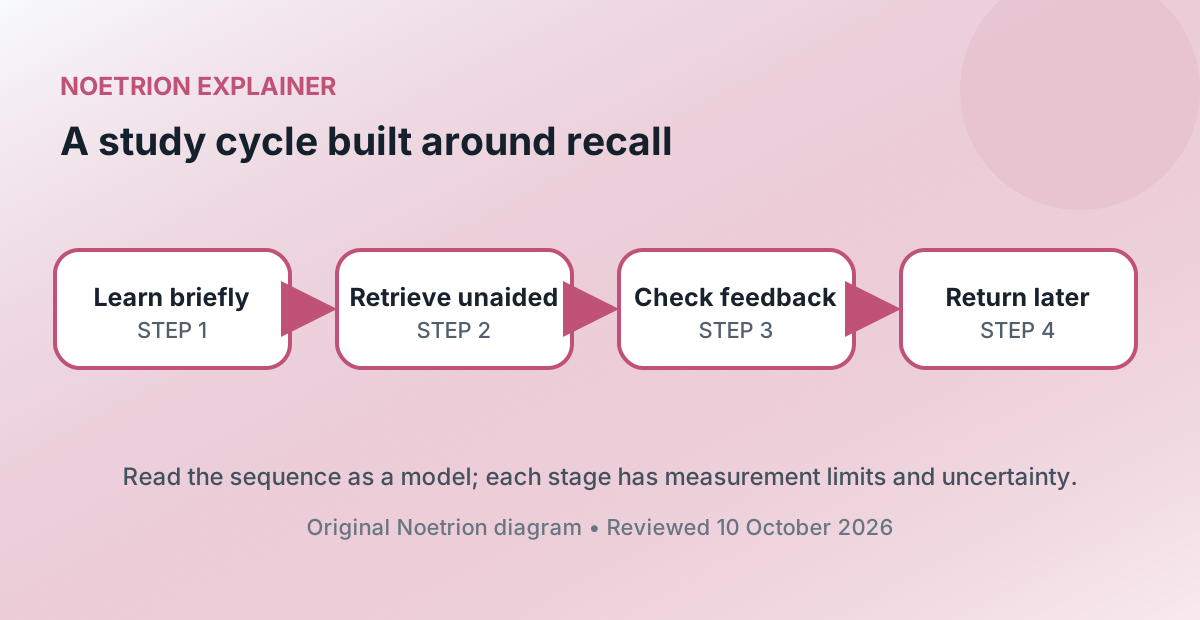
Retrieval and spacing work together because they place productive difficulty at the center of study. You try, expose what is missing, receive feedback, and return after time has passed. That loop produces evidence of learning rather than only the feeling of studying.
A worked routine for turning a video into recall
After a ten-minute lesson, close the video and write its main claim, the mechanism, and an example from memory. Reopen the source and correct errors in a different color. On your next review, explain the mechanism without the transcript; later, solve a fresh problem or identify where the explanation stops applying. Repeating an incorrect answer without feedback would reinforce the wrong lesson.
| Illustrative review | Task | What to record |
|---|---|---|
| First session | Understand one worked example | Which step you cannot explain |
| Next day | Recall without notes | Missing or incorrect ideas |
| Day 3 or 4 | Solve a fresh problem | Whether you chose the right method |
| About a week later | Mix related topics | Whether similar concepts remain distinguishable |
This is a planning example, not an optimal schedule established for every learner. Shorten an interval after repeated failure, add instruction where understanding is missing, and extend intervals after reliable recall. A 2025 classroom-focused meta-analysis supports distributed practice while documenting variation across educational contexts.
For a suggested 25-minute session, spend five minutes recalling, ten solving, five checking, and five recording errors and scheduling the next review. The timing is a practical suggestion. Track delayed success on unfamiliar problems, rather than time spent rereading. Use the worked mistake log to see what such a record looks like.
Primary sources and further reading
- Carpenter et al., The science of effective learning with spacing and retrieval practice
- Roediger and Karpicke, Test-enhanced learning
- Dunlosky et al., Improving Students' Learning With Effective Learning Techniques
- Institute of Education Sciences, Organizing Instruction and Study to Improve Student Learning