A Technical Study Mistake Log: Turn One Wrong Answer Into a Better Week
Build a compact error log, repair a Python aliasing mistake, and plan a worked study week around independent retrieval and unfamiliar applications.
“I need to study harder” is difficult to act on. “I thought assigning a list created a copy” gives you a specific idea to repair. A technical mistake log turns an unsuccessful attempt into a small learning task, then checks whether the repair survives after the example disappears.
Retrieval-practice research supports the value of trying to recall material instead of relying only on restudy. The Learning Scientists provide practical materials on retrieval and spacing. This log and the worked week below are an original adaptation; their exact timing is a flexible example, not a research-established optimum.
Log the cause, not the embarrassment
| Field | What to write |
|---|---|
| Task | The prompt and the conditions of the attempt. |
| My answer | What you actually predicted or produced. |
| Expected answer | The verified result and its source or calculation. |
| Cause | The missing distinction, wrong rule, or execution slip. |
| Repair | A contrast example or explanation targeting that cause. |
| Retest | A new question and a later date. |
Keep confidence as an optional field. A confident wrong answer deserves attention because it can survive ordinary rereading. Avoid assigning every failure to carelessness; that label does not tell you whether to practice method selection, notation, assumptions, or checking.
Work one Python mistake completely
a = [2, 4]
b = a
b.append(6)
print(a)  # [2, 4, 6]
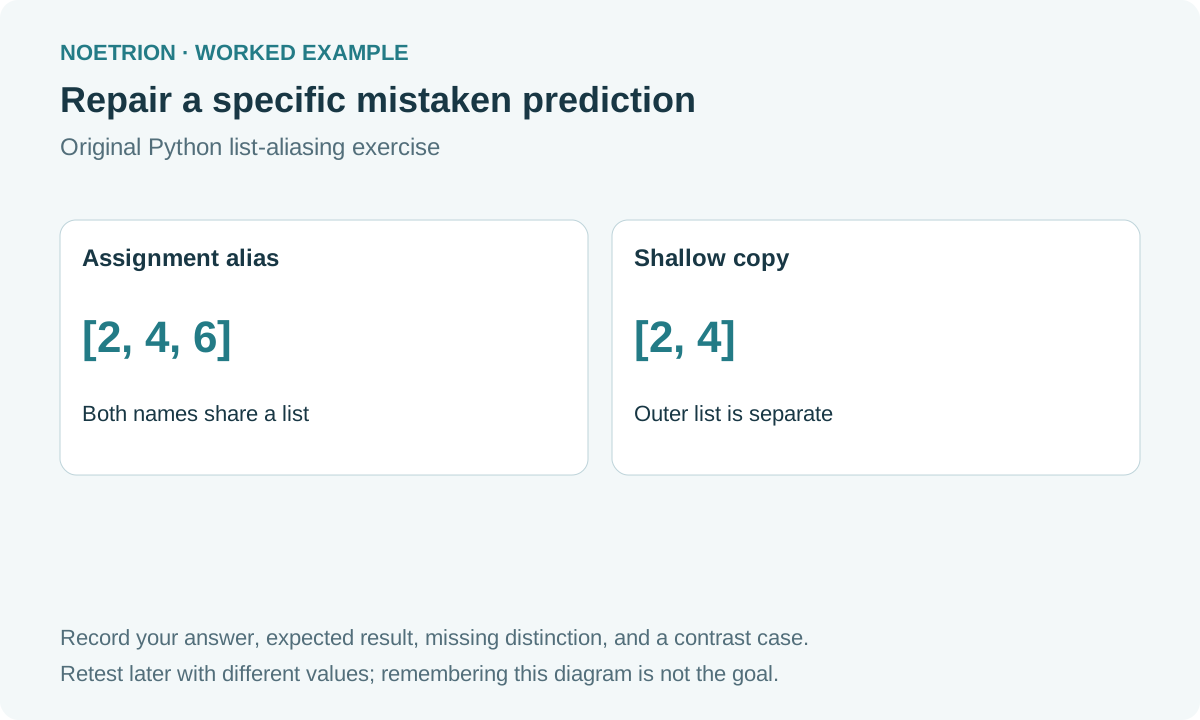
Suppose you predicted [2, 4]. The problem is not the behavior of append(); it is the assumption that b = a copies the list. Both names refer to the same list. The repair is to compare assignment with an explicit shallow copy:
a = [2, 4]
b = a.copy()
b.append(6)
assert a == [2, 4]
assert b == [2, 4, 6]
Now write a contrast prompt: “Predict what changes when two names share a list, and what changes when one list is copied.” On the next attempt, use different values and replace an element instead of appending. That variation checks the concept rather than memory of one printed output. Nested mutable elements require a further distinction; a shallow copy does not recursively copy everything inside.
Separate three kinds of technical failure
A knowledge gap means you cannot state the rule. A method-selection gap means you know several rules but choose the wrong one. An execution slip means you choose the correct approach but make an identifiable arithmetic or syntax error. Repairs should differ: explanation, contrasting tasks, or a checking routine respectively.
For example, a probability task asking for the first success on trial three uses a geometric waiting-time model under independent trials with a constant success probability. With p = 0.4, the probability is 0.6 × 0.6 × 0.4 = 0.144. A fixed number of successes across a fixed trial count asks a different question. Log that distinction before assigning more identical calculations.
Try a two-hour worked study week
| Day | Time | Independent task |
|---|---|---|
| Monday | 35 minutes | Study a small topic, attempt three questions, and log one precise error. |
| Tuesday | 20 minutes | Explain the repaired rule closed-book, then test a changed example. |
| Thursday | 25 minutes | Mix the topic with a similar-looking task and justify the method. |
| Friday | 15 minutes | Correct one remaining gap with a short contrast example. |
| Sunday | 25 minutes | Attempt an unfamiliar application and update the log from evidence. |
Move sessions when your timetable requires it. If an assessment date is known, add a timed practice session before it; do not let a generic schedule invent a deadline. Repeat a difficult item sooner, while allowing secure ideas to wait longer.
Use help after committing to an attempt
Ask a tutor or AI assistant for a hint that targets the cause you recorded. Preserve your original answer before viewing a solution. Verify code by running it and numerical work against a reliable course source or a hand calculation. Generated feedback can be wrong, so it should not become the only authority in the log.
Close an item only after you can explain the distinction and solve a changed problem without the original model. The log is not another notebook to polish. Its value is the next independent attempt it causes. For the broader learning principles, see the spaced retrieval guide.