An AI-Generated Game Becomes Easier to Trust When Its Rules Can Be Tested
Turn a playable AI-generated prototype into a reviewable game. Define state invariants, test repeated actions and save recovery, and separate demos from release evidence.
The first generated prototype looks convincing. A character moves, a button spends coins and a progress bar fills. The next useful question is what happens when the player clicks twice, reloads midway or opens an older save after the rules change.
On 7 October 2026, Google introduced Playground, describing an experimental platform for creating, playing and sharing games through prompts. This is an October development, not a new announcement today. It illustrates how quickly a playable experience can become available; the announcement is not independent evidence that every generated game has been tested for every release requirement.
The original checklist below applies to a separate fictional browser-game prototype. It makes no claim about a defect in Playground or another named platform. Its purpose is to turn “it seemed to work” into a small set of behaviors someone else can verify.
Write the state before polishing the screen
List the values that determine the game: balance, inventory, unlocked stages, active run and save version. Then identify which actions may change each value.
A visual label can disagree with the underlying state. Updating the displayed coin count does not prove that the stored balance changed, and changing the stored balance does not prove that the next screen will read it correctly.
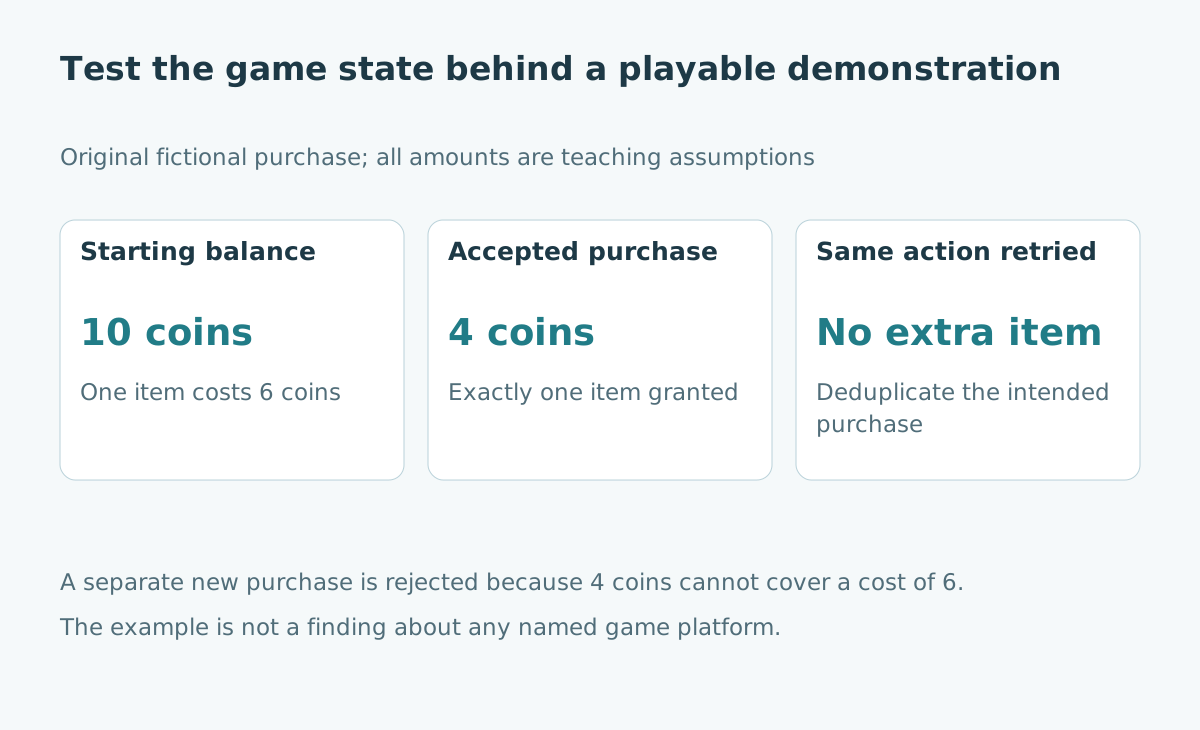
For an original release note, describe the result of each action in terms of state. “The purchase animation plays” is weaker evidence than “one authorized purchase changes balance from ten to four and grants exactly one item.”
Define invariants that remain true
An invariant is a condition the game should preserve across permitted actions. In this fictional prototype, a balance cannot be negative, a unique reward cannot be granted twice for the same completion, and a locked stage cannot start before its unlock condition is met.
| Original rule | Checkable condition | Example test |
|---|---|---|
| Purchase requires enough coins | Cost is checked before acceptance | Attempt purchase with four coins and cost six |
| One intended purchase grants one item | Repeated submission does not repeat the effect | Double-click the same pending action |
| Reward follows a valid completion | Failure cannot grant the completion reward | End a run unsuccessfully |
| Save preserves accepted progress | Reload reconstructs the same valid state | Buy once, save, reload |
The rules must match the intended design. A repeatable consumable purchase is different from a unique reward, so do not impose uniqueness where the game deliberately permits repetition.
Trace one action from start to finish
Start with ten coins, no item and an item cost of six. A valid purchase leaves four coins and one item. A second independent purchase should be rejected because four is less than six.
Now distinguish a repeated delivery of the first action from a genuinely new action. If the interface resends a pending purchase after a delay, the game should follow its defined transaction identity and recovery policy rather than blindly granting another item.
The state arithmetic is simple. The important implementation question is where acceptance, balance deduction and item grant become effective together. A button disabled on screen is useful feedback but should not be the only protection for a consequential shared state.
Test the less convenient paths
Try insufficient balance, repeated input, an interrupted animation, a lost response and a reload after acceptance. Decide what should happen before running the test.
For a local single-player prototype, the required behavior may be modest. For a shared leaderboard, paid item or multiplayer economy, the authority and recovery requirements are different. Define that scope rather than assuming every game needs the same infrastructure.
Record the starting state, action, expected state and observed state. A screenshot of the final screen can support the record, but the actual saved or authoritative state may also need inspection.
Know where the save lives
MDN's Web Storage reference distinguishes browser localStorage from session storage and describes their scope. A browser-local save can be appropriate for a small prototype. It does not, by itself, establish cross-device synchronization or a trusted shared leaderboard.
MDN's client-side storage guide provides context for separating browser storage from server-side data. Choose the persistence design according to the actual product promise.
If a prototype promises “your progress is saved,” explain the relevant boundary. The player needs to know whether that means this browser, this account or an exported file that can be restored elsewhere.
Version the save format deliberately
Suppose version one stores an item as a string, while version two stores an object with an identifier and quantity. An old save may remain valid JSON while no longer matching the new schema.
Define how the game recognizes a save version, migrates supported older versions and handles unsupported or corrupted data. Preserve a recoverable copy when a migration could otherwise destroy the only progress record.
| Original save case | Expected review outcome |
|---|---|
| Current valid save | Load the same accepted state |
| Supported older save | Migrate under an explicit rule |
| Unsupported future version | Explain incompatibility without silent overwrite |
| Invalid or incomplete data | Follow a defined recovery path |
These are original test categories, not a prescribed implementation for any named platform.
Check progression as a complete path
A stage can work in isolation while the complete progression becomes impossible. Test the first unlock, a middle transition and the final available stage using the actual reward and requirement values.
For a fictional progression, list how a player earns the required resource and when it is consumed or merely checked. Confusing those two operations can make a visible unlock sequence differ from the intended economy.
Also test reset and restart behavior. If a reset removes progress, specify which state it removes and which it retains. The player should not have to discover the rule through an accidental loss.
Preserve a release candidate and its evidence
Generated revisions can change unrelated behavior. Keep a version that produced the test results, together with a short list of accepted rules and known limitations. Recheck the affected paths after a material change.
A demo proves that a selected interaction occurred under selected conditions. A release decision asks whether the required behavior is sufficiently supported for the intended audience and consequences. More visual polish cannot answer that question by itself.
Use a small release checklist that a second person can run. If its steps depend on the creator remembering an unstated rule, improve the checklist or the interface before relying on it.
Let the test results shape the next prompt
A precise revision request names the failed transition: “The second purchase was accepted with insufficient balance; preserve the non-negative-balance rule and the one-item grant.” That gives a generated-code workflow a concrete target.
After the change, repeat the failed case and nearby cases. Passing the original case does not establish that the repair preserved saving, resets or another purchase type.
For related tools, see data contracts and single-file publication boundaries. The broader habit is the same: define the state that matters, identify the acceptance boundary and inspect the evidence.
Sources and limits
- Google: Introducing Playground, 7 October 2026, checked 27 October 2026. Provider announcement, not an independent platform audit.
- MDN Web Storage API and client-side storage guide, checked 27 October 2026.
The game, economy and test checklist are original examples. No named platform's security, persistence or transaction behavior is asserted.