AI Infrastructure Investment: Read the Cash Flow Before the Growth Story
A worked worksheet separates capital spending, depreciation, operating cash, financing, and useful output when evaluating AI infrastructure.
A company announces a large AI infrastructure budget. The figure sounds like proof of confidence, but it leaves several questions unanswered: how much cash has actually been paid, when the equipment becomes usable, how long it will remain useful, and whether customers will pay enough to support it. You can investigate those questions without trying to predict the entire AI industry.
The IMF’s 2026 analysis discusses both potential productivity gains and risks from expensive, debt-financed AI investment. Use that macroeconomic context as a reason to examine company disclosures carefully. The worksheet below is an original, simplified teaching example; its amounts do not describe a real company.
Separate the five amounts people call investment
| Item | Question to record | Common confusion |
|---|---|---|
| Announced budget | Over what period, and is spending committed? | An intention is treated as completed spending. |
| Capital expenditure | What assets were acquired and what cash was paid? | A large cash outflow is mistaken for an immediate operating expense. |
| Depreciation | What useful life and residual value were assumed? | A noncash expense is treated as this year’s equipment payment. |
| Operating costs | What recurring power, staffing, and maintenance are needed? | Purchase price becomes the whole cost story. |
| Financing | Who supplied cash, at what cost, and with which obligations? | Funding is mistaken for revenue from customers. |
IAS 16 provides a framework for recognizing and depreciating property, plant, and equipment. The specific treatment in a real report depends on the applicable accounting framework, asset readiness, contracts, and disclosures. Start with the company’s accounting notes, rather than imposing this toy model on every business.
Work through one synthetic facility
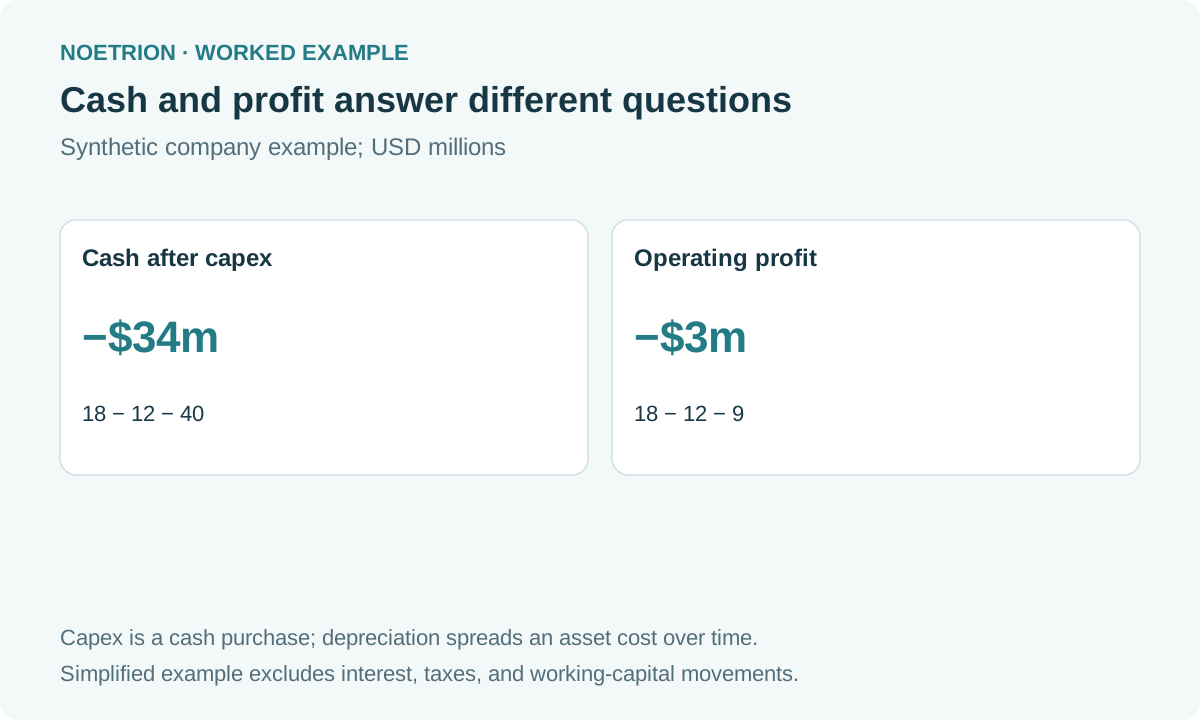
Assume equipment costs $40 million, is available for use at the beginning of the year, has a $4 million residual value, and is depreciated on a straight-line basis over four years. Annual depreciation is (40 − 4) / 4 = $9 million. Suppose the facility earns $18 million of revenue and incurs $12 million of cash operating costs. Ignore tax, interest, working-capital movements, and other assets for this exercise.
| Calculation | Result | Interpretation |
|---|---|---|
| Revenue − cash operating costs | 18 − 12 = 6 | Simplified operating cash contribution, before omitted items. |
| Revenue − operating costs − depreciation | 18 − 12 − 9 = −3 | Simplified operating loss. |
| Operating cash contribution − equipment payment | 6 − 40 = −34 | Cash still required in the acquisition year. |
| Equipment payment / annual cash contribution | 40 / 6 ≈ 6.67 years | Simple payback, ignoring residual proceeds and changing cash flows. |
The facility can generate positive operating cash while reporting an operating loss and requiring substantial acquisition funding. Those statements answer different questions. The payback estimate also extends beyond the assumed four-year equipment life, a prompt to examine replacement costs and later cash flows rather than declare the project successful.
Test the assumption that changes the story
Extend the assumed useful life to six years while keeping the residual value unchanged. Depreciation falls to $6 million annually, and the simplified operating result rises from a $3 million loss to zero. Customer cash receipts and the original equipment payment have not improved. A change in accounting estimates can affect reported profit without demonstrating a corresponding productivity gain.
Now lower revenue to $15 million with operating costs unchanged. Annual cash contribution becomes $3 million and simple payback becomes about 13.33 years. This sensitivity exercise shows why utilization, pricing, and customer retention deserve more attention than the size of an announced budget.
Keep a disclosure ledger
For each figure, save its report date, currency, reporting period, definition, and location in the filing. Separate outright purchases, leases, deposits, and future commitments where the report does. Record whether an AI customer is also an investor or financing counterparty; the IMF highlights interconnected financing as a potential risk, but a relationship alone does not establish improper accounting.
Your final page should contain the cash bridge, depreciation assumptions, operating-cost scope, and one downside case. Leave missing information visibly blank. The useful result is a set of answerable questions for the next report, not a confidence score manufactured from incomplete disclosures.