Medical AI Procurement: Questions for Hospitals and Patients
An evidence-request worksheet connects intended use, local workflow, alert workload, monitoring, and patient communication when evaluating medical AI.
This guide explains research and technology. It does not provide diagnosis or treatment, and regulatory status should be checked with the relevant authority.
A hospital can ask whether a device is authorized and still miss the question that matters locally: what exactly will change for staff and patients? The answer belongs in a procurement record that connects the device’s intended use to its evidence, the proposed workflow, and the people responsible for exceptions.
The FDA’s AI-enabled device resources identify authorized products and their regulatory context. Its transparency principles, developed with partner regulators, emphasize information for relevant audiences and the performance of the human–AI team. The worksheet below translates those themes into original questions for procurement discussions; it does not determine clinical eligibility or treatment.
Start with a one-page evidence request
| Topic | Question | Useful evidence |
|---|---|---|
| Intended use | Which task, population, equipment, and setting are covered? | Current labeling and relevant authorization record. |
| Validation | Where was performance tested, and who was excluded? | Study design, sites, reference standard, and uncertainty. |
| Local compatibility | Does the proposed workflow match those conditions? | Documented gaps involving equipment, staff, and patient mix. |
| Responsibility | Who reviews an unexpected output or a failed input? | Escalation ownership and an approved fallback process. |
| Updates | How will version changes and limitations be communicated? | Change notices, release records, and monitoring responsibilities. |
| Data handling | Where do inputs and logs go, and who can access them? | Data-flow description and applicable contractual controls. |
A slide with an accuracy percentage is not a complete response. Ask the vendor to tie each answer to a document, version, and page or section. A missing answer should remain an open item, rather than being replaced by a reassuring adjective.
Make invisible review work visible
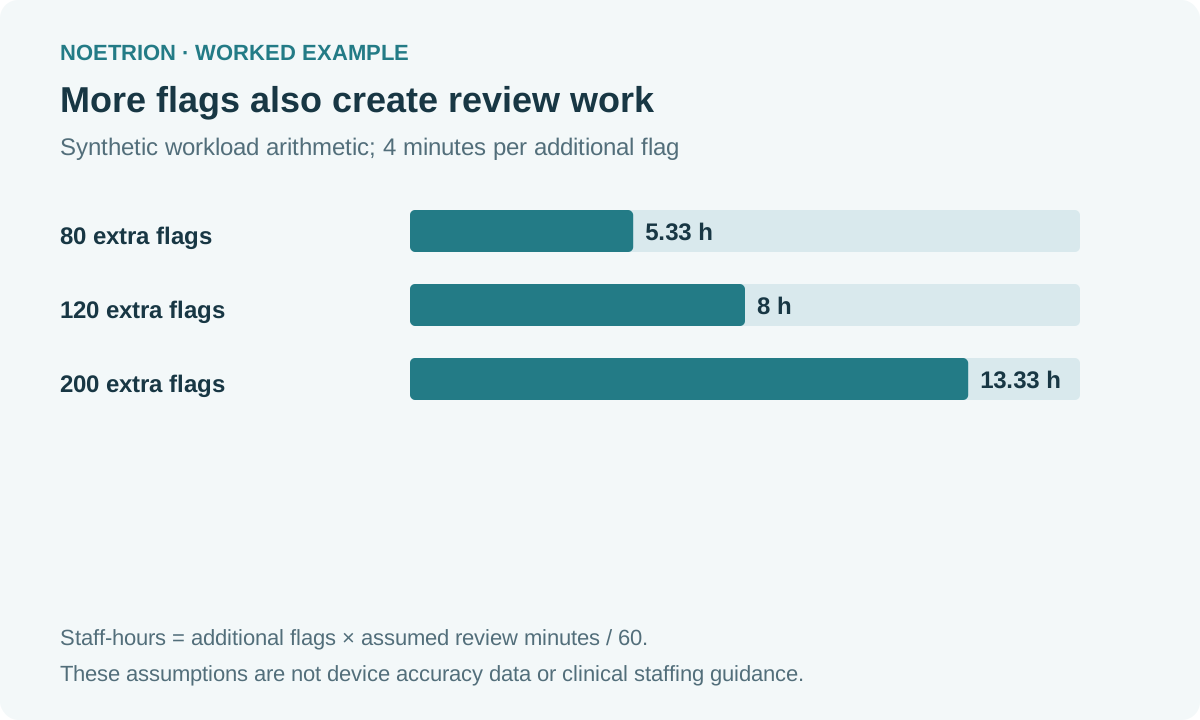
Consider a synthetic planning exercise involving 1,000 imaging cases. A proposed system flags 120 for a second review. If each additional review takes four minutes, the queue requires 120 × 4 = 480 minutes, or eight staff-hours. That calculation says nothing about diagnostic accuracy or whether those reviews are clinically justified. It simply exposes a workload that a procurement budget must account for.
Do not subtract those eight hours from existing work and call the result a saving. Staff may still perform the original interpretation, explain discrepancies, handle technical failures, and document decisions. Obtain local observations through an appropriately governed evaluation before claiming time savings. Record task boundaries consistently for the baseline and proposed workflow.
| Flags requiring additional review | Minutes per review | Additional staff-hours |
|---|---|---|
| 80 | 4 | 5.33 |
| 120 | 4 | 8.00 |
| 200 | 4 | 13.33 |
Document the decision before a pilot
A useful pilot plan names the authorized task, evaluation population, permissions, outcome measures, responsible clinical team, technical owner, and review dates. Separate clinical outcomes from operational measures such as failed inputs, review time, queue length, and system availability. Their importance differs, and one should not silently stand in for another.
Specify how the team will handle exceptions and record incidents under its approved procedures. Decide who can pause the evaluation and who authorizes a restart. Changes in equipment, software version, or workflow should trigger a documented assessment of whether the original evidence still applies. These are planning questions for the responsible organization, not instructions to patients about care.
Give patients understandable answers
Patients should not need a machine-learning course to understand the device’s role. A clear explanation can answer four ordinary questions: Is AI involved in this part of my care? What task does it help with? Who checks its output? Whom can I ask if I have a concern? The wording should reflect the actual device and local process, including meaningful limitations.
Procurement teams can ask patients and staff whether the proposed explanation is understandable, then revise it. A technically accurate description may still fail if it appears at the wrong point in the workflow or uses terms the audience cannot interpret. The FDA’s transparency principles address audience, content, placement, timing, and communication method.
Close the loop with an accountable record
For every unresolved question, record an owner, the evidence needed, and the decision it could change. Archive the documents considered, not only the final score. The outcome may be a request for additional evidence, a narrower pilot, or a decision that the current proposal does not fit the intended workflow.
For the conceptual distinction between authorization and real-world benefit, see Noetrion’s medical AI overview. This companion supplies the practical questions that turn that distinction into an inspectable procurement process.