AI Medical Devices: How to Read the Evidence Behind the Promise
Understand the FDA's 2026 generative AI discussion paper, device authorization, clinical evidence, human oversight and questions to ask before trusting a medical AI claim.
This guide explains research and technology. It does not provide diagnosis or treatment, and regulatory status should be checked with the relevant authority.
Reviewed October 12, 2026. This article explains medical technology evidence and the U.S. regulatory context; it does not provide diagnosis or treatment advice.
A hospital software demonstration can look convincing in less than a minute. A scanned document goes in, a polished summary comes out, and someone asks how soon the team can use it. The harder question arrives later: which patients, decisions, users, and failure conditions did the evidence actually cover? A smooth demonstration gives you something to investigate. It does not answer that question.
On August 18, 2026, the U.S. Food and Drug Administration opened a discussion about generative AI-enabled medical devices. The timing makes medical AI a useful subject to follow now. The enduring lesson is how to connect a product's promise to its evidence, without confusing an interesting prototype, a marketing authorization, and a demonstrated benefit in a particular workflow. FDA announcement.
What the FDA's 2026 discussion does—and does not—change
The discussion paper asks for input on risk assessment, premarket evaluation, postmarket monitoring, and related issues. Its webpage explicitly states that it is neither draft nor final guidance and does not propose or implement policy changes. Feedback is requested by October 19, 2026. That is the status checked for this article, not a prediction about what the agency will do afterward. Discussion paper and status.
This distinction matters when you read headlines. “FDA considers” describes a discussion. “FDA requires” describes a requirement that needs its own legal or regulatory basis. Replacing the first phrase with the second can turn a useful news update into a misleading instruction for developers or hospitals.
The paper's existence also does not mean that generative AI previously operated in a regulatory vacuum. Software classification depends on what a function is intended to do. A general writing aid, a clinician-facing decision support function, and software making a medical recommendation are not interchangeable descriptions. Readers should check the actual product function and applicable jurisdiction instead of treating “uses AI” as a complete classification.
Start with intended use, not the model's name
Consider a hypothetical document assistant that drafts a referral summary for professional review. Now imagine the same underlying model offered directly to patients as a tool that determines whether a symptom requires urgent treatment. The inputs may look similar, but the decisions, users, and consequences differ. Evidence for the first scenario cannot automatically be transferred to the second.
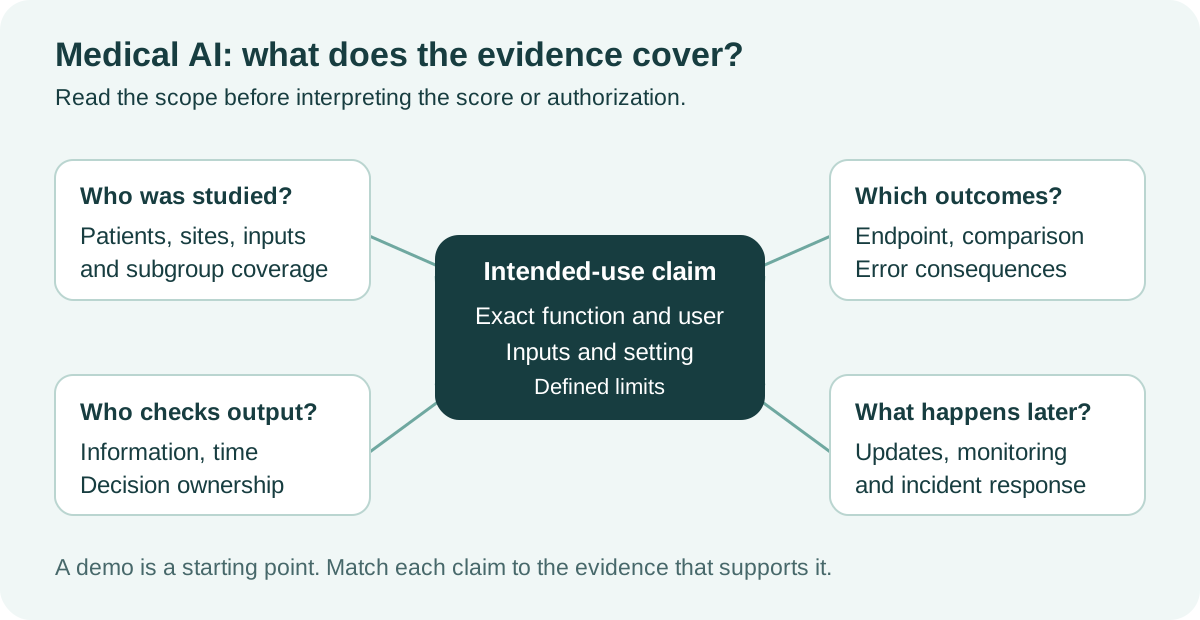
Write down the claim in an ordinary sentence: “This tool helps this user perform this task, using these inputs, in this setting.” Then ask what the tool is explicitly not intended to do. That negative boundary is useful information. A product might handle a limited document format or require a particular professional review process. A broader advertisement does not erase those boundaries.
The FDA's January 2026 clinical decision support guidance addresses software functions that may fall outside the device definition under specified statutory criteria, alongside functions that remain devices. It is not a blanket exemption for any product described as decision support. Final CDS guidance.
For a journalist, procurement analyst, student, or founder, the practical first step is simple: identify the function being discussed before deciding what an authorization or study tells you about it.
An authorization is attached to a device and its scope
The FDA maintains a list of AI-enabled devices authorized for marketing in the United States. It explains that entries have met applicable premarket requirements, including review relevant to their intended use and technological characteristics. The list is not comprehensive, and publicly released summaries do not contain everything submitted to the agency. FDA device list.
Consequently, a missing entry is not enough to conclude that a product is unlawful, while a listed entry is not proof that every AI application from the same company has been evaluated. Search the device name and submission number. Read the associated decision information. Record the precise function and version described where available.
Avoid upgrading the wording yourself. Clearance, approval, and authorization have specific meanings in their respective pathways. Using “FDA-approved AI” as a casual label for all entries can obscure the route and scope. A better article or purchasing note names the device and reports the language used in its actual record.
For readers outside the United States, the FDA record is evidence about U.S. status. It does not independently establish authorization, reimbursement, or permitted use in another country.
Read a study as a match between a question and a design
Suppose a fictional system summarizes discharge documents. A developer shows excellent agreement with expert-written summaries on historical records. That is valuable evidence about a defined evaluation. It still leaves questions about how busy users check the output, whether important omissions are noticed, and what happens when local documents differ from the test collection.
Retrospective evaluation uses previously collected material. Prospective evaluation plans observation as cases arise. These words do not form a universal ladder where every prospective study is automatically better. A carefully designed retrospective test can reveal important errors; a poorly designed prospective evaluation can still answer the wrong question. Look for a design appropriate to the claimed benefit.
The 2025 International Medical Device Regulators Forum principles emphasize intended use, representative data, independence of training and test data, clinically relevant testing, and human-AI interactions. These are useful questions to bring to an evidence review, rather than a promise that a single benchmark settles them. GMLP principles.
Ask what outcome was measured. Text similarity, expert ratings, workflow time, and patient outcomes are different endpoints. A claim about one should not silently become a claim about another. Also check the comparison: against which process, users, or baseline was the tool evaluated?
A practical evidence worksheet
Use the following table when reading a vendor page or study. The questions are an editorial worksheet, not a compliance checklist or substitute for specialist review.
| Question | Evidence to look for | A reason to keep investigating |
|---|---|---|
| What is the exact claim? | Defined function, user, inputs and setting | A product name is presented without its scope |
| Which product was evaluated? | Version, configuration and study dates | A new version inherits an old score without explanation |
| Who was represented? | Population, sites and meaningful subgroup information | Strong overall results conceal thin evidence for some users |
| What counted as success? | Endpoint definition and comparison process | A writing-quality measure is described as clinical benefit |
| What mistakes occurred? | Error types, omissions and consequences | Only a single headline score is available |
| What happens after release? | Monitoring, escalation and update processes | Responsibility ends at the demonstration |
Do not expect every answer to be public. Instead, distinguish “not reported in the material I read” from “not done.” That wording protects the integrity of your review and points to a specific follow-up question.
Human review needs a workable design
“A professional checks everything” sounds reassuring, but it is incomplete as a workflow description. In the fictional summarizer example, a reviewer needs access to the underlying record, time to inspect important details, and a clear way to reject or edit the draft. A button labelled “accept” does not tell you whether those conditions exist.
Imagine two interfaces. One displays the draft beside its supporting document and highlights uncertain information. Another displays only a fluent paragraph inside a crowded task queue. The same model output could create different review demands. This example is a design comparison, not a claim that either interface has been clinically validated.
During an evaluation, ask who owns the final decision and what happens when the system is unavailable. Ask which errors reviewers are instructed to search for. A review process should have a reasoned purpose; it should not be a ceremonial click that merely transfers responsibility to the user.
For non-specialist readers, the useful habit is to ask for the complete human-and-software process. This makes the discussion more concrete than arguing whether AI, in general, is trustworthy.
Updates make the evidence a continuing question
A product demonstration is tied to a moment. Operational use continues afterward. Documents, institutions, software configurations, and user habits may change. A reasonable investigation therefore asks how the organization notices performance problems and how a software change is evaluated before being relied upon.
The FDA's GMLP webpage presents the principles as relevant across the product lifecycle, building on international work rather than treating initial deployment as the finish line. FDA GMLP overview.
For a hypothetical procurement meeting, turn that idea into named responsibilities. Who receives reports of an omitted fact? Who can pause the tool? Which records establish the version used? Who informs users that behavior has changed? These questions do not require you to invent a universal update interval. They require the organization to explain its own process.
If the answers are unavailable, record the uncertainty. If the product changes substantially, revisit the comparison between the original evidence and the current claim. Evidence is more useful when its boundaries remain visible.
Frequently asked questions
Does appearing on the FDA list mean an AI tool works for every medical task?
No. The record concerns a particular device and the scope of its reviewed use. It does not validate unrelated functions, general-purpose chatbots, or every later configuration. Follow the submission record and product documentation before interpreting what a list entry establishes.
Is a high benchmark score enough to establish patient benefit?
A benchmark answers the question its design measures. It can support an investigation without resolving workflow performance or patient outcomes. Ask how the measured endpoint connects to the claimed benefit, and keep the unanswered steps explicit.
Carry the evidence through the device lifecycle
An authorization record, an intended-use statement, a local validation exercise, and post-deployment monitoring answer different questions. Keep a record of the model or device version, intended population, input requirements, human review, and conditions that trigger reassessment. A later configuration should not silently inherit every claim established for an earlier one.
The WHO publication on regulatory considerations for AI for health provides lifecycle context. Use it alongside the applicable jurisdiction's device record. For a practical comparison, the hospital procurement worksheet separates the seller's claim, the supporting study, local acceptance criteria, and unresolved evidence. This is an educational appraisal method, not a clinical recommendation.