AlphaFold Predictions: What the Confidence Colours Actually Mean
Interpret pLDDT and predicted aligned error, distinguish local geometry from domain placement, and learn when a predicted protein structure still needs experiments.
Reviewed October 12, 2026.
Interpret pLDDT and predicted aligned error, distinguish local geometry from domain placement, and learn when a predicted protein structure still needs experiments.
| Concept | What it means | Important limit |
|---|---|---|
| pLDDT | Per-residue local confidence from 0 to 100 | Not a measured atomic uncertainty |
| PAE | Expected positional error between residue pairs | Must be read as a matrix |
| Domain | A structural unit that may be locally confident | Relative domain orientation can remain uncertain |
| Database model | A prediction for a selected sequence | May omit ligands, states, or complexes |
1. A predicted model is coordinates plus uncertainty
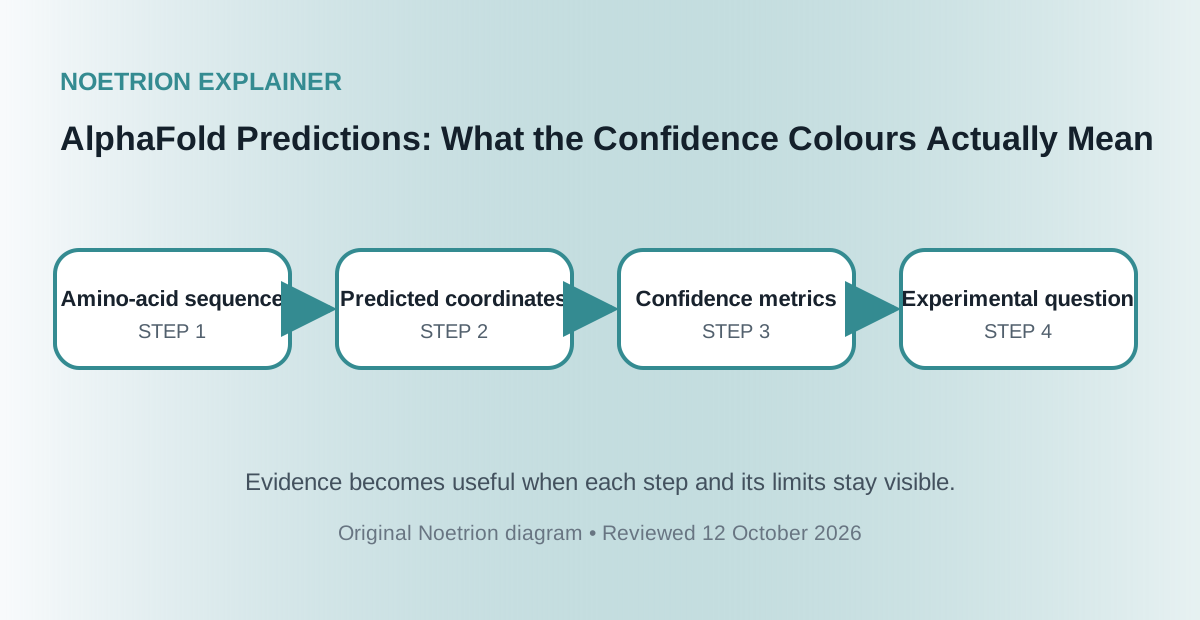
AlphaFold takes an amino-acid sequence and produces a three-dimensional model together with confidence estimates. The coordinates are a hypothesis about one structural arrangement, not a direct image of molecules in a sample. Confidence values help researchers decide which regions can support structural reasoning and which should be treated cautiously. The most responsible workflow views the model, examines its metrics, compares biological context, and designs follow-up work. Downloading a PDB file without its confidence information discards part of the scientific result.
2. pLDDT describes local confidence residue by residue
The predicted Local Distance Difference Test score, pLDDT, runs from 0 to 100 and is commonly shown by color. High values suggest that local backbone and side-chain neighborhood geometry is likely to be modeled accurately. Lower values indicate uncertainty and can occur in intrinsically disordered regions, flexible linkers, or areas with weak evolutionary information. A protein can have a high average while containing an important low-confidence segment. Researchers should inspect the residue-level pattern instead of reporting one mean score for the entire chain.
3. Local accuracy does not fix the arrangement of domains
Two domains may each have high pLDDT while their orientation relative to one another is uncertain. Predicted Aligned Error, or PAE, addresses this by estimating how confidently residue i can be positioned relative to residue j after alignment. The result is a matrix, not one quality number. Blocks of low predicted error can reveal internally coherent domains; high error between blocks warns against treating their relative placement as fixed. This distinction is crucial when inferring active-site access, mechanical motion, or interaction surfaces.
4. Sequence choice determines the question being answered
A database entry corresponds to a particular protein sequence record. Alternative splice isoforms, mutations, signal-peptide processing, proteolytic cleavage, and post-translational modifications can change the biologically relevant form. The cellular protein may also join other chains or membranes. Before interpreting a model, verify species, accession, isoform, residue numbering, and construct boundaries. A beautifully confident prediction for the wrong sequence is still the wrong object for the experiment or clinical variant under discussion.
5. Proteins do not have only one frozen shape
Many proteins move between conformations as they bind partners, catalyze reactions, or respond to modification. A predicted static structure may resemble one low-energy or data-supported state while missing an open, closed, inactive, or transient state. Disorder can be functional rather than a prediction failure. Confidence therefore should not be translated into rigidity. Molecular dynamics, biophysical experiments, homologous structures, and biochemical data can reveal an ensemble that a single coordinate set cannot represent.
6. Ligands, cofactors, membranes, and partners change interpretation
The large AlphaFold database primarily made monomer predictions available at enormous scale. Many biological functions depend on metal ions, heme, nucleic acids, small molecules, lipids, or protein complexes. Missing context can reshape loops, stabilize folds, or create interfaces. Even when a newer model predicts complexes, confidence and training-domain limits still matter. A putative pocket is not automatically druggable, and predicted binding is not an affinity measurement. Experimental controls remain necessary for mechanistic and therapeutic claims.
7. Experimental structures answer additional questions
X-ray crystallography, cryo-electron microscopy, nuclear magnetic resonance, cross-linking, and other techniques observe samples under stated conditions. They can reveal ligands, stoichiometry, alternate conformations, density support, and heterogeneity. Experiments also have limitations and model-building choices; they are not flawless ground truth. Prediction and experiment are complementary: a prediction can help molecular replacement or construct design, while observations test the state, interaction, and chemistry that computation proposes.
8. Use models to prioritize rather than certify
AlphaFold can accelerate hypothesis generation, identify plausible domains, suggest mutation sites, and extend structural reasoning to proteins lacking experimental models. Strong use cases state which residues have high local confidence, whether domain placement is supported by PAE, and what biological assumptions remain. Weak use cases present a colored rendering as proof of function. The difference is an audit trail from sequence to confidence to a falsifiable experiment. Prediction is most transformative when it makes the next test sharper, not when it removes testing.
Conclusion
AlphaFold changed structural biology by making high-quality hypotheses available at proteome scale. The confidence colors are not decoration: pLDDT qualifies local geometry and PAE qualifies relative placement. Reading both, together with sequence and biological context, turns a striking model into evidence that can responsibly guide experiments.