Antimicrobial Resistance: How Selection Becomes a Surveillance Problem
Follow resistance from genetic variation and antibiotic selection to laboratories and global surveillance, while avoiding simplistic claims that a person becomes resistant.
This guide explains research and technology. It does not provide diagnosis or treatment, and regulatory status should be checked with the relevant authority.
Reviewed October 12, 2026. This article is not individualized medical advice.
Follow resistance from genetic variation and antibiotic selection to laboratories and global surveillance, while avoiding simplistic claims that a person becomes resistant.
| Concept | What it means | Important limit |
|---|---|---|
| Resistance | A microorganism can survive a drug exposure | The patient’s body does not become resistant |
| Susceptibility test | Laboratory estimate for an isolate and drug | Results depend on method and breakpoints |
| Antibiotic use | Exposure that can select resistant variants | Necessary treatment still has benefits |
| Surveillance proportion | Resistant isolates among tested isolates | May not represent every infection in a country |
1. Microorganisms, not people, acquire resistance
Bacteria can carry mutations or genes that reduce a drug’s effect by changing the target, destroying the compound, pumping it out, or limiting entry. Antibiotic exposure kills susceptible competitors and gives resistant variants a relative advantage. A person can carry or be infected by resistant organisms, but saying the person is resistant obscures the mechanism. Resistance can also spread horizontally through mobile genetic elements, so selection in one setting may influence organisms encountered elsewhere.
2. Antibiotics create selection but are also essential medicine
Use in humans, animals, and agriculture can increase selection pressure, especially when exposure is unnecessary, too broad, incorrectly dosed, or poorly controlled. Yet avoiding all antibiotics would cause preventable harm. Stewardship aims to use the right drug, dose, route, and duration for a defined indication while obtaining cultures when useful and revising therapy as evidence arrives. The goal is better treatment with less avoidable pressure, not blaming patients who need effective care.
3. Resistance can carry costs and still persist
A resistance mechanism may slow growth in one environment, but compensatory mutations can reduce that cost. Genes can remain linked with other useful traits, and continued exposure in hospitals, communities, farms, or wastewater can preserve them. Removing one antibiotic does not guarantee immediate reversal because ecological and genetic histories remain. This is why resistance policy must combine prescribing, infection prevention, vaccination, sanitation, diagnostics, and environmental controls rather than relying on one behavior message.
4. Laboratories translate growth into categories
Clinical laboratories culture organisms or use validated molecular and automated methods, then interpret susceptibility using standardized breakpoints. A result such as susceptible, intermediate or increased exposure, and resistant connects measured inhibition or minimum inhibitory concentration with expected treatment at specified dosing. Breakpoints can change as evidence evolves. A gene detection may predict a mechanism but does not always replace phenotype. Reports need organism identity, specimen, method, quality control, and the standard used.
5. Surveillance starts with who was sampled
Resistance percentages are usually calculated among isolates submitted and successfully tested. Those samples may overrepresent severe disease, hospital patients, treatment failures, or regions with stronger laboratories. Countries differ in diagnostic access, specimen practice, site coverage, and data completeness. WHO’s GLASS framework standardizes key methods and assesses surveillance quality, but estimates still require context. A higher reported proportion can reflect real resistance, changing case mix, better detection, or several effects together.
6. Use denominators that match the question
The number of resistant isolates, the fraction resistant among tested isolates, infections per population, antibiotic consumption per inhabitant, and deaths attributable to resistance answer different questions. A growing count may reflect more testing; a stable percentage can coexist with more infections. Trend analysis should align pathogen, specimen, infection origin, age, setting, drug, breakpoint, and reporting sites. Collapsing all bacteria and antibiotics into one percentage hides clinically important variation.
7. One Health connects otherwise separated reservoirs
Humans, animals, food systems, soil, and water exchange microorganisms and genetic material. The strength and direction of pathways differ by organism and setting, so One Health should guide measured investigation rather than vague attribution. Integrated surveillance can compare antibiotic use and resistant organisms across sectors with compatible sampling. Interventions may include farm biosecurity, wastewater management, vaccination, clean water, hospital infection control, and restrictions on non-therapeutic use. Coordination matters because no sector can fully isolate itself.
8. Better access and better stewardship must advance together
In some places antibiotics are overused; elsewhere people die because effective drugs, diagnostics, or clinicians are unavailable. Policies that only reduce consumption can worsen inequity. Global action needs reliable supply, affordable diagnostics, trained laboratories, vaccination, sanitation, research incentives, and stewardship. New antibiotics should be protected from unnecessary use without being withheld from patients who need them. Surveillance is valuable when it directs this balance and reveals where first-line treatment is failing.
Conclusion
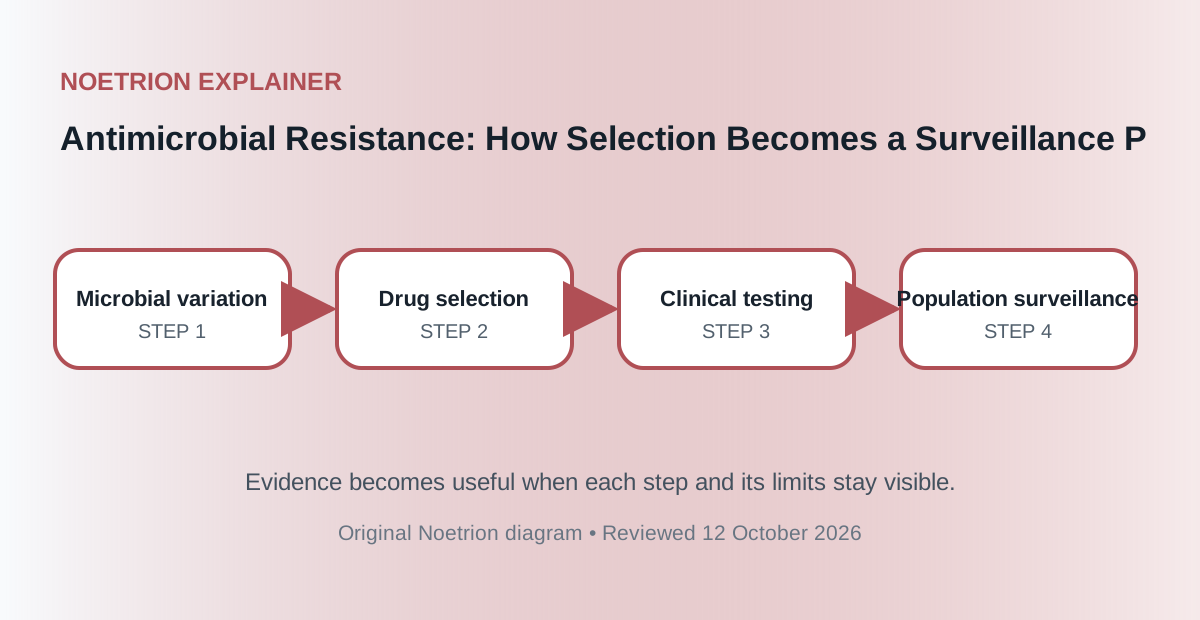
Antimicrobial resistance is an evolutionary process expressed through health systems. Drug exposure shapes microbial populations, laboratories classify individual isolates, and surveillance aggregates selected observations. Reading each layer with its proper denominator supports treatment, prevention, and policy without turning a complex global problem into a slogan about “using fewer antibiotics.”