APP Fraud Reimbursement: What the Headline Rate Does Not Tell You
Read UK APP fraud reimbursement data correctly, understand the scope of protection, and use an independent-verification worksheet before bank transfers.
Educational analysis, not a personal investment or payment recommendation. Check the dated sources and the rules that apply in your jurisdiction.
The payment screen can be completely genuine while the story behind the payment is false. In an authorised push payment scam, a person is deceived into sending money. The transfer may pass normal authentication because the account holder really did approve it. Authentication answers who approved a transaction; it does not prove that the recipient's explanation is honest.
That distinction is essential when reading reimbursement headlines. A high rate of money returned within an eligible category is not a promise that every transfer will be refunded. Understanding the boundary of protection helps you interpret the data, preserve useful evidence, and design checks that happen before money leaves the account.
Start with the latest verified reporting period
The UK Payment Systems Regulator's dashboard updated July 30, 2026 reports that 89% of the value of reimbursable APP scam claims was returned in Q1 2026, with reimbursement value of £72.6 million. It reports around 58,400 reimbursable claims closed in that quarter.
The dashboard covers UK Faster Payments claims, not every payment type, every jurisdiction, or every case of online fraud. It uses closed claims reported to payment firms within its stated reporting scope. The publication date is July; the quarterly measurement period ends in March. Do not call these October incident totals merely because the page was checked in October.
The regulator also cautions that comparisons with broader industry statistics are not direct because definitions, payment coverage, and calculation methods differ. This article therefore does not subtract two headline rates and call the difference a causal policy effect.
Distinguish four problems that look similar
The same phrase—“I lost money online”—can describe different legal and operational situations. Correct classification helps the payment provider route a report, though the customer does not need to solve the entire legal question before asking for help.
| Situation | Illustrative event | Why classification matters |
|---|---|---|
| APP scam | You send money after an impersonator deceives you | You authorised the transfer, but under deception |
| Unauthorised fraud | Someone makes a payment without your permission | Different protection and investigation rules may apply |
| Civil dispute | A legitimate supplier provides defective goods without fraudulent intent | A contractual or consumer-rights route may be relevant |
| Genuine payment mistake | You enter the wrong recipient details without deception | Recovery is different from proving an APP scam |
The PSR's consumer protection explanation distinguishes APP fraud from unauthorised fraud and civil disputes. A disappointing purchase is not automatically a scam, and an authorised payment is not automatically excluded from fraud protection.
For readers outside the UK, use the distinctions as a conceptual map, then check your own regulator and provider's rules. UK reimbursement requirements do not travel with an app's brand into every country where the app operates.
Understand the boundary of the UK protection
The PSR's consumer guidance covers protected UK individuals, microenterprises, and charities making relevant UK Faster Payments or CHAPS transfers from October 7, 2024. Cards, cash, and cheques have different protections. Eligibility and exceptions require assessment.
The maximum mandatory reimbursement is £85,000. Providers may apply an excess up to £100, excluding vulnerable consumers. The guidance describes an expected five-business-day process, possible information-gathering pauses, and an outcome within 35 business days. Report promptly and within 13 months of the payment. These rules were checked October 14, 2026; they are UK rules, not global app guarantees.
These are boundaries, not reasons to wait. Early reporting may help the provider trace a transfer and act on an account. Equally, the existence of a cap is not evidence that a particular loss will qualify. This overview is based on consumer guidance; a disputed case depends on the facts and applicable rules.
Audit the denominator before interpreting a rate
Imagine a fictional provider receiving 100 reports with a total reported loss of £200,000. After investigation, 80 reports with £150,000 of loss are classified within the reimbursable category. The provider returns £135,000 across 72 of those reports. These invented numbers deliberately separate three different rates.
| Calculation | Result | What it describes |
|---|---|---|
| £135,000 ÷ £150,000 | 90.0% | Returned value within the reimbursable category |
| £135,000 ÷ £200,000 | 67.5% | Returned value across all reported losses in this example |
| 72 ÷ 80 | 90.0% | Share of eligible reports receiving some reimbursement |
| 72 ÷ 100 | 72.0% | Share of all reports receiving some reimbursement |
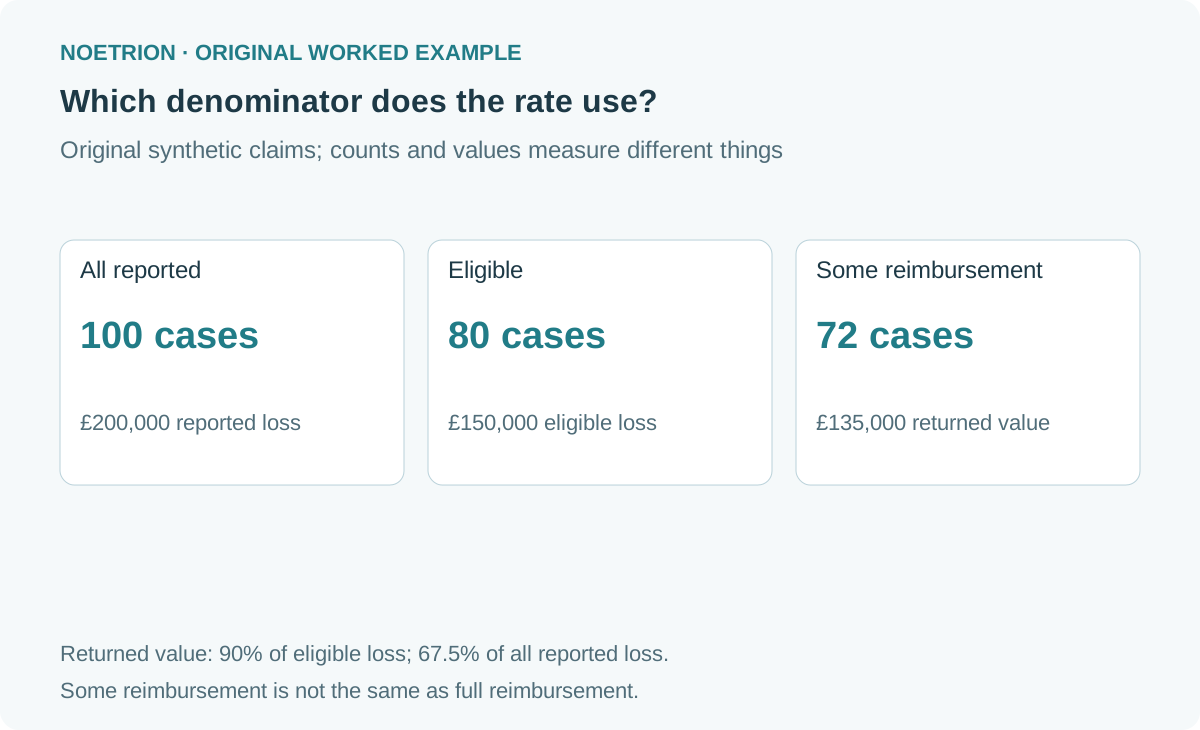
The two 90% results happen to match because of the example's chosen numbers. In actual data, case rates and value rates can differ substantially. A few large losses may dominate the value measure. “Received some reimbursement” also does not mean “recovered the full amount.”
Before using a dashboard in a product comparison, record what the numerator includes, what the denominator excludes, whether cases are closed, and whether rejected reports remain in the denominator. A percentage without that information is incomplete evidence.
Verify the instruction independently
A practical payment check should challenge the story, not merely inspect the payment screen. Suppose a supplier emails new bank details shortly before an invoice is due. The change could be legitimate, or the message could be fraudulent. A familiar signature and an accurate invoice number are not sufficient proof.
Use a contact method already established before the change. Call the supplier using a number from your existing records, not the number supplied in the same change request. Confirm both the change and who has authority to request it. This is an operational recommendation inferred from the impersonation problem, not a guarantee against all fraud.
Confirmation of Payee, where available, provides an account-name check. The PSR recommends paying attention to this and other bank warnings. Treat a warning as a reason to stop and investigate. Even a matching name does not prove that a promised investment exists or that the transfer's stated purpose is legitimate.
A small test payment has a limited role. It can establish that money reached the details entered, but it does not establish that the person requesting the payment is honest. Do not let successful delivery replace independent verification of ownership and purpose.
Use a worksheet that creates a real stopping point
An effective checklist has an owner who can delay the transfer. If it is completed after payment or if nobody is allowed to challenge an urgent request, it provides documentation without much prevention.
| Verification field | What to record | Stop condition |
|---|---|---|
| Reason for payment | Invoice, agreement, or other legitimate purpose | Purpose cannot be independently established |
| Recipient change | Whether account details or contact channels changed | Unverified change request |
| Independent contact | Established channel and person confirming | Only the requesting message can be used |
| Account-name result | Match, mismatch, unavailable, and any warning | Warning cannot be resolved |
| Approval owner | Person authorised to approve this amount | Approval is missing or ambiguous |
| Pressure indicators | Secrecy, urgency, or requests to bypass checks | Request conflicts with normal controls |
For a small business, separate the person changing recipient details from the person approving a significant payment where feasible. Choose thresholds based on your actual exposure and staffing rather than copying an arbitrary amount. Keep legitimate urgent-payment exceptions documented and subject to later review.
For a household, the worksheet can be shorter: what is the payment for, how did you verify the person, and what would make you stop? Involve a trusted person when pressure or confusion makes it difficult to evaluate the story. A respectful pause is more useful than blaming someone after a convincing deception.
Preserve evidence and report promptly
If a payment may be fraudulent, contact your payment provider immediately through a trusted channel. Save payment references, amounts, times, recipient details, and the communications that led to the transfer. Preserve the original messages where possible; a cropped screenshot can remove information needed to reconstruct events.
Write a factual timeline. Separate what the sender claimed from what you independently verified. For example, “the caller said they represented the bank” is more precise than “the bank called” when the caller's identity is uncertain. Tell the provider about other transfers connected to the same incident.
The PSR's complaints guidance says the provider is the first point of contact; the regulator does not investigate individual reimbursement cases. If the provider's response is unsatisfactory, use its formal complaints process and the appropriate escalation route. Avoid copying sensitive financial evidence into public comments or sending it to someone who contacted you offering paid recovery.
What payment teams should measure next
Reimbursement is a remedy after loss. A stronger operational review also asks how quickly suspicious changes are detected, whether staff can interrupt a transfer, and whether controls create avoidable friction for legitimate customers. Measure these separately instead of assuming a high reimbursement rate proves good prevention.
Review a sample of both blocked and completed transfers. For each, examine the evidence available at the time, not only what became obvious afterward. Track why legitimate payments were delayed so that verification can improve without becoming an indiscriminate obstacle.
A short monthly exercise can test one scenario: changed supplier details, an impersonated authority, or a request to move funds urgently. The learning outcome is whether someone identifies an independent verification channel and a stopping point. It is not whether they can memorize every scam label.
The Verification of Payee explainer compares another jurisdiction’s account-name checks without treating them as fraud guarantees.
Sources and verification notes
- PSR APP reimbursement dashboard, updated July 30, 2026: reporting period, quarterly results, denominator notes, and coverage limitations.
- PSR APP reimbursement consumer guidance: scope, timelines, reporting window, cap, and excess.
- PSR frequently asked questions: provider-first reporting and complaint routes.
Checked October 14, 2026. The numerical funnel is fictional and independently recalculated. Verification recommendations are practical editorial analysis, not promises of prevention or a legal determination of an individual claim.