Instant Euro Payments: Why Speed Alone Does Not Make a Transfer Safe
Instant euro payments are fast and available around the clock. Learn how verification of payee works, where risks remain, and what businesses should change.
Educational analysis, not a personal investment or payment recommendation. Check the dated sources and the rules that apply in your jurisdiction.
A payment arriving in seconds sounds like an uncomplicated win. For a freelancer waiting on an invoice, it often is. But when money moves almost immediately, an incorrect account number or convincing scam can become harder to recover from.
That tension explains why Europe's instant-payment reforms pair speed with a second feature: verification of payee. According to the European Central Bank, providers subject to the euro-area 2025 deadlines were required to support receiving instant euro payments by 9 January 2025 and sending them by 9 October 2025. Verification-of-payee obligations for the euro area also took effect on 9 October 2025. Other countries and types of institutions have later deadlines: euro-area payment institutions and electronic-money institutions have a 9 April 2027 instant-payment deadline. Charges for instant euro transfers cannot exceed those for corresponding standard credit transfers, according to the linked ECB guidance.
What happens during an instant transfer?
A conventional bank transfer may involve cut-off times and delayed settlement. An instant euro credit transfer is designed to be available around the clock, including weekends. The European Commission says the 2025 changes made it possible for people and businesses across the eurozone to send euro payments within seconds.
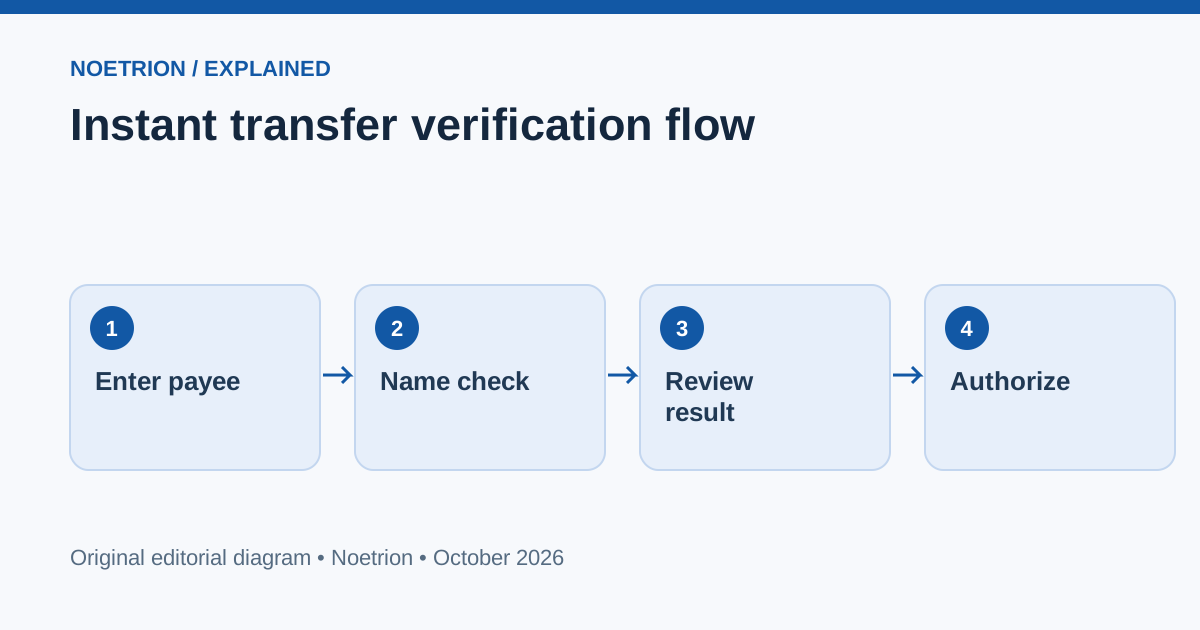
Yet the customer experience contains several steps: the payer enters a recipient, the bank checks the account details, the payer confirms the transfer, and the payment is processed. Faster infrastructure does not eliminate the possibility that the payer was tricked into authorizing the wrong destination.
Verification of payee is a warning system, not a guarantee
The ECB describes verification of payee as a service comparing the beneficiary name with the account identifier before the payment is initiated. The response can indicate a match, close match, no match or another status.
| Verification response | What it suggests | Sensible payer action |
|---|---|---|
| Match | The submitted details are consistent | Continue only if the payment itself is legitimate |
| Close match | There may be a spelling or formatting difference | Confirm the recipient through a trusted channel |
| No match | The name and account may not belong together | Stop and independently verify details |
| Other/unavailable | A conclusive comparison was not returned | Do not treat the absence of a warning as approval |
The ECB says the verification service must be free to the payer. Importantly, a matching name does not prove that an investment offer, invoice or emergency request is genuine. It verifies account details, not the underlying story.
A practical workflow for small businesses
Imagine a design agency receives an email saying a supplier has changed bank accounts. The email looks authentic and the invoice amount is familiar. An employee enters the new IBAN and receives a name match. Should they pay?
Not yet. A criminal may control an account with a plausible matching name. The safer procedure is to confirm bank-detail changes using a previously verified phone number or supplier portal, not the contact information in the change request.
A simple policy can prevent expensive mistakes:
- Require independent confirmation for new beneficiaries and changed account details.
- Use dual approval for unusually large or urgent transfers.
- Record the invoice, recipient verification result and approver.
- Train staff to recognize pressure tactics and altered email threads.
- Establish an incident contact at the bank before an incident occurs.
These steps apply to many payment rails, not only euro instant payments.
What about fees and cross-border payments?
The EU regulation includes requirements concerning charges for instant credit transfers. However, customers should still read their provider's actual terms, especially for currency conversion, international transfers outside the covered scheme, and business account services. A “seconds-fast” domestic euro transfer is not the same product as a complex cross-border payment involving foreign exchange.
What consumers should remember
Instant payment infrastructure can improve cash flow, convenience and competition. It cannot replace skepticism. Treat a beneficiary warning as a reason to stop; treat a successful match as only one check among several.
The best payment experience is not merely the fastest one. It is one in which a customer understands whom they are paying, why they are paying, and how to challenge a mistake.
FAQ
Can an instant euro payment be sent on a Sunday?
The system is designed for round-the-clock availability. Specific account and service eligibility still depend on the provider and regulatory timetable.
Does a name match mean a payment is fraud-free?
No. It checks consistency between the account identifier and payee name, not whether the transaction is legitimate.
Sources and further reading
- ECB, Instant Payments Regulation
- European Commission, new EU rules for instant payments, 10 October 2025
Editorial notes
Visual: Instant transfer verification flow. Original diagram: payer enters beneficiary, bank compares name and IBAN, payer reviews the result, payment is authorized.
Verification note: Facts were checked against the linked primary or specialist sources on 13 October 2026. Forecasts are labeled as forecasts, illustrative calculations as hypothetical, and the article does not constitute personalized legal, medical, or investment advice.