Tokenised Deposits Are Reaching Live Payments: What Actually Changes?
Understand the September 2026 UK tokenised deposit pilots, how programmable bank money differs from stablecoins, and what users should check before adoption.
Educational analysis, not a personal investment or payment recommendation. Check the dated sources and the rules that apply in your jurisdiction.
Reviewed October 12, 2026. News context is dated; the payment examples and evaluation framework below are explanatory, not product recommendations.
Imagine buying a used camera from someone you have never met. The seller wants payment before handing it over. You want to inspect it before paying. A faster transfer does not solve that disagreement. What would help is a payment that waits for an agreed condition, then releases the money without either person having to trust the other completely.
That is one reason tokenised deposits deserve attention beyond the cryptocurrency audience. The useful question is whether bank money can support better transaction workflows, with understandable rights and reliable ways to resolve mistakes. The token itself is only part of that problem.
On September 24, 2026, UK Finance reported live customer transactions using tokenised sterling deposits. Its Great British Tokenised Deposit initiative included two remortgage completions and a consumer marketplace transaction. These were bounded live use cases, not evidence that every UK customer can now use a universal tokenised payment service. The distinction matters when reading an announcement that sounds like the future has already arrived.
What is a tokenised deposit?
A tokenised deposit represents a claim on a commercial bank using a programmable digital record. The central distinction is the underlying claim: whose liability do you hold, and what happens when you want conventional money back? Adding a blockchain does not turn a bank deposit into central bank money or remove the need to understand its terms.
In its August 2026 speech on stablecoins and tokenised deposits, the Bank for International Settlements describes an account-based model in which bank balances are debited and credited, with interbank settlement through central bank accounts. The BIS argues that this architecture can preserve exchange at face value across bank money. That is a policy argument about a particular design, not a guarantee about every product carrying the tokenised-deposit label.
For a reader encountering the term for the first time, the best starting point is therefore a balance-sheet question. If an app displays a digital pound, does that pound represent a bank deposit, a claim against a stablecoin issuer, or something else? Similar screens can hide very different arrangements underneath.
What the UK pilots demonstrated—and what they did not
UK Finance says the remortgage pilots locked deposit funds and released them at completion. The marketplace use case linked release to the exchange of goods. These are examples of conditional payment: money movement depends on a defined event. The announcement also discusses further digital-asset settlement pilots as future work. It does not establish nationwide availability, a published consumer fee schedule, or long-term fraud performance.
The practical significance is the move from a demonstration using test balances to transactions involving customers. That is a useful milestone. It still leaves substantial questions for any broader service: how often does it fail, how long does a disputed payment remain locked, which banks can participate, and how does a customer get help?
An announcement establishes that specified transactions occurred. A dependable service requires evidence about repeated operation, exceptions, capacity, recovery, legal obligations, and customer support. Readers should look for those later publications rather than treating the first successful transaction as the last stage of development.
Tokenised deposits, stablecoins, and central bank money
The comparison below describes common structures, not every possible implementation. Legal classification and protection depend on the product and jurisdiction.
| Question | Tokenised bank deposit | Fiat-referenced stablecoin | Central bank money |
|---|---|---|---|
| Whose liability is held? | A commercial bank's deposit liability | A claim or redemption arrangement involving the issuer | The central bank's liability |
| What deserves inspection? | Account terms, eligibility, settlement and deposit protection | Reserve arrangements, redemption rights and operational access | The specific access and settlement framework |
| Does a digital token guarantee interoperability? | No; networks can be restricted | No; chains and services can differ | No; interfaces and access rules still matter |
| Does automation remove disputes? | No | No | No |
| Is broad retail availability implied? | No | No | No |
The BIS's 2023 bulletin comparing stablecoins and tokenised deposits focuses on the singleness of money: money denominated in the same unit should exchange at face value. Its reasoning distinguishes bearer-like private instruments from deposits settled in central bank money. That makes settlement architecture more important than a superficial comparison of transfer speed.
Avoid extending this distinction into an absolute ranking. A regulated bank can still experience operational problems. A stablecoin can have specific redemption arrangements that require careful reading. Identifying the claim helps you ask better questions; it does not complete due diligence by itself.
Programmable payments need a trustworthy condition
Consider the camera sale again. “Release the payment when the goods arrive” sounds precise until you ask what arrival means. A courier can confirm delivery to an address, but not necessarily the condition of the camera inside. A buyer can confirm receipt, but may delay confirmation. A marketplace can decide, but then its dispute rules become part of the payment arrangement.
This is an original hypothetical workflow, not a description of the UK pilot's implementation:
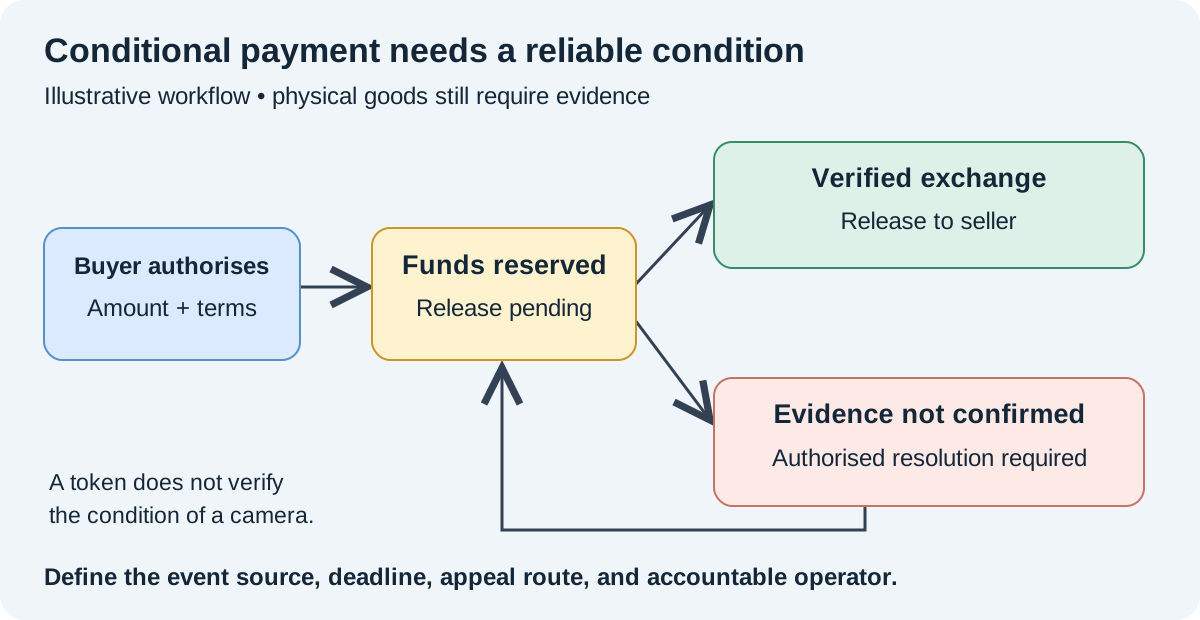
A good design needs an explicit event source, an agreed deadline, an exception route, and someone accountable for resolving ambiguity. “Programmable” describes the ability to apply rules. It does not establish that the rules are fair, the inputs are correct, or the software cannot fail.
The user experience should make the distinction between available and reserved funds visible. A buyer needs to know whether a locked balance can pay another bill. A seller needs to know whether confirmation creates an irreversible entitlement or whether a later dispute can reverse the transfer. These questions belong in plain-language terms before either side authorises payment.
Faster execution and stronger protection are separate claims
Suppose a payment workflow removes two manual checks. That could shorten a process. It could also remove opportunities to notice a mismatch. A credible evaluation should measure the completed transaction, including verification and exception handling, rather than only the time taken to update a ledger.
For a pilot, an analyst might request median completion time, the proportion requiring intervention, disputed-payment resolution time, and results separated by transaction type. Those are proposed evaluation measures, not reported outcomes from the September announcement. They help distinguish operational improvement from promotional language.
Fraud claims need similar care. A condition that prevents release before delivery may address one kind of risk while leaving impersonation, compromised accounts, or misleading listings unresolved. Payment design and identity verification work together. Neither replaces the other.
It is also possible to improve a payment workflow without tokenising deposits. The relevant comparison is the best realistic alternative: an existing payment service, an escrow arrangement, or a better integrated bank process. A new system should justify its migration and support costs with measurable benefits against that baseline.
Why wholesale settlement is a different story
On September 21, 2026, the European Central Bank announced the launch of Pontes, enabling wholesale tokenised-asset transactions to settle in central bank money. This concerns financial-market infrastructure. It should not be presented as the launch of a new everyday payment app for all consumers.
The distinction helps interpret a busy news cycle. Retail payments involve customers buying goods or completing household transactions. Wholesale settlement involves financial institutions and market transactions. A project can be important in one setting without offering a direct service in the other.
For a business, the potential relevance also differs. A small retailer might care about fees, refunds, and integration with checkout. A large treasury team might care about moving balances between participating locations or coordinating asset and cash transfers. Both are cash-management problems, but their access requirements and operational constraints are very different.
A practical checklist before trusting a service
Ask for the identity of the bank or issuer, the contract governing your claim, and the currencies and locations actually supported. Then ask how conventional money enters and leaves the service. A convenient entry route paired with a restrictive exit route can create unpleasant surprises.
HSBC's tokenised deposit service page illustrates why scope matters: it describes transfers within participating HSBC locations on a private network, with eligibility and local restrictions. Its discussion of deposit insurance is expressly market-dependent. A product page of this kind is useful for understanding that provider's stated service, but is not independent evidence of comparative performance.
Next, inspect exception handling. Who can unlock funds? What happens when the event source is unavailable? Can customers appeal a disputed outcome? What records can they download? How are accidental duplicate instructions handled? The answers should identify accountable organisations rather than point vaguely to “the blockchain.”
Finally, ask about interoperability in concrete terms. “Works across banks” should come with a list of supported participants and transaction types. “Available around the clock” should clarify maintenance, support, conversion, and any external settlement dependencies. Broad phrases become useful only when translated into boundaries you can rely on.
Frequently asked questions
Do tokenised deposits mean I should buy a cryptocurrency?
No. Understanding a payment infrastructure announcement does not imply purchasing a tradable token. Check the actual product: a bank-deposit representation is conceptually different from buying a speculative asset associated with a platform.
Are all tokenised deposits automatically insured?
Do not assume that. Inspect the underlying account, depositor eligibility, currency, jurisdiction, coverage limits, and current scheme rules. The word “deposit” is not a substitute for those details, and this article does not establish coverage for any reader's circumstances.
Will every transfer become conditional?
There is no such conclusion from the announcements reviewed here. Conditional release is useful for some transactions but unnecessary for others. More complicated rules also require understandable consent and reliable support.
What should I watch next?
Look for service availability, published rulebooks, participating institutions, independent operational results, and how disputes are resolved. Those developments will reveal more about practical value than another demonstration of a fast transfer.
Sources and scope
The primary sources reviewed are the UK Finance live-transaction announcement, the BIS August 2026 speech, the BIS stablecoin/deposit bulletin, the ECB Pontes announcement, and HSBC's service description. The hypothetical marketplace workflow and evaluation checklist are Noetrion's explanatory analysis. They are not documented pilot specifications, measured results, or legal advice.