Project Agorá Explained: Can Tokenisation Make Cross-Border Bank Payments Better?
BIS Project Agorá demonstrated tokenised wholesale settlement in May 2026. Learn atomic settlement, central-bank reserves and what remains unproven.
Educational analysis, not a personal investment or payment recommendation. Check the dated sources and the rules that apply in your jurisdiction.
Published-source date: May 27, 2026
Sending money across borders can involve multiple institutions, time zones, compliance checks, and currency conversions. The customer sees one transfer; behind the scenes, several ledgers may need to agree about who owes what. That complexity is why central banks and commercial banks are exploring tokenisation—not as a fashionable label, but as a possible way to improve how payments settle.
On May 27, 2026, the Bank for International Settlements (BIS) announced that Project Agorá had delivered a prototype demonstrating multi-currency wholesale settlement using tokenised commercial-bank deposits and tokenised central-bank reserves. The project involved seven central banks and more than 40 regulated financial institutions. The BIS said it intends to advance testing, including real-value transactions involving certain currencies and participants.
What does tokenisation mean here?
Tokenisation represents a financial claim or asset in a form that can be processed on a programmable platform. In this project, the relevant instruments are not speculative retail tokens. They are tokenised forms of commercial-bank deposits and central-bank money used in wholesale payments between financial institutions.
The distinction matters because a deposit at a regulated bank, central-bank reserves, and a freely traded cryptoasset carry different legal claims, risks, and settlement arrangements.
| Concept | Role in the system | Common misunderstanding |
|---|---|---|
| Commercial-bank deposit | Claim on a commercial bank | It is not automatically central-bank money |
| Central-bank reserves | Settlement asset used by eligible institutions | Not a retail account for everyone |
| Tokenisation | Digital representation and processing mechanism | Does not by itself remove financial risk |
| Atomic settlement | Linked transfers complete together or not at all | Does not eliminate all operational problems |
| Programmability | Conditional logic in a transaction workflow | Does not replace governance and compliance |
Why atomic settlement is interesting
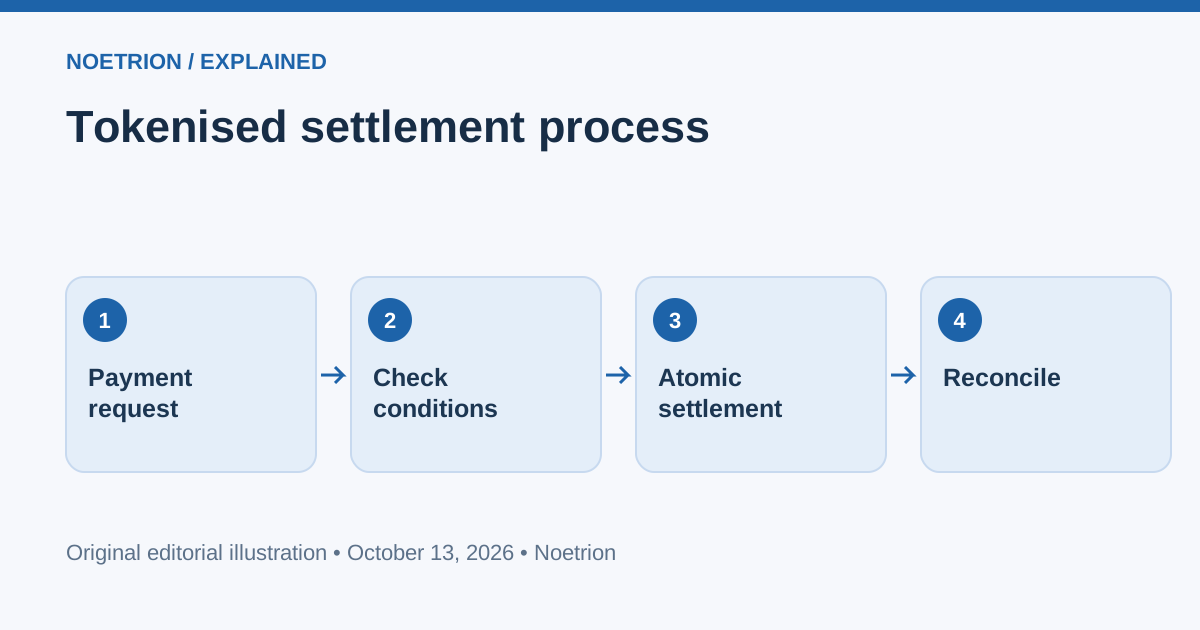
Suppose two banks exchange currencies. In a fragmented system, one leg of a transaction may complete before the other, creating coordination and settlement challenges. Atomic settlement aims to make the linked steps complete together or fail together under the system's rules.
Project Agorá's prototype demonstrated that this kind of settlement is technically feasible with tokenised deposits and reserves. That is significant, but a prototype is not the same as a globally deployed payments network. Production systems must address legal finality, cyber resilience, participant governance, privacy, scalability, and operational recovery.
What programmability could improve
A programmable workflow might release a payment when specified conditions are satisfied. It could reduce manual reconciliation and make some compliance checks more integrated. The BIS describes possibilities for conditional and around-the-clock wholesale payments if such a platform were implemented.
But smart contracts cannot make incorrect data true. If a shipping record is wrong, automatically triggering a payment from that record may simply automate a mistake. Good systems need trustworthy inputs, clear responsibility, exception handling, and human escalation.
Is this a new consumer payment app?
No. The project focuses on wholesale cross-border payments and regulated financial institutions. Consumers and small businesses could eventually benefit indirectly if infrastructure becomes faster or cheaper, but the BIS announcement does not establish that retail customers can use the prototype today or that their fees will fall by a particular percentage.
For business readers, the practical lesson is to separate infrastructure experimentation from products available for purchase. Ask whether a claimed benefit has been demonstrated in a prototype, tested with real money, or delivered at commercial scale.
What to watch next
The most important milestones are real-value pilots, regulatory and legal treatment across jurisdictions, participant onboarding, operational resilience, and measurable improvements in settlement time and cost. Compare outcomes with existing payment rails rather than assuming that a tokenised design is automatically superior.
FAQ
Is Project Agorá a cryptocurrency for consumers?
No. It is a wholesale cross-border payment infrastructure research project involving regulated institutions.
Does atomic settlement remove all payment risk?
No. It can address particular settlement coordination risks but not every legal, cyber, credit, or operational issue.
Has the system launched commercially?
The May 2026 BIS announcement describes a successful prototype and plans for further testing, not a universal commercial rollout.