Carbon Removal and Permanence: Where the Carbon Goes Matters
Compare biological, geological, and product storage while separating avoided emissions from atmospheric removal and accounting for reversal risk.
Reviewed October 11, 2026.
Compare biological, geological, and product storage while separating avoided emissions from atmospheric removal and accounting for reversal risk.
| Concept | What it means | Important limit |
|---|---|---|
| Avoided emission | Prevents a new release | Does not remove past atmospheric CO₂ |
| Forest storage | Carbon in biomass and soils | Fire and land-use change can reverse it |
| Geological storage | CO₂ injected into rock formations | Requires site selection and monitoring |
| Durable product | Carbon retained in material | Lifetime and end-of-life determine storage |
1. Removal begins with a counterfactual
Carbon dioxide removal takes CO₂ from the atmosphere and stores it durably. Installing capture equipment at a fossil-fuel facility can reduce a new emission, but that is not automatically atmospheric removal. Bioenergy with carbon capture or direct air capture can qualify when the full system yields a net transfer from atmosphere to storage. The accounting baseline matters: what would emissions and land carbon have been without the project? A credible claim defines boundaries for energy, materials, transport, construction, and indirect effects.
2. Gross capture is not the same as net removal
A machine may capture one tonne of CO₂ while electricity, heat, sorbent production, transport, and storage operations cause emissions elsewhere. Net removal subtracts those life-cycle emissions and any displaced effects. The result depends on energy source, equipment lifetime, capture efficiency, and system boundary. Comparing projects by gross tonnes rewards incomplete accounting. High-quality reporting states gross capture, attributable emissions, net removal, uncertainty, and the date when storage begins rather than collapsing everything into one promotional number.
3. Biological storage is valuable but reversible
Forests and soils can accumulate carbon while supporting biodiversity, water regulation, and livelihoods when projects are well designed. They are also exposed to fire, drought, pests, harvest, and future land-use change. Permanence is not a claim that no tree will ever die; ecosystems continually cycle carbon. The accounting question is whether an intervention increases landscape-level stocks over a defined baseline and how reversals are detected and compensated. Buffers, diversified sites, long monitoring, and legal protection can reduce risk but not erase it.
4. Geological storage uses physical trapping mechanisms
Compressed CO₂ can be injected into deep saline formations or depleted reservoirs beneath sealing rock. It may remain as a trapped phase, dissolve in formation fluids, become immobilized in pore spaces, and over longer periods react to form minerals. Site characterization examines capacity, injectivity, faults, wells, pressure, and caprock integrity. Monitoring can use pressure, seismic imaging, plume models, and surface measurements. Good geology does not remove the need for operations, verification, closure plans, and responsibility if migration occurs.
5. Storage duration should match the climate claim
CO₂ from fossil carbon can influence climate for very long periods. A credit based on storage expected for decades is not physically equivalent to storage expected for millennia. IPCC assessments distinguish methods with different storage times and reversal risks. Policy can handle differences through separate categories, discounting, buffer pools, replacement obligations, or explicit duration contracts. The key is transparency: “one tonne” describes mass, not how long the climate benefit lasts or how certain that duration is.
6. Measurement uncertainty is method-specific
Direct air capture can meter gas flows, yet life-cycle emissions and storage verification remain. Forest inventories sample plots and use models to estimate biomass; soil carbon varies spatially and requires repeated sampling. Enhanced weathering must distinguish newly dissolved carbon from background chemistry and track downstream fate. Product storage depends on composition, service life, and disposal. Monitoring plans should identify measurable variables, detection limits, sampling frequency, model assumptions, and who audits the result.
7. Removal complements rather than substitutes for rapid cuts
Climate pathways reaching net zero use removal to counterbalance residual emissions that are difficult to eliminate and, in some scenarios, to reduce atmospheric CO₂ after overshoot. Relying on uncertain future removal can delay available emission cuts and increase cumulative warming. The prudent strategy expands durable removal capacity while reducing emissions quickly. Separate targets can prevent easy, reversible credits from masking continued fossil releases. The order matters because every additional emission adds to the stock that future systems would need to remove.
8. Governance continues after a certificate is issued
Durable storage creates long obligations: monitoring, maintenance, reversal reporting, community engagement, and liability. Contracts must specify ownership of injected CO₂, responsibility after site closure, and what happens if a developer fails. Land-based projects need legitimate tenure and benefit sharing rather than treating local users as leakage risks. Public registries can reduce double counting by linking each credited tonne to a project, period, method, and retirement record. Scientific durability and institutional durability must reinforce each other.
Conclusion
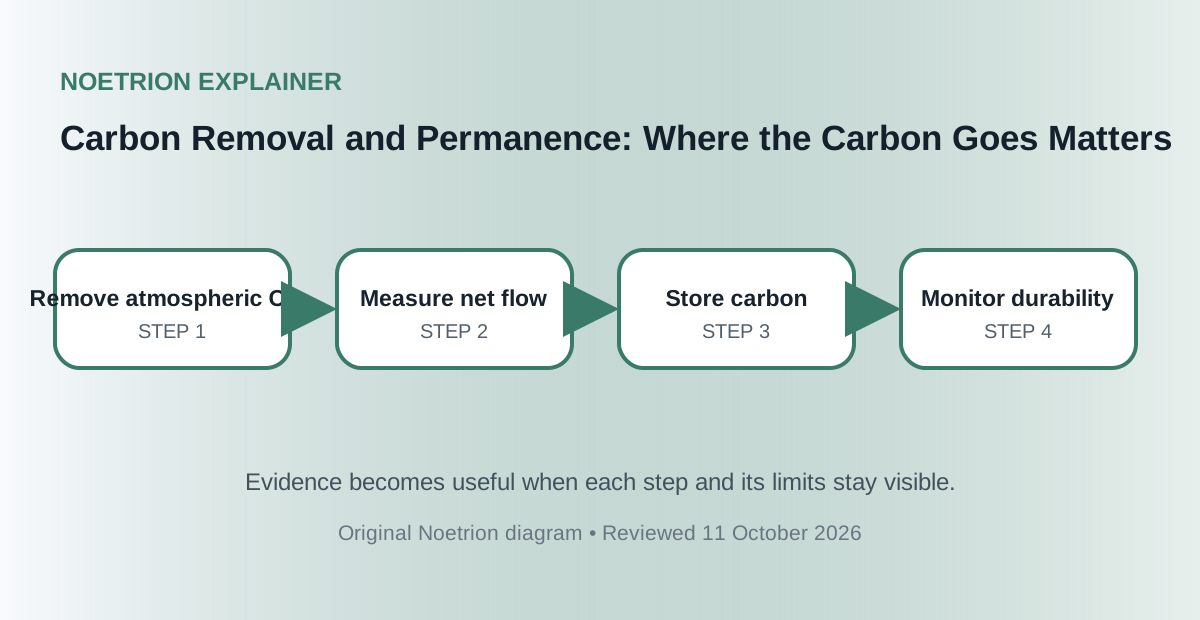
Carbon removal is a chain, not an atmospheric vacuum cleaner followed by a number. The climate value depends on net removal, storage medium, duration, uncertainty, and governance. Asking where the carbon goes—and who remains responsible—turns a broad promise into a claim that can be measured and compared.