Central Bank Digital Currency: What It Is—and What Design Choices Change
Compare CBDCs with cash, bank deposits, and stablecoins while examining privacy, access, offline payments, and financial-stability trade-offs.
Reviewed October 11, 2026.
Compare CBDCs with cash, bank deposits, and stablecoins while examining privacy, access, offline payments, and financial-stability trade-offs.
| Concept | What it means | Important limit |
|---|---|---|
| Cash | Central-bank liability | Physical, often usable offline |
| Bank deposit | Commercial-bank liability | Credit and liquidity risk managed by regulation |
| Retail CBDC | Central-bank digital liability | Design may be account- or token-like |
| Stablecoin | Private issuer liability or arrangement | Backing and redemption depend on issuer |
1. Begin with the issuer’s balance sheet
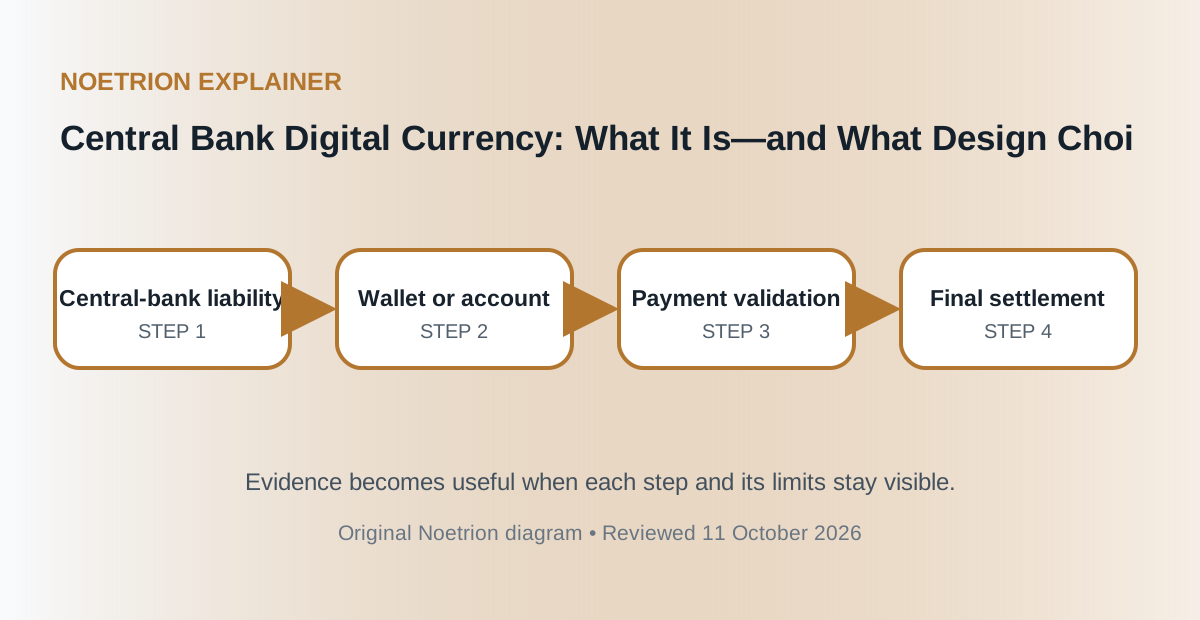
Money is not classified only by whether it appears on a screen. Physical banknotes are liabilities of a central bank, while the balance in a typical checking account is a liability of a commercial bank. A central bank digital currency would be a digital central-bank liability denominated in the national unit of account. That definition separates it from ordinary mobile banking and most private cryptoassets. The remaining questions—who can hold it, through which intermediaries, with what privacy and limits—are design choices rather than automatic properties.
2. Retail and wholesale CBDCs address different users
A retail CBDC is intended for households and businesses, potentially providing a public digital payment instrument analogous in issuer to cash. A wholesale CBDC is designed for eligible financial institutions and settlement of financial-market transactions. Wholesale central-bank money already exists in many reserve-account systems, so innovation may concern programmability, operating hours, tokenized assets, or cross-border interoperability. Statements that a country is “working on a CBDC” can therefore describe research, a prototype, a pilot, or an issued product serving very different participants.
3. Architecture determines who knows and who operates
In a direct model, the central bank could maintain end-user accounts, a role that would require customer service, compliance, cybersecurity, and enormous transaction capacity. In intermediated models, banks or payment providers handle wallets and customer relationships while the central bank records or guarantees the core liability. A hybrid can preserve claims even if an intermediary fails. Architecture distributes operational responsibility and data access; it does not eliminate them. Evaluating a proposal requires a data-flow diagram, not only a promise of innovation.
4. Privacy is a spectrum of rules and technical controls
Digital payments create records somewhere. A CBDC can be designed so intermediaries see necessary customer information while the central bank sees limited transaction detail, or with stronger central visibility. Small-value offline payments might offer cash-like privacy but create double-spending and device-security challenges. Anti-money-laundering duties and lawful access must be reconciled with data minimization, retention limits, and due process. “Anonymous” and “fully traceable” are not the only options; governance, access controls, cryptography, and audit rules jointly shape privacy.
5. Offline use turns payments into a hardware problem
Cash works during a network outage because value transfer does not require a live server. A digital equivalent may allow secure devices to exchange limited value offline and synchronize later. Designers must prevent the same balance being spent twice, limit losses when devices are compromised, support recovery, and serve people without modern phones. Transaction caps, secure elements, expiration rules, and risk sharing can help. Offline capability is therefore not a checkbox; it is a bundle of compromises among inclusion, resilience, privacy, and fraud control.
6. Financial stability depends on substitution behavior
If households can move funds instantly from commercial-bank deposits into central-bank money, stress could accelerate deposit outflows. Even in normal periods, large shifts could alter bank funding and credit provision. Possible mitigations include holding limits, tiered remuneration, or non-interest-bearing balances. Those measures can reduce risk but also make the product less attractive. The effect depends on existing deposit insurance, payment competition, bank structure, crisis communication, and whether the CBDC replaces cash, deposits, or private wallets.
7. Cross-border payments require coordination, not merely tokens
International payments involve foreign exchange, compliance, messaging, liquidity, time zones, and legal jurisdiction. Two domestic CBDCs do not become interoperable automatically. Central banks may align technical standards, operating hours, identity rules, and settlement arrangements, but closer links introduce questions about capital flows and monetary sovereignty. A faster rail cannot by itself resolve every cost. Pilot results should state which corridor, participants, currencies, and legal assumptions were tested before claiming a general cross-border solution.
8. Survey numbers measure exploration rather than adoption
BIS surveys show strong central-bank engagement, but respondents may be conducting research rather than committing to issuance. Percentages also change with the sample and with definitions of proof of concept, pilot, and live system. Read the survey year, number of central banks, and retail-versus-wholesale split. A headline such as “most central banks explore CBDCs” says that the policy question is widespread; it does not say most citizens will soon receive a CBDC wallet.
Conclusion
A CBDC is best understood as a public digital monetary instrument whose consequences depend on architecture. Issuance alone does not determine privacy, inclusion, bank competition, resilience, or cross-border usefulness. Those outcomes emerge from explicit rules, technical controls, institutional capacity, and the alternatives already available in each country.