Cognitive Load and Worked Examples: Designing Practice for Novices
Use worked examples, fading, segmentation, and retrieval without turning cognitive load into a vague excuse for simpler lessons.
Reviewed October 11, 2026.
Use worked examples, fading, segmentation, and retrieval without turning cognitive load into a vague excuse for simpler lessons.
| Concept | What it means | Important limit |
|---|---|---|
| Intrinsic demand | Interacting elements in the task | Sequence and pretrain prerequisite knowledge |
| Extraneous demand | Work caused by presentation | Integrate sources and remove irrelevant detail |
| Productive processing | Work that builds useful schemas | Prompt explanation and comparison |
| Expertise | Prior schemas available | Fade support as knowledge grows |
1. Working memory is a bottleneck, not a fixed intelligence score
When learners handle unfamiliar material, only a limited number of interacting elements can be actively coordinated. Long-term memory changes the situation: organized knowledge lets several details function as one schema. A chess expert can perceive a meaningful position where a novice sees many unrelated pieces. Cognitive load theory focuses on this interaction between task complexity and existing knowledge. It does not imply that students should avoid effort. It suggests arranging effort so scarce working-memory capacity contributes to building durable, usable knowledge.
2. Task complexity depends on element interactivity
Learning isolated vocabulary may allow items to be processed independently, while solving an algebra equation requires coordinating rules, signs, goals, and intermediate states. The second task has greater element interactivity for a novice. The same problem may be simpler for an expert who retrieves a familiar schema. Teachers can manage intrinsic demand by pretraining prerequisites, sequencing from parts to integrated tasks, and selecting examples appropriate to current knowledge. They cannot make a complex domain genuinely simple without sometimes removing what must eventually be learned.
3. Extraneous load comes from avoidable instructional work
Students may spend capacity searching between a diagram and a distant explanation, deciphering inconsistent symbols, or replaying an animation that disappears too quickly. This processing is caused by presentation rather than the learning goal. Integrating labels with diagrams, segmenting transient material, signaling structure, and removing decorative detail can reduce it. The principle is not “minimalism always wins.” A relevant explanatory visual can reduce load, while deleting necessary context can increase it. Design decisions must be evaluated against the learner’s task.
4. Worked examples reveal the hidden path through a problem
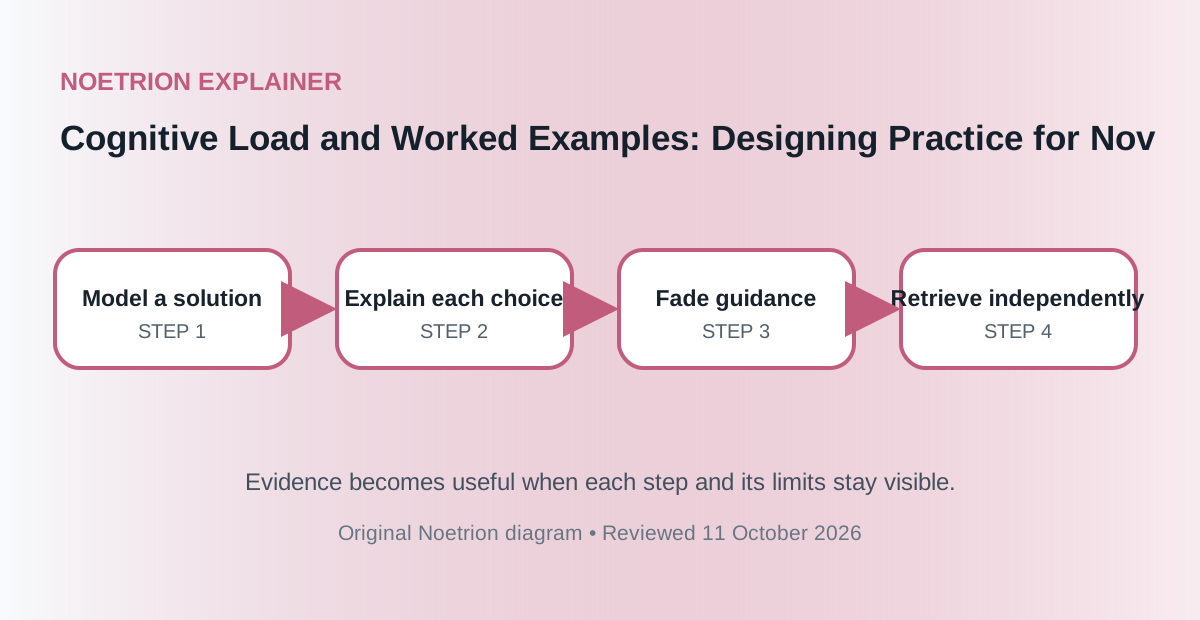
A worked example presents a problem together with a solution sequence. Novices can study why each step follows instead of exhausting capacity through unguided search. Research has repeatedly found benefits over immediately solving equivalent problems in suitable novice settings. Effective examples make goals, subgoals, and reasons visible rather than displaying unexplained arithmetic. Comparing correct and incorrect examples can expose misconceptions. However, passive copying is weak; prompts that ask learners to explain steps or predict the next move encourage active construction of the underlying schema.
5. Guidance should fade as expertise grows
Support that helps a novice can become redundant for an experienced learner, an effect often called expertise reversal. Once a procedure is understood, rereading every completed step may add avoidable processing and reduce independent practice. Example-problem pairs offer a bridge: study one complete solution, complete a similar problem, then encounter partially completed examples with progressively fewer steps. Fading should respond to demonstrated performance, not a fixed calendar. Learners need opportunities to retrieve, select methods, and handle variation before support disappears entirely.
6. Measurement is harder than the vocabulary suggests
Researchers use self-report scales, performance, response time, secondary tasks, eye measures, and physiological signals as imperfect indicators of cognitive load. A student saying “that was hard” may report task complexity, confusion, fatigue, or emotional pressure. High performance with high effort can mean productive learning; low effort with low performance can mean disengagement. Designers should not label any disliked feature “extraneous load” after the fact. Strong claims connect a predicted mechanism with multiple outcomes and a clear comparison condition.
7. Multimedia requires coordination across time and space
Animation can show change, but transient information vanishes while the learner is still processing it. Controls, pausing, and segmentation can help. Narration can complement a visual when channels are coordinated, yet duplicating dense on-screen text word for word may split attention. Spatial contiguity places explanations near what they explain. Temporal contiguity presents corresponding information together. These are design hypotheses, not universal recipes: accessibility needs, language proficiency, pacing, and the material’s structure can change the best solution.
8. Combine explanation with retrieval and spacing
Worked examples mainly support acquisition; retrieval practice tests whether knowledge can be produced without the model present. A robust sequence might include a concise explanation, one annotated example, a self-explanation prompt, an analogous problem, feedback, and a delayed return. Spacing reveals what was genuinely retained, while varied problems test transfer. If students repeatedly fail, restore a smaller amount of guidance rather than simply adding more attempts. Instruction and practice form a loop in which evidence from learner performance controls the next level of support.
Conclusion
Cognitive load theory is most useful as a precise design lens. Ask what elements must interact, what the learner already knows, which work is created by the presentation, and when guidance should fade. Worked examples then become neither shortcuts nor permanent crutches, but carefully timed scaffolds toward independent problem solving.