CRISPR as a Medicine: What Casgevy Changes in Sickle Cell Disease
Trace an approved ex vivo CRISPR treatment from stem-cell collection to fetal hemoglobin, including conditioning, benefits, risks, and follow-up.
This guide explains research and technology. It does not provide diagnosis or treatment, and regulatory status should be checked with the relevant authority.
Reviewed October 11, 2026. This article is not individualized medical advice.
Trace an approved ex vivo CRISPR treatment from stem-cell collection to fetal hemoglobin, including conditioning, benefits, risks, and follow-up.
| Concept | What it means | Important limit |
|---|---|---|
| Editing location | Outside the body in collected stem cells | Not an injection of CRISPR throughout the body |
| Target | Erythroid enhancer of BCL11A | Not a direct rewrite of the sickle mutation |
| Desired effect | More fetal hemoglobin in red cells | Not guaranteed elimination of every symptom |
| Follow-up | Long-term monitoring | Approval does not end safety surveillance |
1. The disease begins with hemoglobin, but treatment begins with stem cells
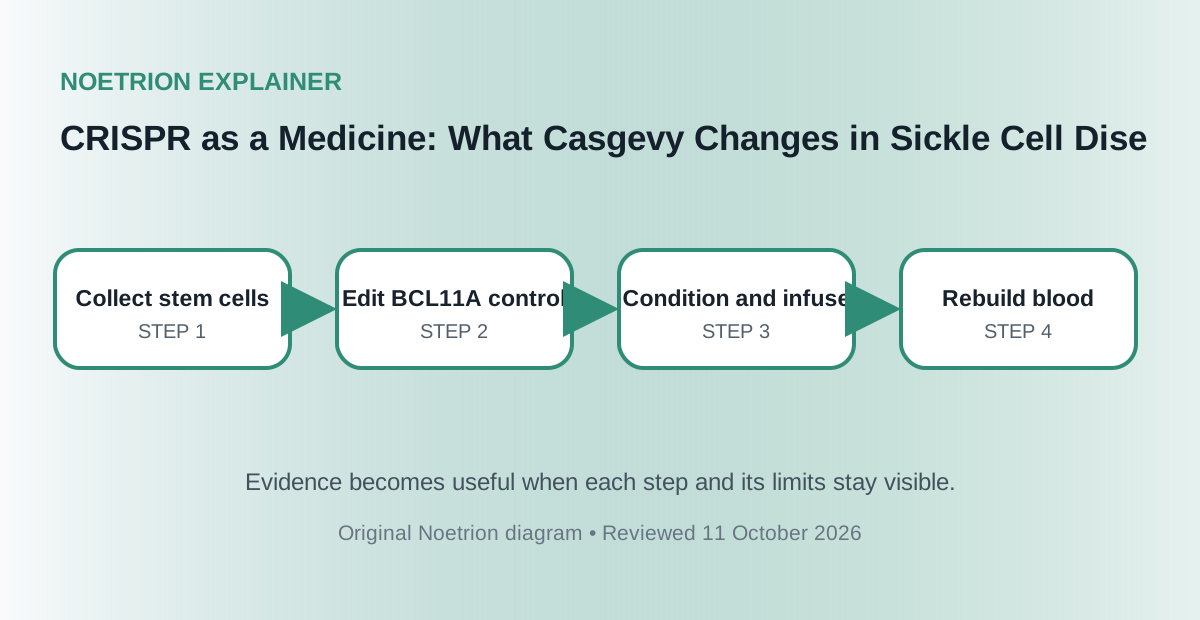
Sickle cell disease is caused by inherited changes in beta-globin that can make hemoglobin polymerize when oxygen is low. Red cells deform, break down, and obstruct small blood vessels, producing anemia, pain crises, organ injury, and other complications. Casgevy does not edit every circulating red cell. Clinicians collect a patient’s own blood-forming stem and progenitor cells, edit them in a manufacturing facility, and later return them. Those durable cells can generate new blood lineages after they engraft in bone marrow.
2. The edit releases a fetal-hemoglobin program
Before birth, fetal hemoglobin uses gamma rather than adult beta globin. Its expression normally falls after birth as BCL11A helps suppress the gamma-globin program in red-cell precursors. Casgevy uses CRISPR/Cas9 to disrupt an erythroid-specific enhancer controlling BCL11A. Red-cell descendants then produce more fetal hemoglobin, which interferes with sickling. This indirect strategy is important: the therapy does not simply replace the sickle variant letter. It modifies a regulatory switch in collected cells to reactivate a protective form of hemoglobin.
3. Ex vivo editing creates a controllable manufacturing chain
The patient first undergoes mobilization and apheresis so CD34-positive cells can be collected. Manufacturing enriches those cells and introduces the editing machinery. Quality controls assess identity, viability, sterility, potency, and editing. Because the work occurs outside the body, the product can be tested before infusion. However, it remains individualized: each batch originates from one patient and returns to that same person. Logistics, specialized centers, manufacturing time, and backup collection all matter to whether a laboratory innovation becomes accessible care.
4. Conditioning is a major part of the clinical burden
Edited cells need room to establish themselves in bone marrow. Patients receive myeloablative conditioning, which destroys many existing marrow cells before infusion. This step can cause severe low blood counts, infections, mucosal injury, infertility risk, and prolonged hospitalization. Discussions that describe only a one-time CRISPR infusion omit much of the treatment experience. The benefit-risk decision therefore compares a complex transplant-like pathway with the person’s disease severity, existing treatment options, organ health, support system, and ability to complete long-term care.
5. Engraftment turns an edited product into a blood system
After infusion, cells migrate to marrow, survive, and begin rebuilding blood production. Neutrophil and platelet recovery are monitored closely. Clinicians track fetal hemoglobin, total hemoglobin, transfusion needs, vaso-occlusive crises, and complications. A successful molecular edit is necessary but not sufficient: adequate cell dose, viability, conditioning, engraftment, and long-term persistence all contribute. Outcomes are reported for defined study populations and follow-up periods, so they should not be converted into a universal promise for every eligible patient.
6. Off-target editing is a risk to measure, not a slogan
CRISPR nucleases are designed for a target sequence, but unintended cuts are biologically possible. Developers use computational prediction and laboratory assays to search candidate sites, while regulators require manufacturing controls and long-term observation. No assay can prove that every cell contains zero unintended change. The useful question is what methods were used, what their detection limits were, and whether clinical surveillance reveals consequences. FDA materials also warn about delayed engraftment, hypersensitivity, and other risks associated with the product and procedure.
7. Approval is specific and has changed over time
The FDA first approved Casgevy in December 2023 for patients aged 12 years and older with sickle cell disease and recurrent vaso-occlusive crises, making it the first FDA-approved treatment using CRISPR/Cas9. Product indications can later expand as evidence is reviewed; current labeling should always be checked rather than copied from an old announcement. Regulatory approval means benefits outweighed risks for the labeled use based on submitted evidence. It does not mean the therapy is simple, universally available, or preferable for every person.
8. Access is part of the technology story
A personalized cell therapy requires trained centers, collection capacity, manufacturing slots, conditioning facilities, and months of coordinated care. Cost and insurance are only part of access; travel, caregiver time, fertility preservation, and infection risk can determine feasibility. Sickle cell disease has a global burden, including regions least equipped for complex transplantation. Future progress may involve simpler conditioning, in vivo delivery, scalable manufacturing, and stronger health systems. Scientific success should be evaluated alongside who can realistically receive it.
Conclusion
Casgevy shows that genome editing can move from a laboratory technique into regulated medicine. Its mechanism is elegant—editing a regulatory enhancer to restore fetal hemoglobin—but the complete therapy is a demanding cell-manufacturing and transplant pathway. Understanding both layers produces a more accurate picture of its achievement, limits, and continuing responsibilities.