mRNA Vaccines: Temporary Instructions and Lasting Immune Preparation
Follow mRNA from lipid delivery to protein production and immune memory, while separating platform mechanics from clinical effectiveness.
This guide explains research and technology. It does not provide diagnosis or treatment, and regulatory status should be checked with the relevant authority.
Reviewed October 10, 2026. This is a platform explainer, not personal vaccination advice; recommendations depend on age, health, product, and current public-health guidance.
Messenger RNA is a temporary molecular instruction used by cells to make proteins. An mRNA vaccine supplies a designed sequence encoding an antigen—a molecular feature that the immune system can learn to recognize. The mRNA is packaged in lipid nanoparticles that help protect it and deliver it into cells.
The cell produces antigen for a limited period. Immune cells respond, and some activated cells become longer-lived memory populations. The mRNA itself is broken down. It does not need to enter the cell nucleus, where chromosomes are stored, to be translated into protein.
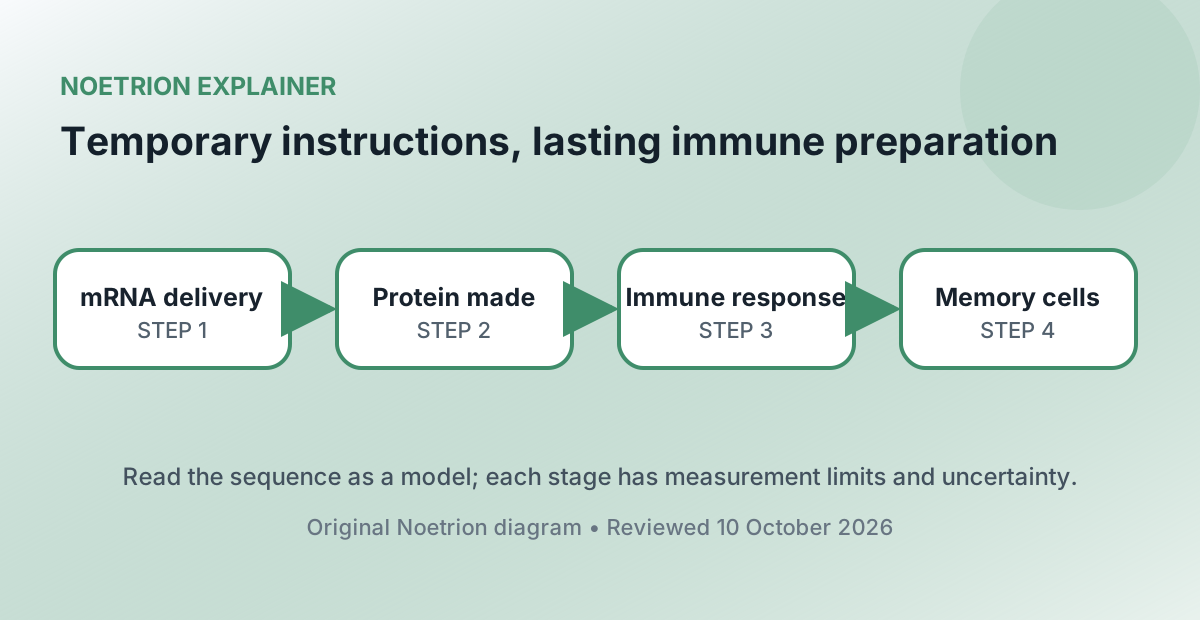
1. The platform separates instructions from manufacturing the antigen
Traditional vaccine platforms may use weakened organisms, inactivated organisms, purified proteins, or engineered viral vectors. An mRNA platform instead manufactures the genetic instructions in a controlled process and lets cells briefly produce the selected antigen.
This can speed design when the antigen sequence is known, but clinical development still requires evidence about dose, immune response, safety, and protection. A fast sequence change is not the same as instant approval or guaranteed effectiveness.
2. Lipid nanoparticles solve a delivery problem
Unprotected RNA is fragile and negatively charged, so it does not readily cross cell membranes. Lipid nanoparticles surround the mRNA, protect it during delivery, and help it enter cells after injection. Formulation affects stability, distribution, and storage requirements.
After uptake, the particle releases mRNA into the cytoplasm. Ribosomes read the sequence and assemble the encoded protein. This is the same cellular compartment in which ordinary cellular mRNAs are translated.
| Component or stage | Main role | What it does not imply |
|---|---|---|
| mRNA sequence | Encodes an antigen | It is not a complete pathogen |
| Lipid nanoparticle | Protects and delivers mRNA | It does not make delivery perfectly uniform |
| Ribosome | Translates RNA into protein | It does not rewrite nuclear DNA |
| Immune response | Learns antigen features | It does not guarantee zero future infection |
3. The immune system sees both antigen and context
Antigen-presenting cells display fragments of the produced protein to immune cells. This can activate helper T cells, antibody-producing B cells, and in some settings cytotoxic T-cell responses. Innate immune sensing also influences the strength and character of the response.
Vaccine design balances sufficient immune stimulation with tolerability. Chemical modifications to nucleosides and formulation choices can reduce unwanted innate activation while allowing efficient protein production. The exact response depends on antigen, dose, schedule, age, prior immunity, and individual biology.
4. Immune memory differs from circulating material
Antibodies in blood can decline after vaccination while memory B cells and T cells persist. Declining antibody concentration does not mean immunity suddenly becomes zero. Conversely, the presence of memory does not guarantee complete protection from infection, especially when a pathogen changes or exposure is intense.
Clinical outcomes also differ. Protection against any detectable infection, symptomatic disease, hospitalization, and death can have different magnitudes and durability. A claim that “the vaccine works” should specify which outcome, population, variant or strain, and time since vaccination.
5. mRNA is designed to be temporary
Cells continually make and degrade mRNA. Vaccine mRNA is also broken down by normal processes after it has been translated. The antigen is cleared over time as well. The platform aims to leave immune memory, not a permanent factory.
Claims that mRNA routinely alters genomic DNA skip necessary biological steps. Translation occurs in the cytoplasm, while genomic DNA is in the nucleus. Integration would require additional machinery and events not supplied by the ordinary vaccine mechanism. This explanation should remain specific: it describes the intended and observed platform biology, not an assertion that every conceivable molecular event in biology has zero probability.
6. Safety signals require denominators and comparison groups
Common short-term effects such as soreness, fatigue, fever, and headache reflect local inflammation and immune activation. Rare adverse events require large surveillance systems because trials may be too small to detect very low rates.
A report after vaccination does not prove the vaccine caused the event. Analysts compare observed rates with expected background rates, examine timing and biological plausibility, and use multiple surveillance systems. They also compare risk from vaccination with risk from the disease for a defined population. Those balances can differ by age, sex, health status, dose, and current disease circulation.
7. Effectiveness is not the same as efficacy
Randomized trials estimate efficacy under study conditions. Observational studies estimate effectiveness in real-world settings, where uptake, prior infection, variants, access, and behavior vary. Confounding can bias observational comparisons, so researchers adjust designs and interpret estimates with uncertainty.
An effectiveness percentage is relative to a comparison group's risk during a stated period. If risk falls from 10 per 1,000 to 4 per 1,000, the relative reduction is 60%, while the absolute reduction is 6 per 1,000. Both descriptions matter for decisions.
8. Variants and updated formulations change the match
Pathogens evolve. Mutations in an antigen can reduce recognition by antibodies generated against an earlier version, although immune responses target multiple features and cellular immunity may remain partly effective. Updating an mRNA sequence can improve antigenic match, but the resulting product still needs manufacturing quality control and clinical or immunogenicity evidence under the applicable regulatory pathway.
Comparisons across seasons must account for different circulating variants, prior immunity, population behavior, and time since vaccination. An old effectiveness estimate should not be copied into a new context without qualification.
9. Read claims through four layers
First identify the platform claim: what molecule enters which cellular compartment? Then identify the immunology claim: which response was measured? Third identify the clinical claim: which outcome and population? Finally identify the policy claim: which current recommendation balances benefits, risks, supply, and disease conditions?
This layered reading prevents a cell-culture result from being promoted into a population guarantee. It also prevents a change in public-health policy from being misrepresented as proof that the underlying molecular mechanism changed.
mRNA vaccines are best understood as a delivery and instruction platform. Their temporary message can initiate a complex immune learning process. The platform's elegance does not remove the need for product-specific evidence, continuing safety monitoring, and recommendations that change when the pathogen and population context change.