A Data Center Can Produce Plenty of Heat Without Having a Useful Heat Customer
Evaluate data center heat reuse with temperature, heat-pump electricity, seasonal demand and a worked energy balance that separates available from delivered heat.
A server hall runs all night. The nearby buildings need heating on cold mornings. Putting those facts together sounds easy: take the unwanted heat from the computers and sell it to the neighborhood. The missing detail is whether that heat arrives at the right temperature, location and time—and what electricity and infrastructure are needed to make it useful.
This is becoming a planning question rather than a speculative curiosity. The European Commission's energy-efficiency roadmap reports that 14 industry associations agreed on 3 June 2026 to develop a model for agreements among data centers, energy stakeholders and public authorities, including waste-heat reuse. That coordination matters because no single participant controls the whole chain.
The useful reader task is to evaluate a heat-reuse proposal before treating the facility's thermal output as guaranteed heating sales. The original calculation below is a screening exercise, not a project design or a claim about a particular operator.
Start with temperature as well as energy
A large quantity of lukewarm water cannot automatically replace a smaller quantity of much hotter water. A heat exchanger requires a suitable temperature difference, and a customer's heating system has operating requirements. The proposal therefore needs source supply and return temperatures, available flow, and the receiving network's required conditions.
The IEA's heat-pump explanation describes how electricity can move heat from a source to a hotter destination. Data-center heat may be a useful source, but the necessary temperature lift affects the design. Do not copy a household heat pump's advertised performance into an industrial business case.
A practical question for a supplier is: “At these source and delivery temperatures, what heat output and electrical input will this equipment actually provide?” A single best-case efficiency number leaves too much unspecified.
Keep three measurement boundaries visible
Draw a boundary around the captured server heat, another around the heat pump, and another around the customer's delivery meter. Otherwise, a presentation may compare thermal energy at one location with useful heat at another.
| Boundary | Quantity to record | Question it answers |
|---|---|---|
| Recovery interface | Captured source heat | How much heat reaches the recovery system? |
| Heat-pump equipment | Heat output and electrical input | What energy is required to raise its temperature? |
| Customer delivery point | Accepted thermal energy | What useful heat can be invoiced under the agreement? |
Also identify pumps, controls and backup equipment. Their consumption does not vanish because it sits outside the heat-pump manufacturer's stated boundary. An equipment COP and a whole-system seasonal performance ratio can be different without either calculation being wrong.
Work through one operating hour
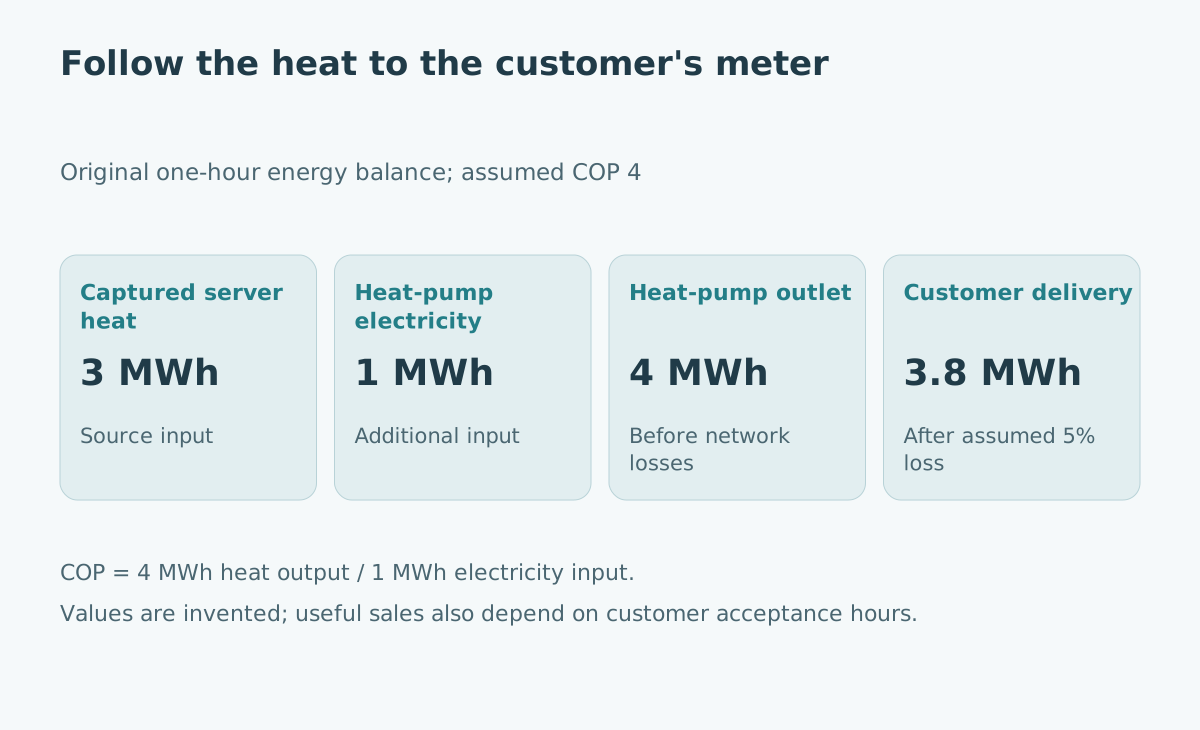
Assume an original hypothetical installation captures 3 MW of source heat during one hour. The heat pump operates at an assumed heating COP of 4, meaning heat output divided by its electrical input equals four. Ignore auxiliary loads initially, and use a steady-state balance with negligible equipment heat loss.
Write Qout = Qsource + W and COP = Qout / W. With the assumptions above, 4W = 3 + W, so electrical input is 1 MW and heat-pump output is 4 MW. During one hour, those become 1 MWh of electricity and 4 MWh of thermal output.
If the distribution system loses an assumed 5% of that output before the customer meter, delivered heat is 3.8 MWh. It would be incorrect to label all 4 MWh “recovered data-center heat”: 3 MWh came from the source and 1 MWh was added as electricity in this simplified balance.
An annual total needs an acceptance schedule
Suppose the same operating point can be maintained for 2,000 accepted hours in a year. The original scenario then yields 6,000 MWh of captured heat, 2,000 MWh of heat-pump electricity, 8,000 MWh at the equipment outlet and 7,600 MWh delivered after the assumed network loss.
Now change only customer acceptance to 1,000 hours. Useful delivery falls to 3,800 MWh. The server hall's continuous operation does not create a year-round buyer. Domestic hot water, industrial demand or thermal storage might improve utilization, but each needs its own evidence and costs.
A realistic model should use hourly or representative seasonal profiles. Include maintenance, customer shutdowns and minimum viable operating load. An annual nameplate-capacity multiplication hides precisely the timing mismatch that can decide whether a project earns enough revenue.
Put a price on the extra electricity
For a deliberately narrow illustration, assume electricity costs 100 currency units per MWh and delivered heat sells for 40 per MWh. At the 2,000-hour operating case, heat receipts equal 7,600 × 40 = 304,000. Heat-pump electricity costs 2,000 × 100 = 200,000.
The remaining 104,000 currency units is a contribution before auxiliary electricity, maintenance, source-heat charges, pipework, financing, taxes and other project costs. It is neither net profit nor a payback estimate. A positive result at this stage means only that one variable-cost comparison is positive.
Change electricity to 160 per MWh and the same narrow comparison becomes negative 16,000. Sensitivity to tariffs is therefore a decision input, not a footnote. Contract duration and tariff indexing may matter as much as the initial technical demonstration.
Check the network and the contract together
The IEA's district-heating analysis emphasizes mapping heat sources and demand, their location and timing, and workable commercial arrangements. A technically suitable neighboring network still needs an agreed connection, responsibilities and operating schedule.
Before approval, request a connection route, delivery-temperature specification, metering method, outage protocol and allocation of backup costs. Ask who pays when the data center expands, the customer reduces demand, or an upgrade changes available temperatures.
The Commission's tripartite approach is relevant here: a municipal network, a private computing operator and an electricity provider may face different investment calendars. An enthusiastic letter of intent should not be entered into the model as an unconditional purchase commitment.
Avoid environmental double counting
Heat reuse can displace another heating source, but a project-specific emissions calculation needs a counterfactual: what heating would otherwise operate, at what efficiency, and when? Additional electricity and distribution losses belong in the comparison. A thermal MWh is not automatically a fixed quantity of avoided carbon emissions.
Also distinguish improving the use of unavoidable waste heat from justifying unnecessary computing demand. The reuse project and the computing service have related but different evaluation boundaries. For infrastructure metrics inside the facility, see PUE, WUE and cooling trade-offs.
A defensible proposal ends with measured or contracted useful delivery, a transparent electricity balance and sensitivity ranges. The presence of warm water is the beginning of that case, not its conclusion.
Sources and evidence limits
- European Commission, New impetus for energy efficiency, including the 3 June 2026 integration-model announcement; checked 28 October 2026.
- IEA, How a heat pump works, foundational mechanism and COP explanation; checked 28 October 2026.
- IEA, Opportunities for district heating in the changing energy landscape, system-planning context; checked 28 October 2026.
All numerical operating and tariff scenarios in this article are original assumptions. They establish arithmetic relationships, not universal feasibility, project performance or regulatory compliance.