A Weighted Decision Matrix: Work the Numbers, Then Test the Ranking
Compare two synthetic platform options, calculate their weighted scores, find a ranking reversal, and record the evidence needed before committing.
A team deciding between two platforms often disagrees about several things at once: cost, reliability, learning effort, and future capacity. A small weighted worksheet can make those disagreements visible. Its usefulness comes from exposing assumptions, not turning subjective ratings into objective truth.
This is a simple teaching worksheet for a bounded, reversible decision. It is not a complete Multi-Criteria Decision Analysis. UK government guidance distinguishes formal MCDA from casual weighting and scoring and discusses structured criteria, evidence, and sensitivity analysis. Use that distinction to keep the limits of this simpler exercise clear.
State the decision and its non-negotiable constraints
Imagine a fictional publishing team choosing a platform for the next twelve months. Option A represents a cheaper, more manual setup; Option B represents a more managed setup with greater capacity. Neither label describes a real product. The deadline, budget ceiling, export needs, and staff maintenance capacity belong in the decision statement.
Check mandatory requirements before scoring. If an option cannot satisfy an essential data-export or accessibility requirement, a high score elsewhere should not compensate for that failure. Keep such requirements as pass/fail gates, then compare the remaining credible options.
Define the scale before rating the options
For this exercise, five means favorable and one means unfavorable on every criterion. A cost rating of five means lower total modeled cost, not a higher price. Define what evidence would justify each rating. Reliability might use documented service behavior; ease of use might use a short staff trial. Missing evidence should be marked uncertain rather than awarded a convenient middle score.
| Criterion | Weight | A rating | A contribution | B rating | B contribution |
|---|---|---|---|---|---|
| Cost | 0.30 | 5 | 1.50 | 3 | 0.90 |
| Reliability | 0.30 | 3 | 0.90 | 5 | 1.50 |
| Ease of use | 0.20 | 4 | 0.80 | 3 | 0.60 |
| Scalability | 0.20 | 2 | 0.40 | 5 | 1.00 |
| Total | 1.00 | — | 3.60 | — | 4.00 |
Each contribution is weight multiplied by rating; the total is their sum. Option B leads by 0.40 points under these particular judgments. That difference is not a statistical confidence interval and does not prove B is superior outside the stated criteria.
Find an explicit ranking reversal
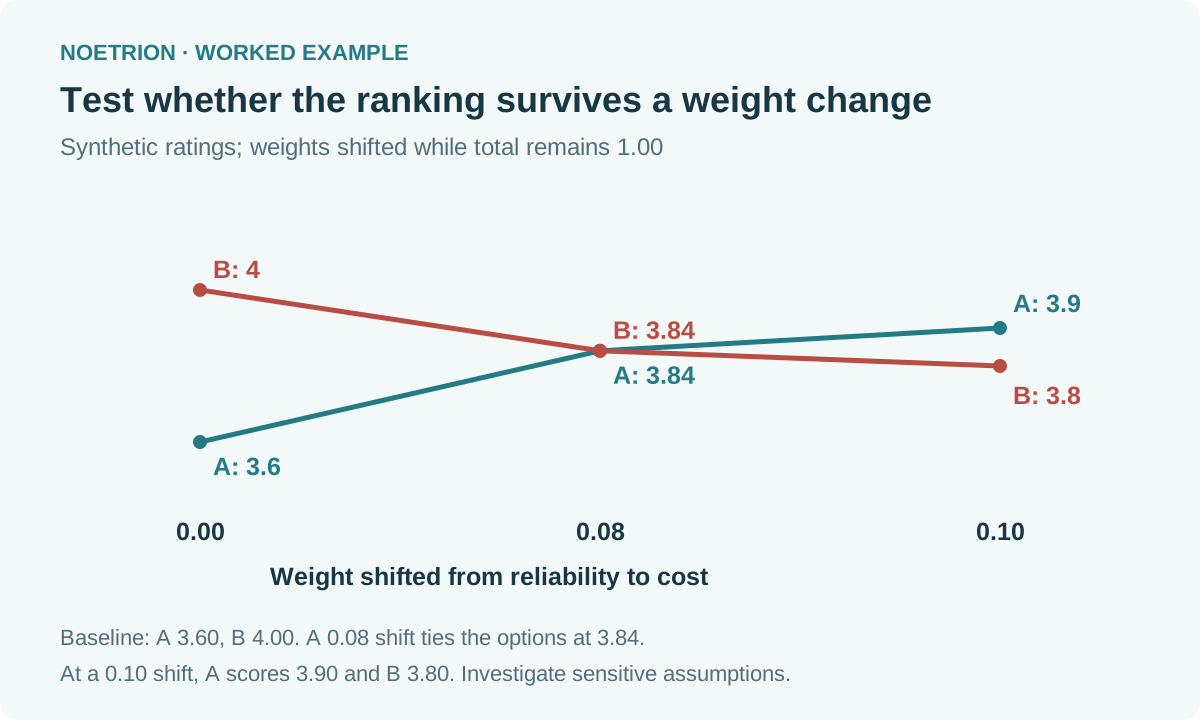
Suppose the team places more emphasis on cost and less on scalability. Move ten percentage points of weight from scalability to cost, leaving reliability and ease unchanged. The new weights are 0.40, 0.30, 0.20, and 0.10. A scores 3.90 and B scores 3.80, so the ranking reverses without changing any rating.
You can calculate the tie. If d is the weight shifted from scalability to cost, A’s score becomes 3.60 + 3d and B’s becomes 4.00 − 2d. They tie when 5d = 0.40, so d = 0.08. Cost then has weight 0.38 and scalability 0.12. Both scores are 3.84. This is a boundary in the worksheet, not a precise measure of a stakeholder’s true preference.
Test ratings as well as weights
Keep the original weights and lower B’s reliability rating from five to four because the supporting evidence is weaker than assumed. Its score falls by 0.30 to 3.70, still above A’s 3.60. Lowering it to three produces 3.40, putting A ahead. The evidence behind reliability could therefore affect the decision more than another polished feature comparison.
Watch for double counting: reliability and support responsiveness may overlap, as may scalability and future flexibility. Ask whether adding another criterion rewards the same advantage twice. Also ask whether a one-point change means a comparable improvement across criteria; informal rating scales often conceal that assumption.
Choose what to learn before committing
The sensitivity results identify a practical next step: test the uncertain reliability assumption or discuss whether future capacity deserves its original weight. A small pilot can compare a representative workload, export behavior, staff effort, and recovery from a deliberate non-destructive failure. Set a time limit and success conditions before starting.
Archive the criteria, ratings, evidence, dissenting views, and date of the decision. After the pilot, update the assumptions with observations and retain the previous version. The worksheet is valuable when it makes a future correction easier and directs attention toward evidence that could change the choice.