Differential Privacy in a Census: Protecting People While Publishing Useful Tables
Understand neighboring datasets, calibrated noise, consistency processing, and why privacy and small-area accuracy must be evaluated together.
Reviewed October 10, 2026. This article explains the statistical concept and the U.S. Census use case; it does not evaluate every released table.
A census collects highly sensitive information and then publishes detailed statistics about small places and groups. Removing names is not enough. An attacker can combine many tables with external data and exploit exact relationships to infer facts about individuals. Differential privacy offers a mathematical way to limit how much the released output can depend on any one person's record.
The protection is not free. Noise and post-processing alter some published counts, especially for small populations and detailed cross-tabulations. The policy problem is therefore not “privacy or accuracy” in the abstract. It is how to allocate a finite privacy loss across statistics while preserving the uses that matter most.
1. Neighboring datasets define the promise
Imagine two datasets that differ only in one person's inclusion or record. A randomized mechanism is differentially private when the probability of any released result is similar across those neighboring datasets, within parameters such as epsilon and sometimes delta.
The guarantee limits what an observer can learn about the presence or attributes of that one record from the output. It is robust to arbitrary outside information under the mathematical model. This is stronger than hoping an attacker lacks a particular auxiliary database.
2. Noise is calibrated to sensitivity
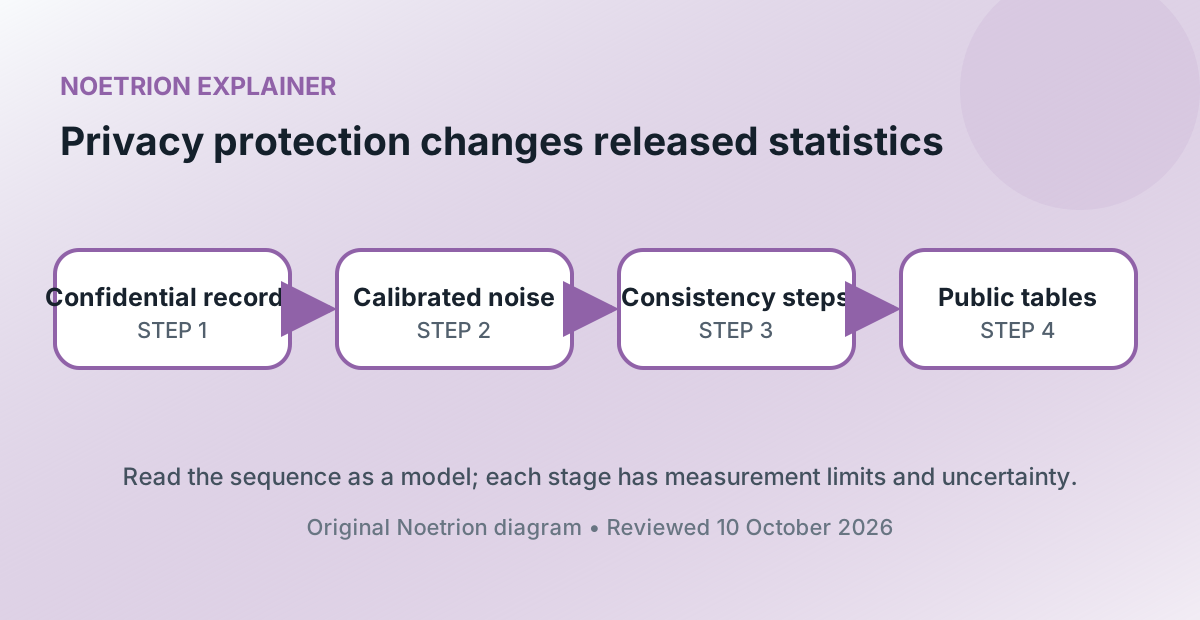
Sensitivity measures how much a query can change when one person's data changes. A total count usually has bounded sensitivity; a poorly bounded numerical sum may not. Differentially private mechanisms add randomized noise scaled to sensitivity and the chosen privacy parameters.
Larger epsilon generally permits outputs that depend more strongly on individual records and therefore less noise, but provides a weaker privacy guarantee. Epsilon is not a universal safety score. Its interpretation depends on the neighboring relation, mechanism, composition, and threat model.
| Design choice | Privacy effect | Accuracy effect |
|---|---|---|
| Smaller privacy budget | Stronger limitation per release | More noise on average |
| More queries | Privacy losses compose | Budget must be divided or increased |
| Detailed geography | More cells involving small groups | Sparse results become harder to preserve |
| Invariant counts | Exact protected totals | Noise shifts to other cells |
3. Releasing many exact tables creates cumulative risk
Traditional disclosure avoidance used techniques such as swapping or suppressing selected values. Modern reconstruction research showed that a sufficiently large collection of exact, overlapping statistics can reveal much of an underlying confidential database, even if each table seems harmless alone.
Differential privacy makes composition explicit: every release consumes part of an overall privacy accounting. This encourages agencies to decide which statistics deserve accuracy rather than releasing an unlimited number of exact queries.
4. A census requires internally consistent tables
Independent noise can produce negative counts or totals that do not equal their components. A production system therefore uses post-processing to enforce constraints and create a usable hierarchy across nation, states, counties, blocks, and demographic categories.
Post-processing cannot weaken a differential privacy guarantee when it uses only the mechanism's output and public information. It can, however, move error among cells. Exact invariants—such as a legally required total—also constrain where noise appears. Users need documentation of both the privacy mechanism and the consistency process.
5. Small groups experience the trade-off most visibly
A noise error of five people is negligible for a population of one million and enormous for a population of eight. Detailed tables for small geographic areas or intersecting demographic groups can therefore show high relative error even when national totals remain accurate.
Accuracy must be assessed for tasks: redistricting, funding formulas, rural planning, epidemiology, historical research, or estimating a rare population. One average error statistic can hide severe failures for a particular use.
6. Randomness does not mean arbitrary manipulation
The noise distribution and parameters are selected according to a published algorithm and policy process. Different runs can produce different protected outputs, but the mechanism is not supposed to favor a party or neighborhood. Reproducibility can be supported through source code, test data, documentation, and fixed released products even though confidential production randomness cannot simply be replayed publicly.
Criticism of parameter choices is legitimate. It should identify the analysis harmed, the error metric, and the privacy consequence of alternatives. Calling all noise “fake data” ignores why exact high-dimensional releases can expose respondents.
7. Privacy protects participation as well as records
Census agencies depend on public trust and often operate under strict confidentiality law. If respondents believe a published table can reveal their household, response quality and willingness to participate may decline. Privacy protection supports the institution's ability to collect useful data over time.
At the same time, inaccurate small-area statistics can harm communities whose representation or resources depend on them. Responsible design makes these competing effects visible and invites evaluation by affected users.
8. Evaluate downstream analyses, not only cells
Analysts should test whether protected data preserves decisions and estimates relevant to their work. Compare totals, rates, rankings, regression coefficients, map classifications, and threshold-based eligibility where appropriate. Use uncertainty and sensitivity analysis instead of assuming every published cell is exact.
For some research, restricted-access confidential data under legal controls may remain necessary. Public differentially private tables and secure research environments serve different access needs and risk levels.
9. Read a protected dataset responsibly
Find the disclosure avoidance documentation, privacy-loss parameters, invariants, geographic hierarchy, and accuracy reports. Check whether counts are independently noisy or processed to consistency. Avoid subtracting many small cells and treating the residual as an exact confidential count.
When communicating a result, name the dataset release and note material limitations for small populations. Do not attach a generic margin of error from sampling: a full census can have no sampling error while still having coverage error, imputation, and disclosure-avoidance error.
Differential privacy turns confidentiality from an informal hope into a property that can be analyzed and budgeted. Its value lies in a clear promise about individual influence. Its difficulty lies in distributing inevitable error across the public statistics on which communities depend.