Digital Health Wallets in Southeast Asia: The WHO Initiative and the Privacy Questions Ahead
WHO launched a 2026 initiative for interoperable digital health wallets in ASEAN. Explore verified credentials, FHIR, privacy and rollout challenges.
This guide explains research and technology. It does not provide diagnosis or treatment, and regulatory status should be checked with the relevant authority.
Published-source date: March 23, 2026
A vaccination record is useful only if the person who needs it can retrieve it and the organization receiving it can trust it. Paper records can be lost, damaged, or difficult to verify across borders. Digital records can solve some of those problems, but they introduce new questions about identity, privacy, and access.
On March 23, 2026, the World Health Organization announced a three-year initiative with the Alliance for Health Policy and Systems Research and Temasek Foundation to support digital health wallets in ASEAN member states. The initiative aims to help countries move from fragmented paper documentation toward secure, interoperable health records.
What is a digital health wallet?
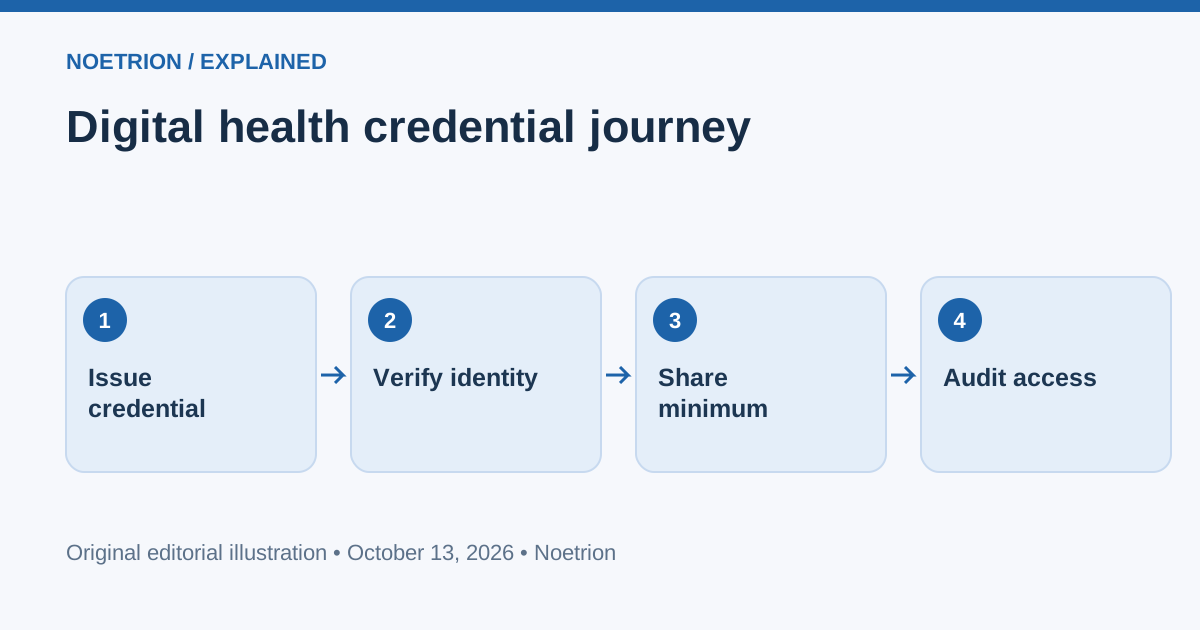
A digital health wallet is a way for an individual to carry or access trusted health credentials. The WHO initiative plans to begin with digital International Certificates of Vaccination or Prophylaxis and potentially expand to routine immunization, maternal and child health records, and broader personal health summaries.
A wallet is not necessarily a single central database holding everyone's complete medical history. Implementations can differ. The important design questions are what information is stored, where it is stored, who can access it, and how authenticity is verified.
| Design concern | Why it matters | A question to ask |
|---|---|---|
| Identity | Preventing records being linked to the wrong person | How is identity verified and corrected? |
| Interoperability | Records must work across systems | Which open standards are supported? |
| Privacy | Health data is highly sensitive | What is shared, with whom, and for how long? |
| Offline access | Connectivity is not always reliable | Can essential credentials be verified offline? |
| Inclusion | Not everyone owns a smartphone | What alternatives are available? |
The technology behind trust
The WHO says the programme will use cryptographic verification through its Global Digital Health Certification Network. It also refers to interoperability standards such as HL7 FHIR and the International Patient Summary. These technologies serve different roles: cryptographic verification helps establish that a credential is authentic, while interoperability standards help systems exchange information in a consistent structure.
A valid digital signature does not automatically prove that the underlying clinical information was correct when entered. A robust system needs processes for correcting errors, updating credentials, and handling disputes.
What the initiative does—and does not—prove
The WHO announcement describes a planned programme and pilots, not evidence that every ASEAN country already has a fully operational wallet. The project intends to assess readiness, build capacity, test deployments, and document results. Its stated objective is to generate practical learning for broader adoption.
That distinction matters. A pilot can demonstrate technical feasibility while leaving questions about cost, usability, accessibility, and long-term maintenance unresolved.
Privacy must be part of the design
Health information can expose sensitive personal circumstances. A good wallet should minimize unnecessary disclosure, protect credentials against theft, and offer a practical recovery path if a device is lost. People should understand which organization can see their information and why.
A health credential used at a border crossing should not automatically reveal unrelated diagnoses or full treatment histories. Designers should evaluate data minimization, consent where applicable, access logs, retention periods, and legal safeguards in each jurisdiction.
What hospitals and policymakers should test
Run realistic journeys, not just demonstrations. Can a traveler retrieve a vaccination certificate with limited connectivity? Can a clinic handle a misspelled name? Can a parent manage a child's records under appropriate rules? Can a person without a smartphone receive equivalent service? What happens if a credential is revoked or a signing key is compromised?
The best metric is not simply the number of wallets issued. It is whether people receive safer, faster, and more equitable care with fewer administrative barriers.
FAQ
Are digital health wallets already universal across ASEAN?
No. The WHO announcement describes a multi-year initiative with planned pilots.
Does a digital signature make medical data clinically correct?
No. It helps verify authenticity and integrity, not the truth of every medical claim.
Must a wallet reveal all of a person's health records?
Not inherently. Good designs can limit disclosure to the information needed for a particular purpose.