Responsible AI in Healthcare: The Questions Hospitals Must Ask Before Deployment
WHO's 2026 report highlights governance, biased data and accountability gaps. Use this practical framework to evaluate AI in clinical workflows.
This guide explains research and technology. It does not provide diagnosis or treatment, and regulatory status should be checked with the relevant authority.
An AI system that summarizes a medical note may save time. It may also omit a medication, misunderstand a negation or present an uncertain interpretation with unwarranted confidence. The technology's promise and its risks can appear in the same sentence.
In a 1 September 2026 report, the World Health Organization's Regional Office for Europe summarized a structured discussion on responsible AI in health. Participants highlighted fragmented and biased datasets, governance gaps, unclear accountability and insufficient AI literacy as barriers to adoption. They also emphasized transparency, strong governance and co-design with patients and clinicians.
The lesson is not that hospitals should avoid all AI. It is that a successful pilot requires more than a compelling demonstration.
Define the clinical job before selecting a model
“Use AI to improve healthcare” is not a testable objective. “Reduce the time clinicians spend preparing discharge summaries without increasing clinically important omissions” is closer.
Write down the intended user, setting, input data, expected output, action taken after the output and foreseeable failure modes. A patient-facing symptom assistant, an imaging decision-support system and a scheduling optimizer may all use AI, but their safety requirements are different.
| Question | Why it matters | Evidence to request |
|---|---|---|
| What decision does the system influence? | Consequences determine risk | Workflow map and intended-use statement |
| Who can override the output? | Human oversight must be real | Escalation and override procedure |
| On whom was it evaluated? | Performance may vary by population | Subgroup evaluation and limitations |
| What happens when it is wrong? | Errors can propagate | Incident response and audit trail |
| Who monitors it after launch? | Data and workflows change | Named owner and monitoring plan |
Measure the outcome that patients experience
A model can perform well on a retrospective dataset and still fail in a busy clinic. Validation should distinguish technical performance from clinical benefit. Accuracy, sensitivity or a language-model score may be relevant, but they are not substitutes for examining workflow errors, clinician burden, delays and patient outcomes.
For example, a documentation assistant might produce fluent summaries while requiring so much correction that it saves no time. A pilot should measure correction time, omission severity and staff experience, not just the percentage of outputs judged “acceptable.”
Use representative cases, including unusual conditions, different languages, incomplete records and high-risk situations. Where appropriate, evaluate performance across relevant patient groups. Protect privacy and obtain the necessary approvals.
Design accountability into the workflow
The WHO's earlier guidance on large multimodal models also calls for stakeholder involvement, ethical governance and attention to post-deployment impacts. A hospital should know which decisions remain with licensed professionals and how staff can report unsafe outputs without punishment for raising concerns.
An effective deployment plan assigns roles: the clinical owner defines acceptable use, the technical owner monitors performance, the privacy lead assesses data handling, and governance leadership decides when to pause or withdraw the system.
Human oversight is not meaningful if a clinician must approve hundreds of suggestions in seconds. Interfaces and workload must make review feasible.
A safe pilot is a learning system
Start with a narrow task and explicit exclusion criteria. Establish baseline performance before introducing AI. Use a controlled pilot with review, monitor errors, and compare results against the baseline. Document model versions and workflow changes so that improvements or regressions can be traced.
If a vendor changes the underlying model, do not assume previous validation remains sufficient. A changed model may require renewed evaluation for the same clinical use.
The question to ask vendors
Instead of asking “How intelligent is your model?”, ask: “What evidence shows this specific tool improves this specific workflow for patients like ours, and how will we detect when that stops being true?”
That question connects procurement, clinical safety and long-term accountability.
FAQ
Does regulatory authorization guarantee a tool is suitable for every hospital?
No. Intended use, local workflow, patient population and implementation still matter.
Can clinicians rely on AI-generated summaries without checking them?
They should follow validated local procedures and applicable professional standards. High-consequence content requires appropriate verification.
Sources and further reading
- WHO Europe, responsible AI in health report, 1 September 2026
- WHO, guidance for large multimodal models, 18 January 2024
Editorial notes
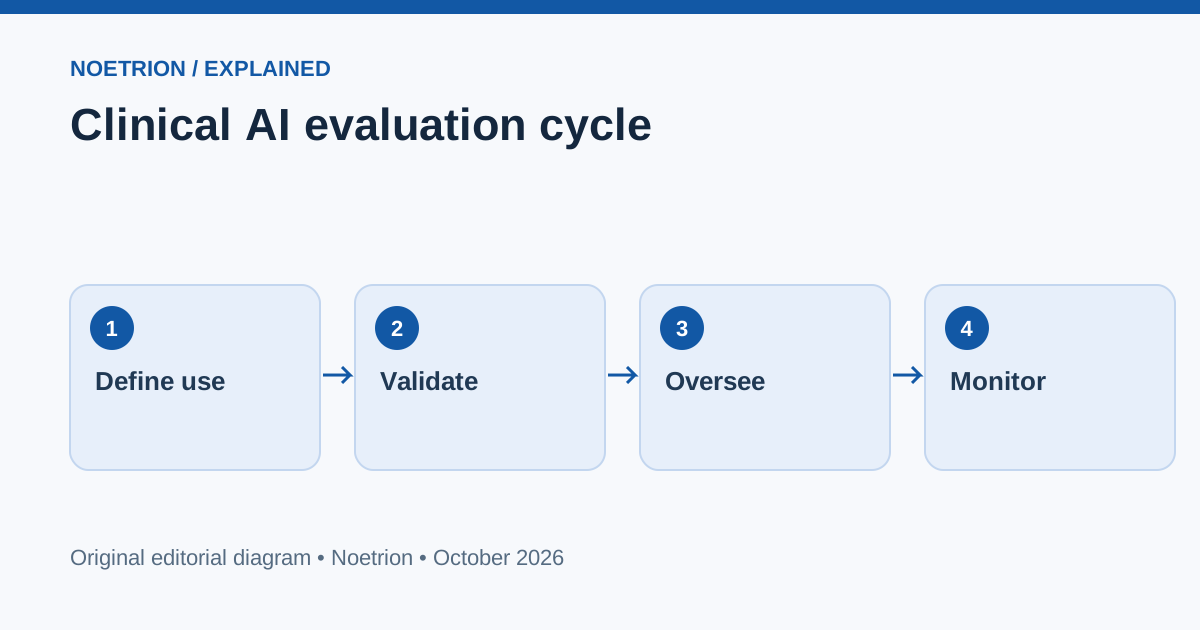
Visual: Clinical AI evaluation cycle. Original diagram showing intended use, local validation, clinician review, incident reporting and reassessment.
Verification note: Facts were checked against the linked primary or specialist sources on 13 October 2026. Forecasts are labeled as forecasts, illustrative calculations as hypothetical, and the article does not constitute personalized legal, medical, or investment advice.