Double-Entry Bookkeeping: The Information Technology of Renaissance Trade
Trace how journals, ledgers, debits, and credits supported expanding commerce, and why Luca Pacioli documented rather than invented the system.
Reviewed October 12, 2026.
Trace how journals, ledgers, debits, and credits supported expanding commerce, and why Luca Pacioli documented rather than invented the system.
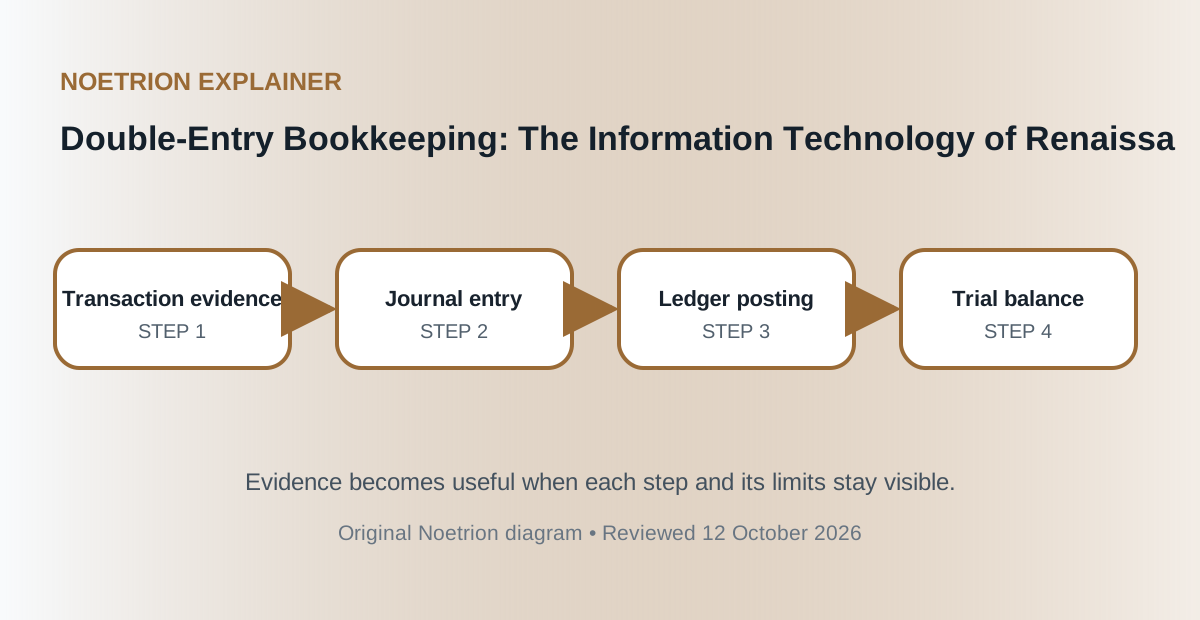
| Concept | What it means | Important limit |
|---|---|---|
| Journal | Chronological record of transactions | Order alone does not show each account balance |
| Ledger | Entries grouped by account | Depends on correct posting |
| Debit and credit | Two-sided notation for account changes | Do not simply mean good and bad |
| Trial balance | Check that total debits equal total credits | Equality does not prove every entry is correct |
1. Expanding trade created an information problem
Late medieval and Renaissance merchants managed credit, partnerships, inventories, agents, foreign exchange, and voyages that unfolded over time and distance. A list of cash receipts could not show who owed what, which venture earned a return, or how a partner’s capital changed. Bookkeeping practices evolved to classify reciprocal effects and preserve a trail from transaction to account. Double entry was not born from abstract algebra alone; it answered the practical need to coordinate claims and obligations in complex commerce.
2. The system was practiced before it was printed
Surviving merchant records show that forms of double entry developed in Italian commercial centers before Luca Pacioli’s famous publication. Pacioli did not claim to invent the method. His 1494 Summa de arithmetica included the first printed exposition, describing Venetian practice in a widely circulated mathematical work. Printing mattered because it stabilized vocabulary and teaching beyond one firm’s apprenticeship. Calling Pacioli the father of accounting recognizes dissemination and pedagogy, but should not erase generations of merchants who developed the practice.
3. Journal and ledger answer different questions
The journal records transactions chronologically with a narrative and amounts. Posting transfers those effects into ledger accounts, where entries concerning cash, merchandise, debtors, creditors, and capital can be viewed together. Cross-references connect the records. Chronology helps reconstruct what happened; classification helps calculate position and performance. Separating these views is a durable information-design idea. Modern databases may automate posting, but audit trails still require links from source event to classified accounts and back.
4. Debits and credits are positions in a structure
Debit and credit do not inherently mean decrease and increase, nor loss and profit. Their effect depends on the account type. Assets normally increase on the debit side; liabilities and equity normally increase on the credit side, while revenues and expenses connect to changes in equity. Every transaction preserves the accounting equation through equal total debits and credits. Learning the logic is easier when students track resource, claim, and residual interest rather than memorizing isolated left-right rules.
5. Balance creates a check, not proof of truth
If every journal entry contains equal debits and credits and postings are arithmetically correct, a trial balance should agree. This detects some one-sided mistakes. It cannot detect an omitted transaction, an entry in the wrong but same-sided account, equal incorrect amounts, or deliberate fabrication. Historical merchants also relied on inventories, correspondence, witnesses, and physical controls. Modern accounting adds reconciliation, documentation, authorization, audit sampling, and analytical review because internal mathematical balance is necessary but insufficient.
6. Periodic profit required decisions about time
A voyage or trading partnership can be evaluated when it closes, but a continuing business needs periodic accounts. Determining profit requires deciding which revenues and costs belong to the period, valuing inventory, recognizing depreciation, and estimating doubtful debts. Double-entry structure supports these adjustments but does not dictate every valuation rule. Accounting standards developed because identical debits and credits can encode different economic judgments. The ledger is a framework for claims, while measurement policy determines what amounts enter it.
7. The method strengthened organizations and states
Reliable accounts helped owners monitor distant agents, partners settle shares, lenders assess claims, and governments tax or regulate enterprises. Historians debate how directly double entry caused capitalism, and grand claims should be treated cautiously. Commerce existed before it, and institutions vary. Still, the method lowered the cost of representing an organization as connected accounts that could be reviewed and aggregated. Its importance lies less in a single invention date than in the administrative capacities it enabled.
8. Digital systems preserve the old invariant
Enterprise software stores transactions in databases, applies rules, and generates reports instantly. Yet a posted transaction still affects balanced accounts, and subledgers must reconcile to the general ledger. Automation shifts risk toward configuration, permissions, interfaces, and bulk errors. An incorrect rule can repeat perfectly at scale. Understanding double entry remains useful because it lets users predict system effects, design controls, and diagnose why a dashboard total disagrees with operational records.
Conclusion
Double-entry bookkeeping was an information technology built for reciprocal economic relationships. Merchant practice preceded Pacioli, while his printed explanation helped the method travel. Journals, ledgers, and balanced entries made complex organizations more inspectable, but truth still depended on evidence, valuation, and control—a lesson that survives in modern software.