DuckDB and Parquet: A Practical Local Analytics Workflow Without a Database Server
Learn how DuckDB queries Parquet files with SQL, why columnar storage matters, and how to build a reproducible local analytics workflow.
A spreadsheet is often enough until it isn't. Once a dataset grows into dozens of files, repeated manual imports become slow, fragile and difficult to audit. Yet installing and maintaining a database server may be excessive for a solo analyst or small team.
That gap is where DuckDB and Apache Parquet are useful. DuckDB is an analytical SQL engine that can query files directly. Parquet stores data in a column-oriented format, making it possible for analytical tools to read only the columns needed for many queries.
The combination is especially attractive for repeatable local reporting, exploratory analysis and teaching SQL.
Why file format changes the workflow
CSV is easy to inspect, but it has limited built-in type information and typically requires parsing rows of text. Parquet stores typed columns and metadata. That does not make Parquet automatically faster in every situation; file sizes, row groups, compression and query shape all matter.
DuckDB's documentation describes projection pushdown (reading required columns) and filter pushdown (using eligible file statistics to avoid unnecessary work). These are optimization mechanisms, not a guarantee that every query will be instantaneous.
| Need | CSV-oriented workflow | Parquet + DuckDB workflow |
|---|---|---|
| Inspect a small file manually | Very convenient | Requires a compatible reader |
| Preserve typed columns | Additional conventions often needed | Built into the format |
| Query selected columns | Often parse more text | Can benefit from column pruning |
| Combine many files | Script or import process | SQL over file patterns |
| Share with nontechnical users | Familiar | Usually export a summary |
Your first reproducible query
Install DuckDB through its documented package manager instructions for your environment. The following SQL assumes a local Parquet file called sales.parquet with columns region and revenue:
DESCRIBE SELECT * FROM 'sales.parquet';

SELECT region, SUM(revenue) AS total_revenue
FROM read_parquet('sales.parquet')
GROUP BY region
ORDER BY total_revenue DESC;
The first statement inspects the schema. The second aggregates revenue. These commands are examples, not claims about an actual Noetrion dataset.
For multiple files with the same compatible schema, DuckDB documents file-pattern queries:
SELECT COUNT(*) AS rows_loaded
FROM read_parquet('data/2026/*.parquet');
Be cautious when combining files with evolving schemas. A file added next week might rename a column, change a type or contain duplicate records.
Build a workflow you can trust
A robust analytics project has more than a clever query. Use a predictable folder structure: raw inputs, transformation scripts, validated outputs and reports. Keep the raw inputs immutable. Record the extraction date and source for each batch.
Then validate the basics:
- Compare input row counts and unique business identifiers.
- Check missing values and unexpected categories.
- Verify currency, time zones and measurement units.
- Reconcile a few totals against the original source.
- Save the SQL that produced the published chart.
A query can be syntactically correct and still answer the wrong question. For example, summing invoice lines may double-count revenue if a joined customer table contains duplicates.
When DuckDB is the wrong choice
An embedded analytical engine is not automatically a replacement for a transactional application database. Systems that need many concurrent application writes, sophisticated user permissions or high-availability online transactions have different requirements.
DuckDB is strongest when the question is analytical: “What happened across these files, and can we reproduce the answer?” It is less appropriate as the sole backend for every kind of web app.
A 30-minute mini-project
Take a small public CSV dataset. Preserve the original file. Convert a cleaned copy to Parquet using a supported tool, inspect its schema, and run the same aggregation twice. Record the counts, missing values and any changes introduced by conversion. Finally, export a small summary that a colleague can inspect without DuckDB.
The real achievement is not a speed benchmark. It is a result whose origin and transformation are understandable.
FAQ
Do I need a database server?
No. DuckDB supports embedded/local analytical workflows, including querying Parquet files directly.
Is Parquet always better than CSV?
No. CSV remains useful for small, human-readable exchanges. Parquet often offers advantages for typed, column-oriented analytics.
Sources and further reading
Editorial notes
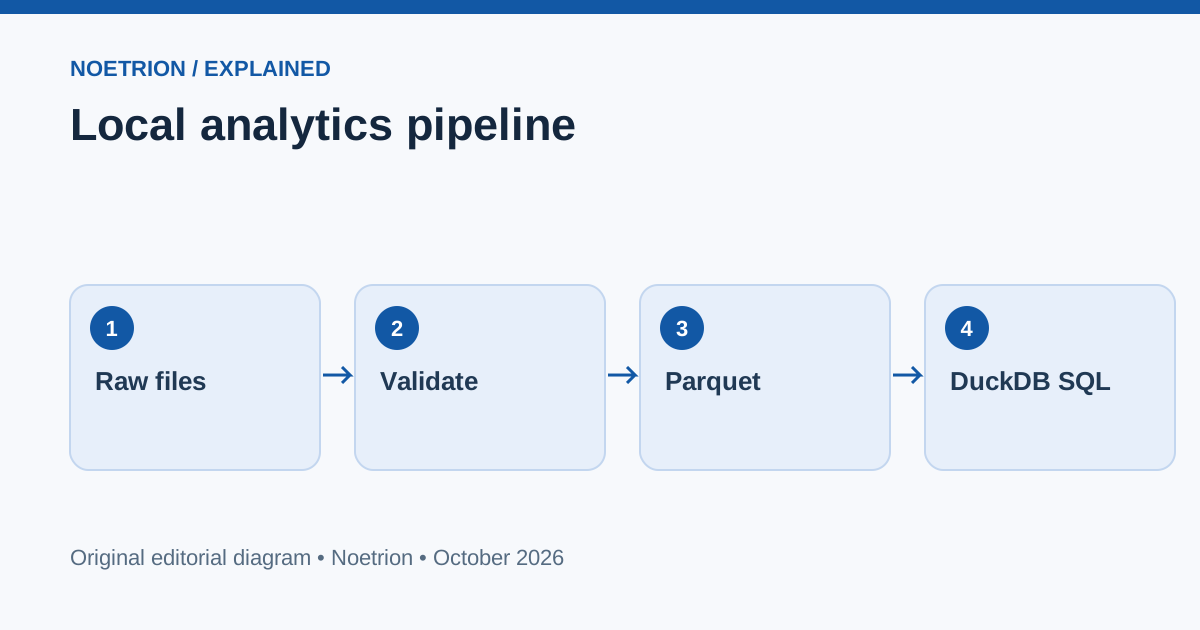
Visual: Local analytics pipeline. Original flow diagram from raw files to validation, Parquet storage, DuckDB SQL and a published summary.
Verification note: Facts were checked against the linked primary or specialist sources on 13 October 2026. Forecasts are labeled as forecasts, illustrative calculations as hypothetical, and the article does not constitute personalized legal, medical, or investment advice.