DuckDB vs SQLite: Choose for Your Actual Data Workload
Compare DuckDB and SQLite for analytics and application storage. Explore SQL examples, transactions, concurrency, and how to test your own workload.
Checked on October 2, 2026. This decision guide focuses on local and embedded use. Query data is synthetic; there are no benchmark results or claims that one engine is always faster.
DuckDB and SQLite can both support local work without a separately managed database server. That similarity can make them seem interchangeable. Yet an application repeatedly looking up one record has different priorities from a project summarizing many records.
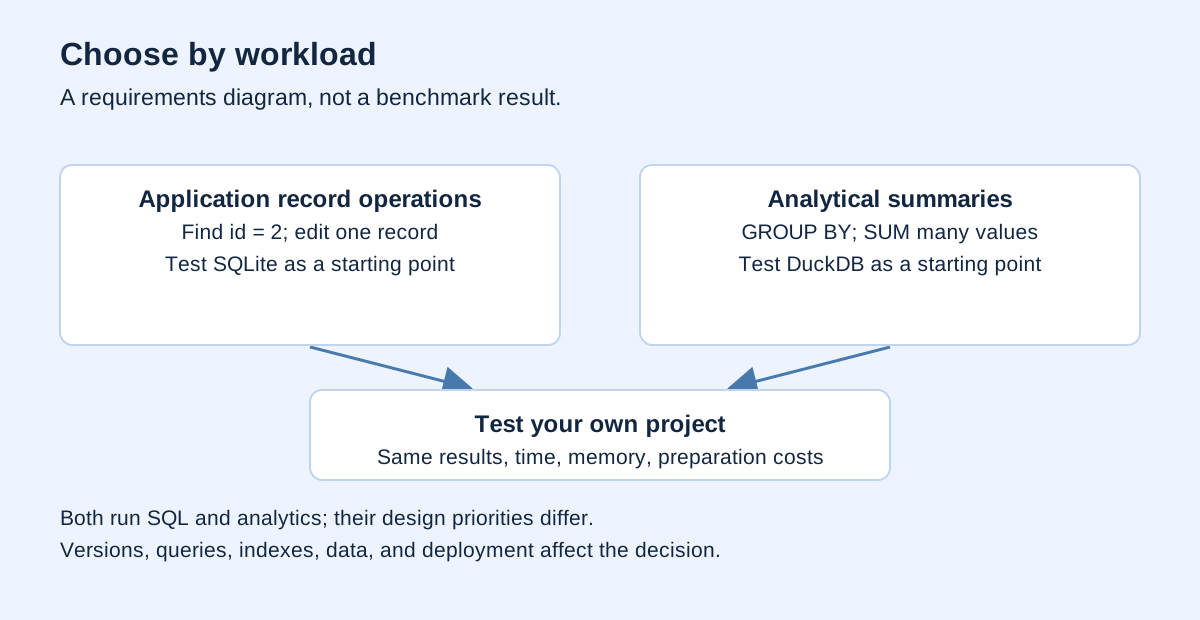
Short answer: consider SQLite for local application storage, transactions, and record lookups; consider DuckDB for analytical queries over many rows and file-based data workflows. Both support SQL and storage. Choose through query shape, writing patterns, integration, and project-specific tests rather than speed slogans.
Begin with the job your database must do
Does the application retrieve one profile by ID or calculate annual sales totals by category? Does one process manage writes, or must independent services write together? Is the data already in CSV and Parquet files, or is the database the primary store for application records?
These questions are more useful than asking whether the dataset counts as "big data." That label says little about selected columns, filter selectivity, indexes, update frequency, memory, or the number of writers. Datasets with equal row counts can impose different workloads.
| Task | Reasonable starting point | What to test |
|---|---|---|
| Local notes with individual record edits | SQLite | Transactions, indexes, write duration |
| SQL summaries of CSV/Parquet files | DuckDB | Schema, scanning, memory |
| Small analytics already using SQLite | Test the existing SQLite setup | Whether migration brings a measurable benefit |
| Multiple services writing concurrently | Review the wider architecture | Writer coordination and deployment support |
| Browser SQL experiments | The tool's Wasm engine | Files, sessions, and SQL dialect limits |
These choices are editorial starting points, not performance guarantees. For a simple, stable project, include the cost of changing engines when evaluating a technical benefit.
Why does analytical orientation matter?
Why DuckDB describes its focus on OLAP workloads: analytical queries involving scans, aggregations, and summaries. Its engine design prioritizes efficient execution of that work.
SQLite emphasizes straightforward local storage. Its official appropriate-use guide also includes data analysis. Saying SQLite "cannot do analytics" is incorrect. Different design priorities do not forbid either engine from executing a class of queries.
A sales report might scan category and amount columns across many records. Editing an order may require one full record and a short transaction. Storage, indexing, and execution affect these jobs differently. Measure the outcome on the data and versions you will actually use.
Run the same checkable SQL example
This query uses four synthetic records. It uses constructs covered by DuckDB SELECT documentation and can also run in SQLite with CTE support.
WITH sales(id, category, amount) AS (
  VALUES
    (1, 'Books', 50000),
    (2, 'Books', 70000),
    (3, 'Stationery', 20000),
    (4, 'Stationery', NULL)
)
SELECT category,
       COUNT(*) AS row_count,
       COUNT(amount) AS available_values,
       SUM(amount) AS total,
       AVG(amount) AS mean
FROM sales
GROUP BY category
ORDER BY category;
| Category | Row count | Available values | Total | Mean |
|---|---|---|---|---|
| Books | 2 | 2 | 120000 | 60000 |
| Stationery | 2 | 1 | 20000 | 20000 |
Verify these numbers with simple addition. COUNT(*) counts records, whereas COUNT(amount) counts non-null values. The SQLite aggregate documentation and DuckDB aggregate documentation explain that distinction.
Do not replace NULL with zero merely to make a report look complete. The fourth amount is unknown. Treating it as zero changes the question by introducing an assumption. Explain missing values so readers understand the denominator.
Two queries can measure different requirements
With this data, WHERE id = 2 selects one record. GROUP BY category needs information from multiple records. One query's duration does not represent the other. An index helping ID lookups does not automatically accelerate every aggregation.
If the application needs both, test lookup/update operations separately from reporting. Include result size. A query returning an entire table can spend substantial time transferring its result into the application even if the engine computes it quickly.
Use the Noetrion SQL Playground to inspect DuckDB concepts and results. Browser timings are not directly comparable with native SQLite timings in a terminal. Wasm, browser execution, and the device introduce different conditions.
Reading CSV is convenient, but inferred schemas need checks
The DuckDB CSV guide documents file reading and format detection. This native example does not imply that every browser tool can access the same local path:
SELECT category, SUM(amount) AS total
FROM read_csv('sales.csv', header = true)
GROUP BY category;
Before trusting totals, check delimiter, encoding, column types, and missing values. An identifier such as 00123 should not accidentally become a mathematical quantity. 1.500 can mean different things under different formatting conventions. Detection helps you start; an explicit data contract remains necessary.
For recurring analysis, define a schema and reproducible import process. Keep raw files, record versions and import options, and inspect accepted and rejected records. See CSV vs Parquet when storage format becomes important to repeated analytical work.
Transactions and concurrency need more than one label
The SQLite transaction documentation explains read and write transactions. Multiple readers are possible, while writes require coordination. Embedded storage does not mean a database lacks transactions or is unsuitable for important records.
SQLite Write-Ahead Logging can let readers and a writer proceed concurrently under appropriate conditions. WAL does not provide unlimited simultaneous writers. Account for companion files and supported backup procedures rather than casually copying one active database file.
The DuckDB concurrency guide distinguishes in-process use, writer threads within one process, and cross-process options. Current documentation also discusses remote and lakehouse approaches. An absolute statement that "DuckDB can never support multiple processes" is too broad.
This comparison focuses on a local database inside an application process. For several writing processes, consult the version you will install and choose a supported coordination mechanism. Do not turn the restrictions of one local mode into a claim about the entire ecosystem.
Persistent databases and session databases
Both engines can support persistent or in-memory work depending on how the database is opened and integrated. A browser tool may deliberately choose session behavior. Engine capabilities and application behavior are different things.
DuckDB-Wasm runs DuckDB in WebAssembly. Browsers impose memory, asset-loading, and file-integration constraints. For sensitive datasets, understand whether a tool uploads files, permits external connections, or retains data after a tab closes.
On Noetrion, follow the session and export information provided by the tool. Save required results before reloading. Successful SQL execution does not automatically turn an uploaded dataset into a durable database.
Design a fair benchmark
Start a personal benchmark with a decision question: "Does this category report finish within the time my monthly workflow needs?" That is more useful than finding the fastest engine on one synthetic query.
| Test component | Record |
|---|---|
| Environment | CPU, RAM, OS, engine versions |
| Data | Rows, columns, types, distributions, missing values |
| Preparation | Import, indexing, and format-conversion time |
| Queries | Equivalent semantics and verified results |
| Repetition | Separate first and subsequent runs |
| Measurements | Time, memory, result size, cache conditions |
Do not report only the fastest attempt. Repeat a consistent procedure, retain all timings, and summarize variation. Verify equivalent results before comparing duration. A quick query answering a different question is not a useful victory.
Include preparation costs. Direct file access may suit a temporary report; a database already imported and indexed may suit repeated application access. These are different scenarios, and the benchmark should identify its scenario upfront.
Example project decisions
For a local study-notes application, adding notes, editing a title, and finding a record by ID may be the main tasks. SQLite is a reasonable starting point. Test its required lookups and transactions before adding another engine.
For a monthly CSV audit, combining files, calculating aggregates, and exporting summaries may dominate. DuckDB is a reasonable starting point. Focus tests on file reading, schema validation, and the queries you will repeat.
Using both may make sense for an application with both needs, but adds synchronization work. Define the source of truth, analytical snapshot timing, and record traceability. Do not duplicate storage before identifying a clear requirement.
Incorrect totals often originate in queries rather than engine selection. Read SQL joins without double counting to inspect grain and cardinality before interpreting business totals.
Frequently asked questions
Is DuckDB always faster than SQLite?
This article makes no universal performance claim. Query shape, indexes, data, caches, versions, and result transfer can change the outcome. Test your workload.
Is SQLite only for small datasets?
Suitability cannot be reduced to a single row count. Examine transaction needs, deployment architecture, and measured performance.
Is their SQL identical?
Both support SQL, but functions, types, and features can differ. Consult the relevant engine documentation for specialized queries.
Must a working project migrate?
Migration makes sense when measurable benefits justify code changes, testing, and operation costs. Another tool's popularity alone is insufficient reason.
Verification and sources
Choose based on real tasks: application records, analytical reports, or both. Run queries with checkable results, document imports, and measure relevant costs. A useful decision identifies its conditions and limits.
Official DuckDB and SQLite documentation is linked beside supported explanations; accessed October 2, 2026. Decision tables are Noetrion analysis. Synthetic query results were checked computationally, but engine performance was not benchmarked.